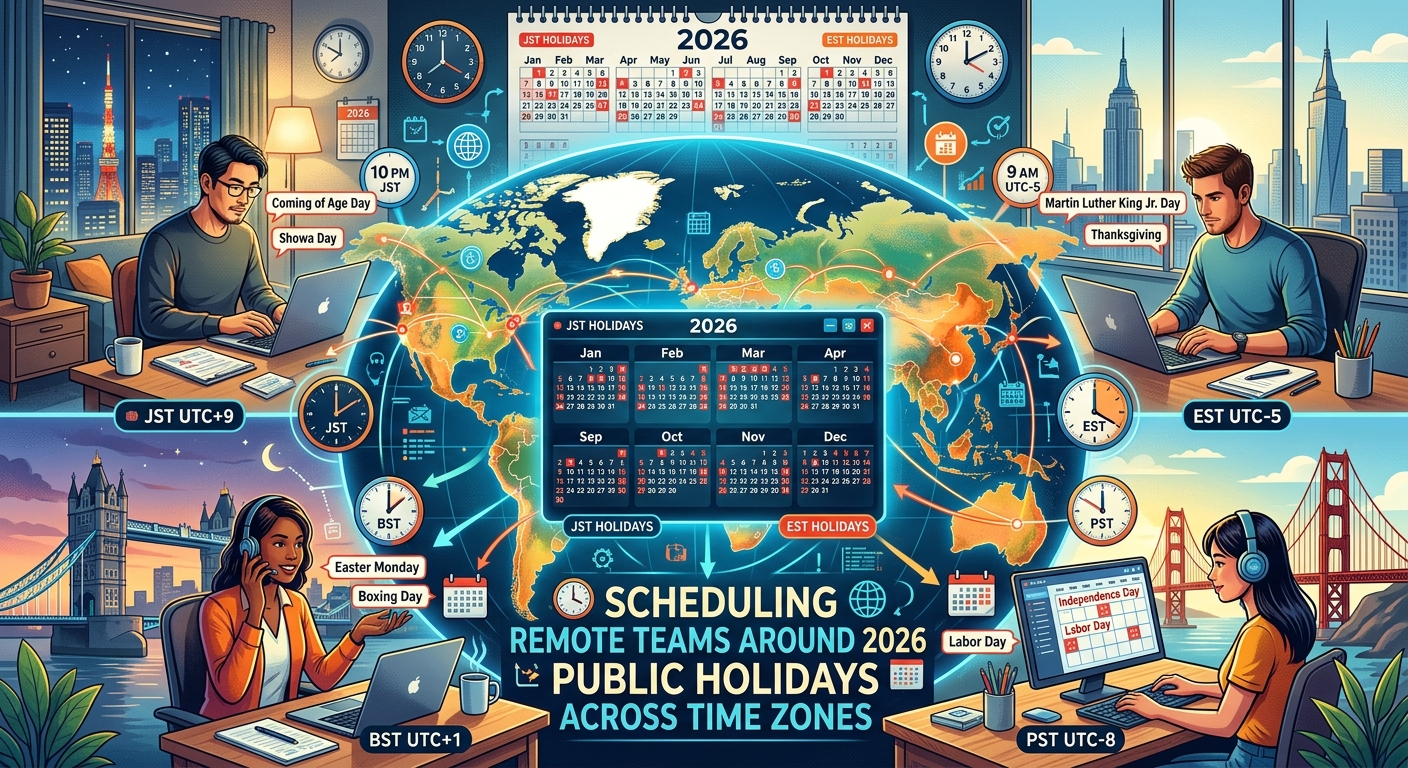
Imagine sending a deadline reminder to your entire team, only to realize that half of them are already offline for a national holiday you forgot about. Three colleagues in Brazil are celebrating a federal observance. Your lead developer in South Korea is marking a public holiday that does not appear on your default calendar app. Your UK project manager is back from a long weekend, but your team in India just started theirs. That is the scheduling reality for most managers running distributed teams in 2026, and it is messier than most people plan for.
Year-Planning Snapshot
Running a globally distributed team means your calendar is never just your calendar. Every colleague adds their country's public holidays, regional observances, and cultural breaks into the mix. The teams that handle this well do one thing early: they map the full year before committing to any sprint cycles, launch dates, or recurring meetings. That single habit prevents most of the scheduling collisions that derail cross-border projects.
The Compounding Problem of Distributed Holiday Calendars
When your team spans multiple countries, holiday conflicts do not just stack up. They compound. A sprint that looks clean on your project management board can quietly fall apart when a public holiday in Japan lands the same week as a bank holiday in the UK and a regional observance in Mexico. Add time zone offsets and you are not just losing individual days. You are losing the narrow overlap windows where synchronous collaboration actually happens.
The math gets uncomfortable fast. A team of ten people across five countries will collectively observe somewhere between 50 and 80 distinct public holidays per year, depending on how many regional and provincial holidays each country recognizes. If just two of those holidays land in the same two-week sprint window, your planned velocity drops well before a single line of code is written or a single document is reviewed. The problem is not that people take holidays. The problem is that most teams treat each colleague's calendar as a local matter rather than a shared planning input.
Why 2026 Is a Particularly Tricky Year to Coordinate
Every year has its quirks, but 2026 has a few features worth paying attention to before you finalize any team calendar. Several major public holidays across the Asia-Pacific region fall mid-week, creating a pattern of fragmented working weeks that can stretch effective downtime across Monday through Friday without technically covering all five days. Teams often find that the days immediately before and after a mid-week holiday see reduced focus even when colleagues are technically online.
Latin American countries observe a dense cluster of public holidays in the first and fourth quarters of 2026. If your team includes colleagues in Brazil, Argentina, Colombia, or Mexico, those quarters carry real scheduling weight. Planning a major product launch or a high-stakes client deliverable into those windows without checking the holiday landscape first is a recipe for missed handoffs and frantic last-minute scrambles.
Europe presents a different kind of challenge. The continent is not a single holiday calendar. Germany's public holidays vary by state. Spain has national holidays layered on top of regional ones. France observes a different set than the Netherlands. A "European team" is not a useful abstraction when you are trying to figure out who is actually available on a given Monday in May.
Mapping the Full Year Before You Lock In Any Dates
The single most effective thing a team lead can do in January is build a complete picture of the year's holiday landscape before committing to any recurring meeting schedules, sprint calendars, or delivery milestones. This does not require expensive software. Keeping a printable yearly calendar on hand gives you an offline, side-by-side view of all twelve months that you can annotate with each team member's national and regional holidays. Printing it out and physically marking the dates gives you a spatial sense of where clusters form that a digital calendar often obscures behind individual event tiles.
Once you have that view, patterns emerge clearly. You will spot the weeks where three or more team members are off simultaneously. You will see the quarters that are relatively holiday-light and therefore better suited for intensive sprints or major launches. You will also notice the shoulder periods around major holidays where attendance is technically complete but focus tends to dip anyway.
Building a Shared Team Holiday Document
A shared holiday document is different from a shared calendar. A calendar shows you when someone is off. A document explains the context, the local significance, and whether the person is likely to be partially available or fully disconnected. That distinction matters more than most team leads realize when you are coordinating across cultures.
A well-built team holiday document includes each team member's location and current time zone, their country's official public holidays for the year, any regional holidays that apply to them specifically, and a brief note about observance patterns. Some holidays are strict disconnection days. Others are more relaxed. A colleague in Japan observing Golden Week is likely to be fully offline for the entire period. A colleague who observes a floating religious holiday may be flexible about which specific day they take, which gives you more scheduling room if you ask in advance.
Keeping the Document Current Throughout the Year
Someone needs to own the maintenance of this document, not just its creation. Holiday calendars change. Countries occasionally add or move public holidays. Individual team members change location or work arrangements. The document owner should review and update it at the start of each quarter and flag any changes to the broader team before they catch anyone by surprise. This does not need to be a senior role. A rotating responsibility works well and keeps everyone engaged with the planning process rather than treating it as an administrative burden passed down from above.
Buffer Days Are Not Wasted Time
One of the most common mistakes in cross-timezone sprint planning is treating the working day immediately before or after a major public holiday as a full-capacity day. In practice, those days often run at reduced effectiveness. Colleagues are wrapping up tasks before a break or easing back in afterward. Attention is split. Response times are slower. Async communication sits unanswered longer than usual, and that delay can bottleneck the whole team even when most members are at their desks.
Building one buffer day on each side of a high-density holiday period protects the sprint's actual output from slipping. Teams that pad their timelines around holiday clusters consistently deliver more reliably than those that plan as if every working day carries equal capacity throughout the year. That buffer day is not lost productivity. It is insurance against the invisible drag that holiday adjacency always creates.
The same logic applies to high-overlap holiday periods, the weeks where multiple team members across multiple countries are off simultaneously. Those windows are not good candidates for critical handoffs, first-draft reviews, or client-facing deliverables. Treat them as planning and documentation cycles instead. Use that time for internal retrospectives, roadmap discussions, or work that does not require real-time collaboration to move forward.
Layering Time Zone Offsets Onto Your Holiday View
A holiday map without time zone data gives you only half the picture. Once you know which days your colleagues are off, you need to overlay the offset information to understand what the remaining available days actually look like for real-time collaboration. A day where your Sydney and London colleagues are both technically working can still yield fewer than two hours of useful overlap, depending on the season and where daylight saving transitions fall for each location.
World clock tools let you layer multiple locations into a single view, showing you at a glance which hours fall within business hours for two or more time zones simultaneously. Using this kind of tool alongside your holiday calendar gives you a composite view: not just which days are available, but which hours within those days are genuinely shared working time. The IANA Time Zone Database maintains authoritative time zone definitions for every region globally and underpins nearly every calendar tool and operating system your team already uses. Knowing how your team's offsets shift across daylight saving transitions is just as important as knowing when their public holidays fall, because the two factors interact constantly.
Putting the Year Together: A Step-by-Step Approach
The following sequence works well for teams starting this process from scratch or refining a system that has not been keeping up with their growth.
- Collect each team member's full list of 2026 public holidays and regional observances, including any floating holidays they observe for religious or cultural reasons.
- Map all of those dates onto a single shared view alongside the current time zone offset for each person, noting which offsets change due to daylight saving transitions mid-year.
- Identify high-overlap periods where three or more team members are off simultaneously, and flag these in your project planning tool as low-availability windows before the quarter kicks off.
- Build your sprint or project milestone calendar around those windows rather than across them, placing intensive collaboration cycles in the quarters that are holiday-light for your specific team configuration.
- Add buffer days on either side of any high-density holiday cluster that falls within a critical delivery window, and communicate those buffers to stakeholders as part of the timeline, not as an afterthought.
- Run a world clock comparison for your top three or four recurring meeting times to confirm that the overlap hours still make sense once holiday-adjacent schedule changes are factored in.
- Review and update the entire picture at the start of each quarter, since team composition, locations, and local holiday calendars will shift as the year progresses.
This process takes a few focused hours up front. Those hours pay back many times over in avoided conflicts, missed handoffs, and frustrated team members who feel like the schedule does not account for where they actually live and what they actually observe.
From Holiday Clashes to Coordinated Momentum Across Borders
The teams that handle cross-timezone scheduling well are not the ones with the most sophisticated software. They are the ones that treat the calendar as a shared team resource rather than a series of individual schedules that happen to run in parallel. When you invest time at the start of the year in understanding where your team's holidays cluster, where the time zone overlaps compress, and where the buffer periods need to sit, you create the conditions for genuine momentum across all four quarters.
Public holidays are not obstacles. They are predictable features of your team's calendar that you can plan around with confidence once you have the full picture in front of you. The distributed teams that build this picture early, share it openly, and keep it updated consistently are the ones that still ship reliably in Q4, even when half the team was in a different hemisphere observing a holiday the other half had never heard of. That kind of coordination is not complicated. It is just deliberate, and deliberate planning is a skill any team can build.