Your brain is not the same at 9 a.m. as it is at 3 p.m. That gap matters more than most people realize. Cognitive performance rises and falls on a biological schedule you can actually predict, and once you understand that schedule, you stop fighting your own mind and start working with it.
Brain Peak Essentials
- Your chronotype, whether you are a morning lark, night owl, or in-between, determines when your alertness naturally peaks.
- Circadian rhythms create predictable windows of sharp focus, moderate energy, and low drive throughout every day.
- Remote workers and students face extra scheduling pressure when their peak hours clash with team or class timetables.
- Deep, demanding tasks belong in your peak window. Lighter habits are better suited to your slump periods.
- Structured mental exercises during off-peak hours keep your brain engaged without burning through its reserves.
Your Chronotype Shapes Everything
Before you can plan your day around your brain, you need to know your chronotype. This is your biological preference for sleep and wakefulness timing. It is not a personality quirk or a discipline issue. It is genetic and hormonal.
Researchers broadly sort people into three groups. Early chronotypes, often called morning larks, feel most alert in the hours after sunrise. Late chronotypes, the night owls, reach their mental peak in the evening. Intermediate types, who make up the majority of the population, land somewhere in the middle and carry the widest range of natural peak windows.
Knowing which group you belong to changes everything about how you schedule your work. A night owl forcing themselves into a 6 a.m. deep-work session is not being productive. They are just burning through mental energy they do not have yet.
To get a rough sense of your chronotype, track your energy and attention across several days without an alarm. Notice when you feel naturally clear and when you fade. That pattern is your chronotype in action.
The Circadian Rhythm Is Running the Show
Your chronotype does not work alone. Layered on top of it is your circadian rhythm: the roughly 24-hour internal clock that governs nearly every biological function in your body, from body temperature to hormone release to cognitive alertness.
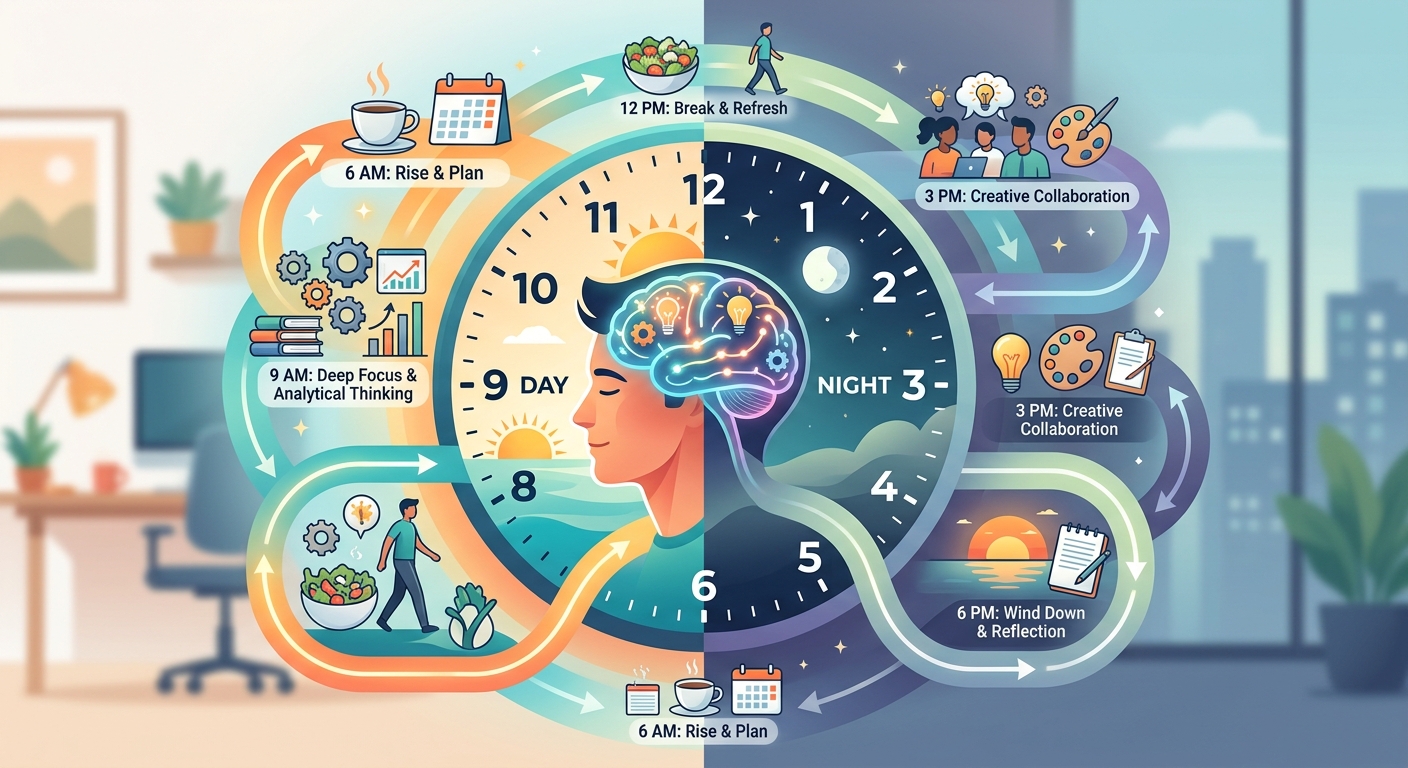
For most people on a standard sleep schedule, the brain experiences two alertness peaks per day. The first arrives in the late morning, usually around two to four hours after waking. The second, smaller peak comes in the late afternoon, sometimes called the "second wind." Between those peaks sits a noticeable dip, typically in the early-to-mid afternoon, that many cultures address with a midday rest or brief nap.
Studies on circadian rhythms from the National Institute of General Medical Sciences confirm that these cycles are consistent and predictable once your sleep timing is stable. The more regular your sleep schedule, the more reliable your peak windows become. Irregular sleep disrupts the rhythm and makes your cognitive peaks harder to locate.
There is also an ultradian rhythm to account for. This is the roughly 90-minute cycle of high focus followed by a brief mental fade that repeats throughout the day. Working in focused 90-minute blocks and then taking a short break aligns with this cycle rather than fighting it.
How Time Zones and Remote Work Shift the Equation
For remote workers, the challenge is that your biological clock does not care about your team's time zone. If you are based in Lisbon and your team is in Singapore, your biological peak hours may land exactly when you are supposed to be in a status meeting. That creates real tension.
The honest answer is that you cannot fully rearrange your chronotype around a calendar invite. But you can protect some of your peak time by being intentional about which hours you keep open. Schedule meetings in your moderate-energy windows, not your peak ones. Use your sharpest hours for the work that genuinely demands deep concentration.
If you manage a team across time zones, consider rotating meeting times so no single person always sacrifices their peak window to be available. Fairness in scheduling is also a form of cognitive respect.
Structuring Your Day Around Your Energy
Here is a practical approach to building a day that reflects how your brain actually works, not just how your calendar looks. Adjust the timing to match your specific chronotype.
- Identify your personal peak window. Track your alertness for one week. Note the times when you feel clear, focused, and able to hold a complex thought without effort. That consistent window is your peak.
- Protect that window fiercely. Block it on your calendar. Decline recurring meetings that land inside it. This time is reserved for writing, analysis, coding, or any task requiring sustained attention.
- Place creative and strategic tasks in the early part of your peak. The first portion of your peak window tends to be the sharpest. Use it for your hardest problems, not your easiest ones.
- Move meetings and admin to moderate-energy periods. After your peak fades, your brain is still functional but not at full capacity. Calls, emails, and lighter coordination tasks fit here naturally.
- Use your slump for recovery and low-effort habits. The mid-afternoon dip is not wasted time. It is a signal. Use it for passive learning, light reading, or a short walk rather than forcing yourself through a difficult report.
- End with a reflective wind-down. The late afternoon second wind supports review work: going over your notes, planning the next day, or tidying your task list.
What to Do With Your Mental Slump Hours
Most productivity advice skips straight past the slump, as if the goal is to eliminate it entirely. That is the wrong approach. The slump exists because your brain is cycling through recovery. Trying to power through it with stimulants or willpower tends to produce mediocre output and a worse crash afterward.
The smarter move is to use those slower hours for lighter cognitive habits that keep your mind engaged without demanding full concentration. Think of it as active rest for your brain. These activities tend to fit naturally into a mid-day or post-meeting slump:
- Reviewing notes or summaries from earlier in the day
- Organizing your files, inbox, or workspace
- Listening to a podcast or recorded lecture on a familiar topic
- Taking a short walk without your phone
- Working through a structured puzzle or timed mental exercise
That last point deserves attention. Timed, structured puzzles are genuinely useful during off-peak hours. They engage the brain at a moderate level, require logic without high creative load, and come with a built-in endpoint. Committing to a daily Sudoku challenge is a good example of this kind of habit. It takes ten to fifteen minutes, keeps your pattern-recognition skills active, and gives your peak-hour thinking a gentle bridge into the afternoon without draining your remaining reserves.
This stands in contrast to scrolling social media or watching random videos during your slump. Those habits might feel like rest, but they often leave you more fatigued afterward. A bounded, logic-based exercise gives your brain a clear start and finish, and that structure matters for genuine mental recovery.
Students and the Irregular Schedule Problem
Students often face the hardest challenge in aligning peak hours with actual obligations. Early lectures, late lab sessions, part-time jobs, and social commitments all compete with whatever biological rhythm they carry. Add late-night study sessions and the circadian clock gets genuinely scrambled.
If you are a student, the most useful starting point is identifying which time blocks in your weekly schedule are consistently open, and then protecting those blocks for focused study. Even two reliable peak-hour sessions per week carry more value than six unfocused ones spread across poor timing.
Sleep consistency also matters more for students than they are typically told. Shifting your bedtime and wake time by several hours between weekdays and weekends creates what researchers call "social jet lag," a misalignment between biological time and scheduled time that taxes cognitive function throughout the week.
If your institution offers some flexibility in course selection, try to schedule your most demanding classes during your natural peak window. Many students do not treat class scheduling as a cognitive performance decision, but it absolutely is one.
The Clock Has Always Been Working in Your Favor
Your brain is not failing you during the slump. It is not lazy in the evening or stubborn in the morning. It is following a biological schedule that developed long before alarm clocks, open-plan offices, or video calls with people twelve time zones away.
The real shift is in thinking about performance differently. Peak output is not about working harder during every available hour. It is about placing the right kind of work in the right kind of hour. That means guarding your sharpest window for your hardest tasks, using moderate-energy periods for collaboration and communication, and leaning into lighter habits during the dip instead of forcing yourself through it.
Once you start mapping tasks to energy rather than just deadlines, the day changes character. Each part of it gets to do what it does best. That is not a scheduling trick. It is just biology, finally respected.