The Heung Yuen Wai Highway (香園圍公路) is an 11-kilometre dual two-lane road in Hong Kong's northeastern New Territories. It runs from the Fanling Highway interchange all the way to the Heung Yuen Wai Border Control Point, giving drivers in Sha Tau Kok, Ta Kwu Ling, and Ping Che a fast, direct path to the rest of Hong Kong — and to mainland China. The road is now fully open, and it has already changed how hundreds of thousands of people travel in the region.
What the Highway Is Made Of
The Heung Yuen Wai Highway is not just one type of road. It is a mix of tunnels, viaducts, and ground-level sections, each built to handle the hilly, protected landscape of northeastern Hong Kong.
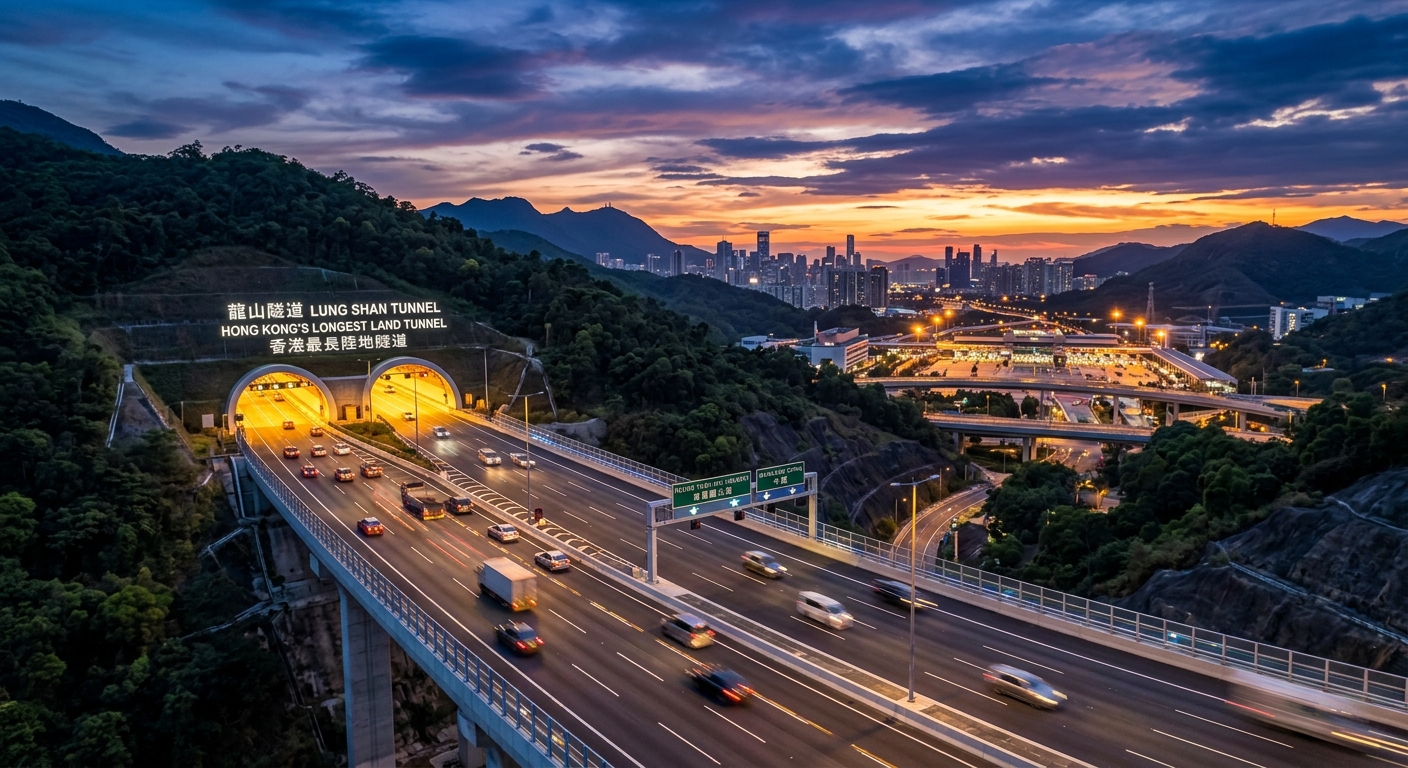
- Lung Shan Tunnel (龍山隧道): about 4.8 km long — the longest land vehicular tunnel in Hong Kong
- Cheung Shan Tunnel (長山隧道): about 0.7 km long
- Elevated viaducts: about 4.5 km, carrying traffic above valleys and terrain
- Ground-level road: about 1 km
- Four interchanges connecting to Lin Ma Hang Road, Ping Yeung, Sha Tau Kok Road, and Fanling Highway
Hong Kong's Longest Land Tunnel
The Lung Shan Tunnel is the centrepiece of the project and a genuine engineering record. At 4.8 kilometres, it is the longest land-based road tunnel in Hong Kong — about 850 metres longer than the Tate's Cairn Tunnel, which previously held the record. It connects the Fanling Highway interchange on the south end to the Sha Tau Kok Road interchange on the north, cutting straight through the mountains rather than winding around them. If you are curious about other major infrastructure milestones in the region, this overview of Hong Kong infrastructure records covers several notable projects.
How It Cuts Travel Times
Before this highway opened, drivers from Ping Che or Ta Kwu Ling heading to Fanling or Kowloon had to take slow, winding local roads. The difference in travel time is dramatic.
Old Route vs. New Route
- From Fanling Lung Hang to Ping Che: used to take about 15 minutes; now takes about 4 minutes
- From Fanling Lung Hang to Ta Kwu Ling / Heung Yuen Wai: used to take about 24 minutes; now takes about 8 minutes
That is not a small improvement — it is saving commuters more than two-thirds of their time on some trips. For freight drivers crossing the border, that kind of saving adds up fast across dozens of daily runs.
Improving Cross-Border Traffic
One of the biggest goals of the Heung Yuen Wai Highway is to ease congestion at existing border crossings. Right now, most cross-boundary goods vehicles heading into or out of northeastern Hong Kong funnel through Man Kam To and Sha Tau Kok border control points. Those crossings are narrow and heavily used.
The new Heung Yuen Wai Border Control Point, which the highway feeds directly, is designed to take a large share of that traffic. Once running at full capacity, it is expected to let cross-border people and cargo flow more smoothly and efficiently, reducing delays for everyone — not just those using the new highway.
Environmental Benefits Built In
Shorter travel times do not just help drivers. They also mean engines run for less time, which means less fuel burned and fewer emissions released.
Engineers estimated that the reduction in total travel time across all users of the highway will cut about 11,000 tonnes of carbon dioxide every year. To put that in perspective, that is roughly the amount of CO₂ that 480,000 newly planted trees would absorb in a year — enough trees to cover an area equivalent to about 67 Victoria Parks. For a road project, that is a meaningful environmental offset built into the design from the start. You can read more about how Hong Kong approaches green infrastructure at our green transport section.
The Greater Bay Area Connection
The highway does not exist in isolation. The Heung Yuen Wai Border Control Point at its northern end is listed as a major cooperation project under China's 12th Five-Year Plan, specifically in the section covering Hong Kong and Macau affairs. It is one of the key infrastructure pieces supporting the Guangdong-Hong Kong-Macau Greater Bay Area (粵港澳大灣區) vision — the plan to connect nine mainland cities, Hong Kong, and Macau into a tightly linked economic region.
The goal is a "one-hour living circle" where residents across the Bay Area can reach each other within an hour. Better border crossings with faster road access are a core part of making that goal real. The Heung Yuen Wai Highway is, in that sense, both a local road project and a piece of a much larger regional strategy.
Who Benefits Most
The communities that gain the most from this highway are the rural towns in Hong Kong's far northeast — places like Sha Tau Kok, Ta Kwu Ling, and Ping Che. These areas have long been somewhat cut off from the rest of Hong Kong by geography and limited road options. The highway gives residents there a genuinely fast link to Sheung Shui, Fanling, Tai Po, and Kowloon. It also opens up the area for businesses that want easier logistics access to the border.
Cross-border goods vehicles and freight operators see major gains too. A faster, more direct route means lower operating costs and more predictable schedules — important factors for companies moving products between Hong Kong and the Pearl River Delta manufacturing regions nearby. For context on how road networks connect to broader trade flows, see our piece on Pearl River Delta logistics.
Key Facts at a Glance
- Total length: approximately 11 km
- Road type: dual two-lane divided carriageway
- Longest tunnel: Lung Shan Tunnel at 4.8 km (Hong Kong record for land tunnels)
- Number of interchanges: four
- Annual CO₂ reduction: approximately 11,000 tonnes
- Status: open to traffic
- Strategic role: feeds the Heung Yuen Wai Border Control Point for the Greater Bay Area