Fajr Prayer Times Around the World and How They Work

Fajr is the prayer that asks the most from the clock, the sky, and the calendar. It begins at the first true light before sunrise, yet that light does not arrive the same way everywhere on Earth. A person in Mecca may see a steady pattern through the year. A person in London can face very early summer starts and much later winter starts. In high latitude places, the challenge grows even more because darkness itself changes shape across the seasons. To understand Fajr around the world, you have to look up at the horizon, look down at the map, and then look at the way scholars and prayer time services turn those facts into a working schedule.
Key takeaway
Fajr begins at true dawn, the moment a horizontal band of light appears and the sun is still below the horizon, usually measured by a twilight angle between 15 and 18 degrees. Its time changes with latitude, season, and local time zone. Near the equator, changes are modest. In northern and southern regions, summer and winter can shift Fajr sharply, and very high latitudes may require special methods when twilight hardly disappears.
What Fajr Means In Daily Worship And In Sky Science
Fajr is the first of the five daily prayers in Islam. Spiritually, it opens the day before sunrise. Astronomically, it is linked to dawn, but not just any dawn. People often use the words dawn and sunrise as if they were the same thing. They are not. Sunrise is the moment the upper edge of the sun becomes visible. Fajr starts earlier, during the phase known as true dawn, when light begins to stretch across the horizon while the sun remains below it.
That distinction matters. If a person waits for the sun to appear, Fajr has already ended. If a person prays too early, before true dawn, the prayer is not yet in its valid time. This is why prayer time calculation is both devotional and technical. It depends on observation, inherited scholarship, astronomy, and local standards.
Quoted idea: Fajr is not tied to a fixed clock hour. It is tied to a moving event in the sky, then translated into local civil time.
Where Fajr Sits Within The Stages Of Dawn
To see how Fajr works, it helps to separate the stages of morning twilight:
- Night, when the sky remains dark and the sun is well below the horizon.
- Astronomical dawn, when the sky begins its faint earliest brightening.
- Nautical dawn, when the horizon becomes easier to distinguish.
- Civil dawn, when outdoor objects become easier to see without artificial light.
- Sunrise, when the sun itself appears.
In many prayer calculation systems, Fajr is placed close to astronomical dawn or slightly after it, depending on the angle chosen by the authority or institution. This is why the relationship between Fajr and astronomical dawn is often discussed. In plain terms, astronomical dawn is the sky event science names by angle, and Fajr is the prayer start linked to the arrival of true dawn, which many modern timetables model through that angle.
The Twilight Angle That Shapes Fajr Timetables
The sun does not need to be visible for its light to affect the sky. Long before sunrise, sunlight starts to scatter in the upper atmosphere. Prayer calculations use this fact by measuring how many degrees the sun is below the horizon. For Fajr, many schedules use a twilight angle between 15 and 18 degrees below the horizon.
That range is not random. It comes from attempts to match observed dawn with reliable calculation methods. Some institutions use 18 degrees because it aligns closely with the deeper phase of early dawn. Others use 17, 16, or 15 degrees based on regional practice, climate, observation programs, or legal opinions within a school of thought. A wider angle places Fajr earlier. A smaller angle places Fajr later.
This explains why two apps can show different Fajr times for the same city on the same day. They may both be accurate within their chosen method, but they are using different standards. For readers checking city specific schedules, Mecca Fajr time can be a useful reference point because many Muslims compare their local practice to the Hijaz region, even though local sky conditions elsewhere may differ greatly.
True Dawn, False Dawn, And Why The Distinction Matters
Classical Islamic texts distinguish between false dawn and true dawn. False dawn is a vertical glow that can appear earlier. It does not mark the start of Fajr. True dawn spreads horizontally along the horizon. That is the beginning of the prayer time and the point when the fast begins in Ramadan.
This old distinction fits remarkably well with modern sky observation. The vertical glow can mislead the eye, especially in dry air or certain atmospheric conditions. The horizontal spread is the more dependable sign. Today, calculation methods try to model true dawn consistently so that communities do not need to rely on direct sky observation every single day.
Why Fajr Starts Earlier In Summer Than In Winter
Seasonal change is one of the biggest reasons Fajr moves across the year. During summer in a given hemisphere, the sun takes a steeper and longer path that brings early light sooner before sunrise. The day stretches. Night shortens. Twilight can begin very early. That pushes Fajr earlier.
During winter, the opposite happens. Nights become longer. Morning twilight begins later. Fajr shifts closer to sunrise and therefore appears later on the clock. This change is easy to notice even in moderate latitudes. It becomes dramatic in places farther from the equator.
In simple terms:
- The Earth is tilted on its axis.
- That tilt changes how sunlight reaches each hemisphere during the year.
- Longer summer days create earlier morning twilight.
- Shorter winter days delay morning twilight.
- Fajr follows that twilight, not a fixed hour.
This is why a city can have a Fajr time that feels surprisingly early in June and much more manageable in December. It is not a software error. It is the geometry of Earth and sun translated into prayer time.
Latitude, The Hidden Force Behind Global Fajr Differences
Latitude tells you how far north or south a place sits from the equator. It is one of the strongest factors in Fajr variation. Near the equator, sunrise and sunset do not change very much through the year. Days and nights stay fairly balanced. Twilight patterns are more stable. That means Fajr times move, but often within a narrower range.
Farther north or south, the annual swing grows wider. Summer days lengthen. Winter days shrink. Dawn in high latitude summer can come extremely early. In some places the sky may not become fully dark at all for part of the season. That creates a serious challenge for prayer schedules, because the standard twilight angle may not occur in the usual way.
For a city with year round steadier patterns, Singapore Fajr time shows the kind of consistency often seen closer to the equator. The differences from month to month are real, but they are modest compared with cities much farther north.
What Happens Near The Equator
Equatorial and near equatorial regions offer some of the most stable Fajr schedules in the world. The sun rises and sets at more regular times through the year, and twilight lengths stay closer to a consistent pattern. Cities such as Jakarta, Kuala Lumpur, Nairobi, and Singapore often reflect this steadiness.
That does not mean every day is identical. Atmospheric conditions, selected calculation method, and time zone rules still matter. Yet the seasonal extremes are much less severe than those seen in Europe, northern North America, or high latitude Asia.
Readers who want to compare another major city in this zone can check Jakarta Fajr time and notice how the annual rhythm tends to be smoother than what appears in London or Toronto.
What Happens In Mid Latitude Cities
Mid latitude cities show a stronger seasonal swing. Places such as New York, Paris, Rome, Madrid, Istanbul, Beijing, and Tokyo all have noticeable changes between summer and winter Fajr times. The exact amount varies, but the yearly pattern is easy to see.
Take New York. In summer, dawn arrives early, and Fajr may occur at an hour that feels very deep into the night. In winter, Fajr arrives later, sometimes much closer to a normal waking routine for many people. This is one reason local mosque timetables and apps become especially valuable for busy families, students, and workers.
For a city based example, New York City Fajr time reflects the mix of seasonal movement and local civil time rules that shape prayer schedules in North America.
What Happens In High Latitude And Polar Adjacent Regions
As you move toward very high latitudes, the problem becomes more than just early or late. In parts of the summer, twilight can linger all night. In parts of the winter, daylight becomes very short. Some regions may not experience the standard twilight angles in a complete way for certain dates. That means the sky no longer provides a simple daily pattern that standard equations can use without adjustment.
This is where special methods enter the discussion. Scholars and calculation committees have developed approaches for abnormal twilight conditions. These include using the nearest day with normal twilight, using a fraction of the night, or following the timings of a nearby city with more regular conditions. Different communities adopt different methods, which explains why schedules may vary in places such as northern England, Scandinavia, or parts of Canada and Russia.
London Fajr time is a good case to study because London is not in the Arctic, yet its summer twilight still becomes complicated enough to generate major discussion about method and accuracy.
Why London And Similar Cities Get So Much Attention
London is often mentioned in Fajr discussions because it highlights a real issue without reaching the absolute extremes of the polar circle. In late spring and summer, the night becomes shallow. True darkness shrinks. Very early Fajr times may appear in timetables that use deeper twilight angles. Some mosques accept those times. Others adopt adjusted solutions to make the schedule workable and aligned with their chosen legal view.
This leads to community questions such as:
- Should Fajr follow the full standard angle even if the time becomes extremely early?
- Should a special high latitude rule apply only in the most extreme weeks?
- Should the same mosque keep one method all year, or switch methods seasonally?
There is no single universal global answer. The shared goal is to preserve the meaning of true dawn while applying a method that is reliable, consistent, and accepted by the local community.
Time Zones, Civil Clocks, And Why Nearby Places Can Differ
Prayer begins with the sky, but people live by legal time zones. A time zone can make two places at similar longitude or latitude show different clock times for Fajr. Daylight saving rules can shift the displayed time again. The sun does not obey political borders, yet timetables have to.
That means Fajr is shaped by two layers:
- The astronomical event, meaning the position of the sun below the horizon.
- The civil clock, meaning the local time zone and seasonal clock adjustments.
Consider a person traveling across borders. The physical dawn may feel similar, but the clock reading can change because the country follows a different time standard. This is why global prayer websites do more than run one simple formula. They must map sky events into local legal time for each city.
For readers comparing Gulf timings, Dubai Fajr time and schedules in neighboring states can show how the same broad region still depends on its own civil time system.
How Daylight Saving Time Changes The Displayed Hour
In countries that use daylight saving time, Fajr does not change because dawn suddenly changed by a full hour. The sky remains the sky. The clock is what jumps. When the local clock moves forward in spring, Fajr appears one hour later by the wall clock, even though the underlying solar event has not shifted by that same amount overnight. When the clock returns in autumn, the reverse happens.
This matters for prayer habits, sleep, work, and school. A person may feel that Fajr became dramatically easier or harder in a single weekend. Much of that sensation comes from civil time policy layered on top of a slower astronomical curve.
Real World Examples Across Major Cities
Looking at actual cities helps turn theory into something more concrete. The cities below do not share one single pattern. Each one reveals a different part of how Fajr works worldwide.
Mecca And Riyadh, A Useful Baseline
Mecca and Riyadh are often treated as useful benchmarks because they sit in a region where the seasonal shift exists but does not reach the intensity of far northern cities. Their Fajr times move through the year, yet the pattern stays easier to interpret. The sky reaches true dawn in a more regular way, and the need for exceptional high latitude methods is far less common.
For Saudi Arabia, Riyadh Fajr time gives a practical comparison with Mecca. Riyadh is inland and slightly different in latitude, but both illustrate how a city can have meaningful seasonal change without the severe complications found in northern Europe.
New York, Toronto, Chicago, And The North American Experience
North American cities often combine noticeable latitude effects with daylight saving rules. New York and Toronto show a clear summer advance in Fajr, while Chicago can also shift strongly across the year. Houston, farther south, still changes, but not quite in the same way as more northern urban centers.
This matters for local community life. Mosques may publish detailed annual calendars. Families may adjust bedtimes in Ramadan. Students and commuters often feel the difference sharply in spring and summer. The farther north a city sits, the more the early morning challenge intensifies.
Those comparing Canada with the United States may also find Toronto Fajr time helpful because it shows how a major northern city can differ from places farther south even within the same broader continent.
Europe, From Paris To Berlin To Istanbul
Europe presents a wide spread of Fajr patterns. Southern cities such as Rome and Madrid usually avoid the harshest twilight issues seen farther north. Paris and Berlin face stronger summer effects. Istanbul, straddling regions and traditions, often serves as an interesting middle case in prayer time discussions because it combines substantial seasonal movement with a deep historical tradition of timetable making.
For readers watching the European curve, Istanbul Fajr time offers a helpful bridge between lower latitude Muslim majority cities and the more demanding twilight conditions found farther north.
East And South Asia, Many Patterns In One Broad Region
Asia is too large for one simple model. Karachi, Delhi, Mumbai, Dhaka, Bangkok, Kuala Lumpur, Seoul, Tokyo, and Beijing all have their own mix of latitude, climate, and local convention. South Asian cities can show meaningful seasonal change but usually remain more stable than northern Europe. East Asian cities such as Seoul and Tokyo can have strong winter and summer contrast. Beijing sits farther north and presents a clearer seasonal spread than cities near the equator.
For a South Asian example, Karachi Fajr time reflects a pattern that is dynamic but generally more predictable than extreme high latitude cases. For East Asia, Tokyo Fajr time helps readers see how a developed urban setting in a mid latitude zone still experiences a distinct yearly shift.
Africa And The Southern Hemisphere
Africa spans equatorial, northern, and southern latitudes, which makes it excellent for comparison. Cairo differs from Nairobi. Khartoum differs from Cape Town. In the Southern Hemisphere, the seasonal pattern flips relative to Europe and North America. Summer comes during the months that the north calls winter. This means Fajr gets earlier in the southern summer and later in the southern winter.
That reversal is easy to forget when reading global schedules. A person in London and a person in Melbourne are moving through opposite seasonal light cycles at the same time of year. For a northern African reference, Cairo fajr time shows a familiar pattern to many readers in the Middle East, while southern cities follow their own inverted seasonal rhythm.
Why Two Valid Timetables Can Still Disagree
A common question is why mosque calendars, apps, and websites sometimes differ. The answer usually comes from one or more of these factors:
- Different twilight angles for Fajr.
- Different rules for high latitude adjustment.
- Different handling of atmospheric refraction or rounding.
- Different city coordinates used in the calculation.
- Different policies on daylight saving presentation.
This does not always mean one source is careless. It may mean the source is following a different recognized method. Still, consistency matters. A prayer service should state its method clearly, especially in cities where twilight questions are sensitive.
How Prayer Time Services Turn Sky Data Into Daily Schedules
A prayer timetable service starts with location data, date, and a chosen calculation method. It calculates the sun’s position for that place and date, finds when the selected Fajr angle occurs, then converts that moment into local clock time. It also adds other prayer times based on solar events and juristic settings.
This is where a broad platform becomes useful. Time.now, with its wider focus on clocks, timers, calendars, and time zones, fits naturally with prayer times because prayer schedules do not live in isolation. They depend on local time standards, seasonal date shifts, and accurate city based timing. A person checking prayer before work or travel often needs all those tools in the same place.
How To Read A Fajr Schedule Without Getting Confused
Many people glance at a timetable and assume it should look steady from week to week. Fajr rarely behaves that way. A better way to read it is to focus on patterns:
- Look at the city and confirm it is the correct location.
- Check whether the site states a calculation method or angle.
- Notice whether the city uses daylight saving time.
- Compare summer and winter months, not just consecutive days.
- In high latitude regions, see whether special adjustment notes are provided.
Once you do that, the movement becomes easier to understand. The timetable stops looking random and starts looking like a map of the sky translated into minutes.
Natural City Links That Help Readers Compare Patterns
Global comparison becomes much clearer when readers move between city pages with a purpose. Someone studying year round steadiness can move from Gulf and equatorial examples to see how the curve changes. A reader interested in northern complexity may compare Europe and North America. Those wanting to compare sacred and administrative centers in Saudi Arabia can review Medina Fajr time alongside Mecca and Riyadh. Readers following eastern European and northern seasonal pressure may also compare Moscow Fajr time with western European cities, where extended twilight becomes a major issue in summer.
Common Questions People Ask About Fajr Timing
Is Fajr the same as sunrise?
No. Fajr begins before sunrise, at true dawn.
Is Fajr always tied to astronomical dawn?
It is closely related, but the exact modeling depends on the angle selected by the calculation method.
Why is Fajr much earlier in June than in December?
Summer twilight begins earlier because of Earth’s tilt and longer daylight in that season.
Why do apps differ by several minutes?
Usually because of method differences, city coordinates, rounding, or local adjustment rules.
What happens where the night barely gets dark?
Communities often use special high latitude methods approved by scholars and timetable authorities.
What To Keep In Mind During Ramadan
Ramadan makes Fajr timing especially significant because it marks the start of the fast. In places with normal twilight, people can rely on a standard local timetable with confidence if they know the method used. In places with abnormal twilight, it becomes even more important to follow a trusted local mosque or established city service rather than guessing.
The practical concerns are easy to understand. An early summer Fajr affects suhoor, sleep, commuting, and family routines. A stable city page can reduce confusion, especially for travelers or new residents trying to adapt to a local prayer pattern.
A useful reminder
A difference of a few minutes can come from a valid method choice. A difference of an hour often points to time zone or daylight saving factors layered on top of the calculation.
Choosing A Trusted Source For Daily Fajr Times
A good source should do more than print a number. It should be city specific, method aware, and consistent with local civil time. It should also make comparisons easy for users who travel or who have family in different parts of the world. That is why integrated time tools matter. Prayer schedules make the most sense when they are presented alongside correct dates and time zone context.
For readers tracing patterns across the Arabian Peninsula and nearby regions, Dubai Fajr time and Gulf comparisons can sharpen the view. For readers tracking western Europe, city pages from London, Paris, and Berlin reveal how much latitude changes the picture. The value is not just the number for today. It is the pattern across the year and across places.
From Horizon Light To Human Schedule
Fajr is one of the clearest examples of how worship connects heaven and Earth in a measured, daily rhythm. It begins with a line of light on the horizon, yet its clock time depends on latitude, season, twilight angle, and legal time. Near the equator, the schedule stays steadier. In mid latitude cities, summer and winter pull it apart. In high latitude regions, local communities may need special methods because ordinary twilight patterns break down. Once you understand that structure, Fajr times around the world stop looking mysterious. They become a readable conversation between astronomy, geography, and the lived routine of prayer.
More Fajr Related Articles:
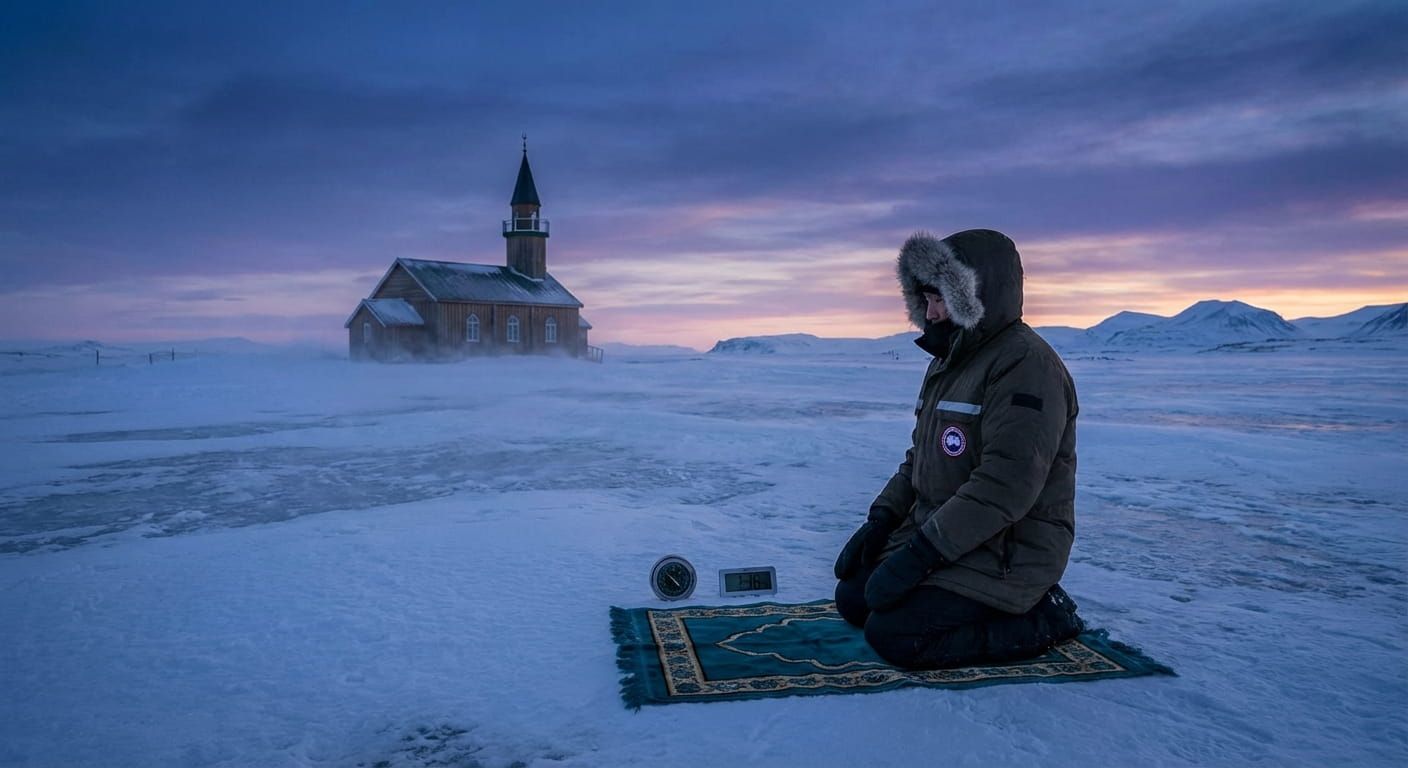
Fajr Prayer Challenges in Countries Near the Arctic Circle
Summer near the Arctic Circle can turn one of the clearest signs of dawn into a real qu...

Why Fajr Prayer Time Changes Every Day Throughout the Year
Fajr does not sit still on the clock. It slides earlier and later across the year be...
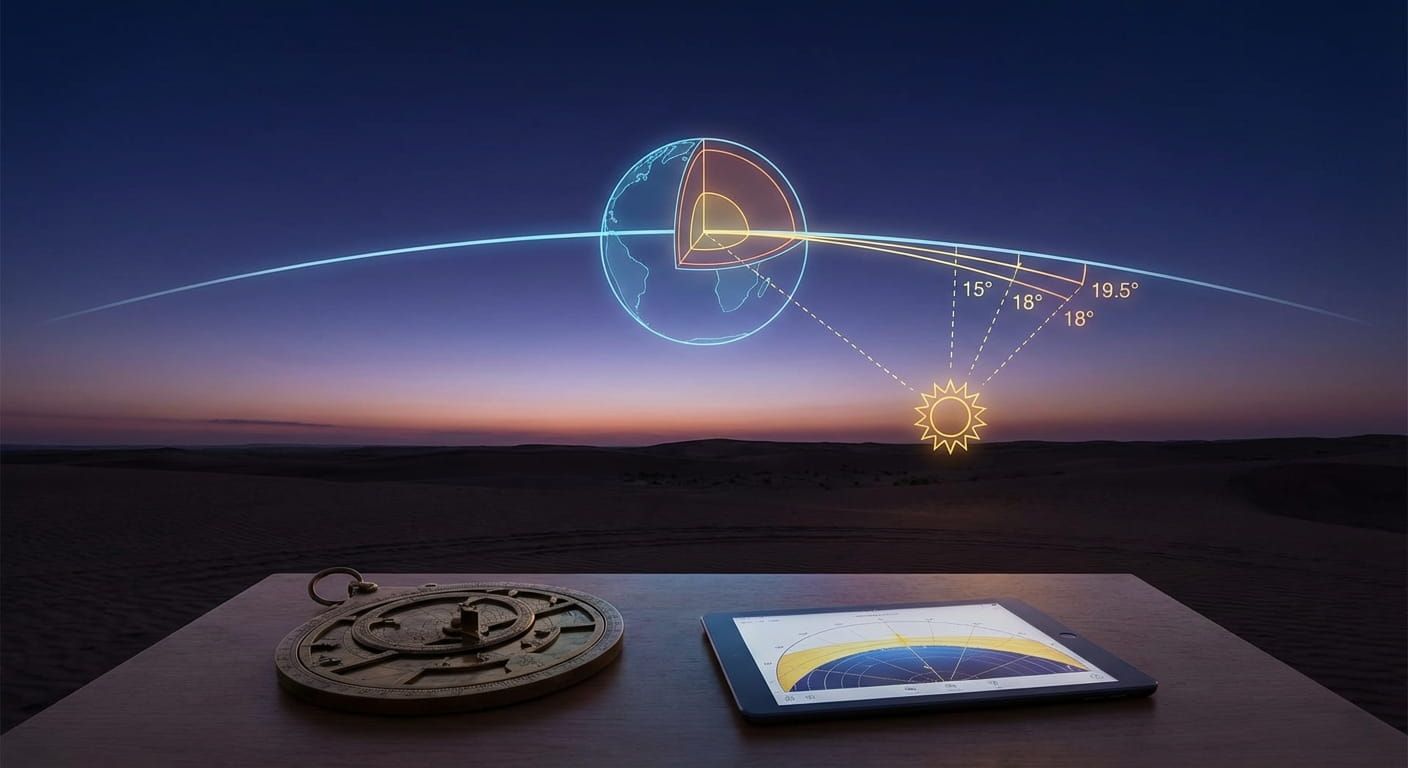
How to Calculate Fajr Prayer Time Using Twilight Angles
Fajr begins before sunrise, in that quiet stretch when the first true light spreads across the horizon. Getting that time right is not guesswork. I...

Fajr Prayer Times in Summer vs Winter Across Different Countries
Fajr can feel like two different prayers depending on where you live. In northern Europe, summer can push it close to 2 AM, while places near the e...
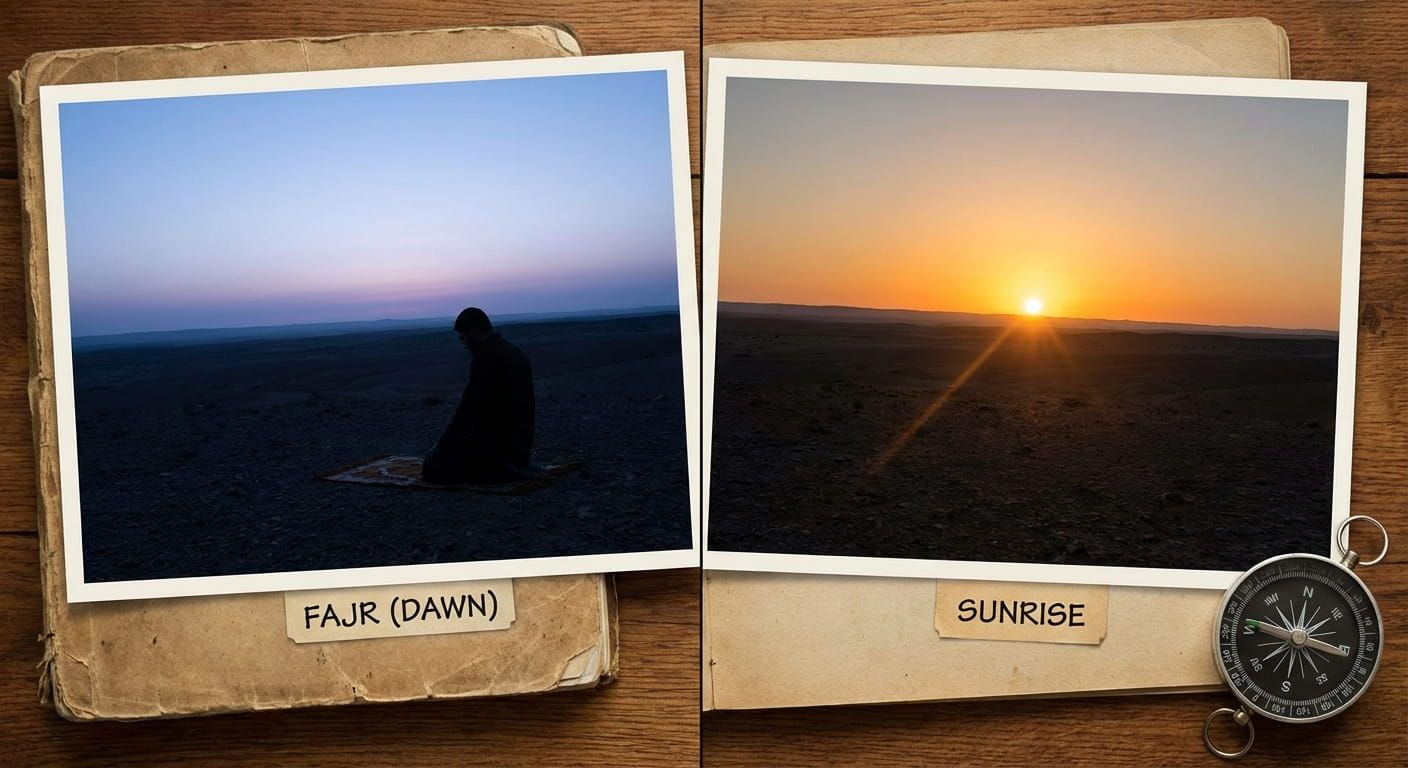
The Difference Between Fajr and Sunrise Times Explained
Summer can make Fajr feel startlingly early in one country and almost steady in anot...

How Time Zones Affect Fajr Prayer Schedules Globally
Fajr begins in the quiet edge of night, yet its schedule is shaped by far more than a clock on the wall. A city can sit on nearly the same longitud...