When Maghrib Prayer Begins After Sunset Each Day
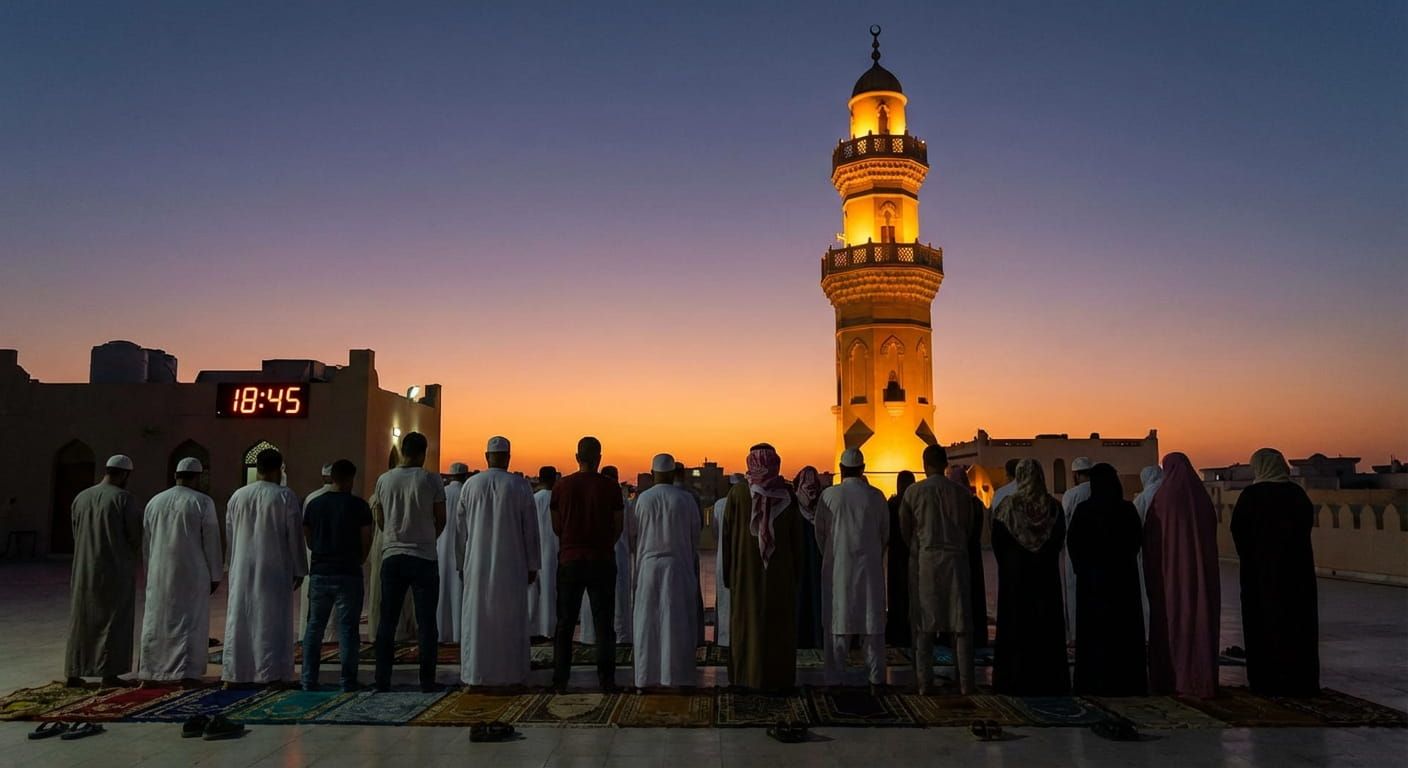
Sunset changes everything in a matter of moments. Daylight softens, the horizon glows, and for Muslims the beginning of Maghrib arrives with a clear sign that has guided worship for centuries. Among the five daily prayers, Maghrib stands out because its starting point is tied to one visible event, the sun dropping below the horizon. That direct link makes it easier to understand than many people expect. Yet the same prayer also has one of the shortest daily windows, which means timing still deserves close attention, especially in Ramadan, in mountain regions, on cloudy evenings, and in places where the coast or inland landscape changes how sunset is experienced.
Key takeaway
Maghrib begins the moment the sun has fully set below the true horizon. That makes its start more direct than any other daily prayer. Its prayer time is also brief, ending when the red twilight fades and Isha enters. Weather, mountains, tall buildings, and local geography can affect what people think they see, but actual sunset remains the reference point. In Ramadan, this moment also marks the time to break the fast.
A brief knowledge check after the opening
Test the main idea before reading further. Pick one answer, then see the note beneath it.
Maghrib starts at sunset, and that simple rule matters
Every daily prayer has a defined time. Some begin when an object’s shadow reaches a certain length. Others depend on dawn light or the disappearance of twilight. Maghrib is different. Its beginning is tied to one event that is easy to describe: the sun has set.
That is why many people think of Maghrib as the most consistent prayer to time. The reference point is not hidden. It is not a matter of estimating how much light remains in the sky or judging a shadow during a busy afternoon. The sign is direct. Once the upper edge of the sun has dropped below the horizon and sunset has actually occurred, the time for Maghrib has entered.
This direct connection is one reason prayer schedules are easy to read for Maghrib. If you are checking daily timings on Maghrib, the number shown for Maghrib is linked to sunset itself, not to a broad estimate or a rough evening range. That clarity helps families plan dinner, helps travelers stay on time, and helps fasting people know the exact point when the fast is over.
Yet clear does not always mean careless. A person can still confuse visible conditions with the true timing. Clouds can make sunset feel earlier. A mountain ridge can block the sun before its actual astronomical setting. Tall towers in a city can change what you think you see from street level. The rule stays simple, but applying it in real life sometimes needs a little care.
The start of Maghrib is tied to the sun setting below the horizon. This is why the prayer is often the easiest one to understand at a glance.
Mountains and uneven terrain can hide the sun from view before true sunset. What you see from one spot may not match the real entry time.
Why Maghrib often feels easier to time than the other daily prayers
Among the five prayers, Maghrib has a special kind of certainty. Fajr depends on true dawn, which many people cannot observe directly because city lights wash out the sky. Dhuhr begins after the sun passes its highest point, a moment that is not visually obvious to most people. Asr depends on shadow length, which can be confusing without knowing the method being used. Isha begins after twilight has faded, which is a slower change in the sky. Maghrib begins at sunset, and sunset is a clear transition.
That simplicity shapes daily habits. Parents can teach children the start of Maghrib with one sentence. A traveler landing in a new city can understand the principle right away. A person who does not know advanced prayer calculations can still understand why the timing is what it is. The prayer is anchored to the day ending in a visible way.
There is also a human rhythm to this prayer. Evening begins. Work slows. Families gather. In many homes the call to Maghrib is the signal that the day’s outward rush is ending. That makes the prayer feel close to life, not abstract.
“Maghrib is easy to define, but not casual to delay.” That idea captures the prayer well. Its entry is plain to understand, but its short window means attentiveness still matters.
The ease of identifying sunset is exactly why many prayer time services can present Maghrib so clearly. A page for Maghrib in Cairo can feel intuitive because local users already expect the prayer to begin right at sunset. The same is true for Maghrib in Istanbul, where seasonal daylight shifts can still move the clock noticeably, even though the underlying rule stays the same.
The prayer window is brief, and that changes how people plan their evening
If Maghrib is the easiest prayer to identify at the start, it is also one of the easiest to miss through delay. The reason is simple. The time window is short. Maghrib begins at sunset and continues until the red twilight disappears and Isha enters. Compared with the wider space available for some other prayers, this is a narrow stretch of time.
That shortness affects real routines. A person may be driving home, serving food, finishing work, helping children, or preparing to break the fast. Because the start is so obvious, some assume there is plenty of time afterward. In practice, evening can move quickly. Sunset arrives, people shift into meal preparation or family tasks, and before long the next prayer time is approaching.
This is why Maghrib teaches urgency without panic. There is time to pray properly. There is also wisdom in not putting it off. Many people feel this most strongly in Ramadan. The prayer, the sunset meal, and family gathering all meet at the same moment. It is a beautiful meeting of worship and daily life, but it also means attention matters.
- Sunset is the entry point. Once the sun has actually set, Maghrib has started.
- The sky can still look bright. Brightness after sunset does not mean Maghrib has not begun.
- The prayer should not be delayed carelessly. Its valid period is shorter than many people realize.
- Isha does not begin immediately. There is a transition period while red twilight remains.
- Checking a trusted local time helps. This is especially useful in cities with blocked horizons.
People living in different cities notice this window in different ways. In Maghrib in London, long summer evenings can make the sky stay bright late into the night, which can make newcomers feel the prayer started “too early” compared with the visible light. In Maghrib in Riyadh, dry skies and a broad horizon can make the transition feel cleaner and easier to read.
Actual sunset and red twilight are not the same thing
One of the most common points of confusion is the difference between actual sunset and red twilight. They are related, but they are not identical.
Actual sunset is the moment the sun disappears below the horizon. That is when Maghrib begins. Red twilight is the glow that remains in the western sky after the sun has set. That glow can continue for some time. Its disappearance is tied to the entrance of Isha in standard prayer reckoning.
This means you can still see color in the sky and still be within Maghrib time. A person who waits for the sky to become completely dark before thinking about Maghrib has misunderstood the prayer. Darkness is not the entry point. Sunset is.
The distinction matters because human eyes often judge brightness more than position. If the evening still looks lit, people may feel that sunset has not fully “settled in” yet. But the prayer does not depend on how dark it feels. It depends on whether the sun has actually set.
- Sunset means the sun has gone below the horizon.
- Maghrib starts at that exact event.
- Red twilight is the remaining glow after sunset.
- Isha starts after the twilight phase ends.
- Visible light after sunset does not cancel Maghrib.
This is one reason local timing pages are valuable. A page for Maghrib in Jakarta or Maghrib in Singapore helps because equatorial regions often have a relatively quick evening transition, while places farther from the equator may have more extended twilight patterns during parts of the year.
Clouds, haze, mountains, and buildings can change what sunset looks like
People often trust what they can see from where they are standing. Most of the time that makes sense. Yet with Maghrib, visible conditions can be misleading.
Cloud cover can make the sun seem to vanish early. Thick clouds near the horizon may hide the sun before actual sunset. Haze can blur the disk and make the timing feel uncertain. In mountain regions, the terrain may block the sun well before it would set over a flat horizon. In dense urban areas, towers can create the same effect from street level.
That is why there can be a difference between perceived sunset and actual sunset. Perceived sunset is what it looks like from your specific viewpoint. Actual sunset is the true astronomical setting of the sun relative to the horizon. Prayer times are tied to the actual event, not to an obstructed personal line of sight.
Consider a valley town surrounded by mountains. Residents may watch the sun disappear behind a ridge earlier than people on a nearby plain. If they relied only on that blocked view, they could begin Maghrib too soon. The same problem can happen in a city where a person only sees the sky through gaps between buildings.
In places with more open horizons, the visual sign is easier to trust. Maghrib in Mecca and Maghrib in Medina are often checked by visitors who want local timing clarity while in spiritually significant places. Geography still shapes experience, but a trusted local time removes guesswork.
Coastal and inland locations can feel different, even on the same date
Geography affects how people experience sunset. A coastal city often has a broad open western horizon over water. An inland city may have trees, hills, dust, mountains, or dense construction that changes the view. That does not change the rule for Maghrib, but it does change how obvious the transition feels.
On the coast, sunset can appear dramatic and clean. There is often an uninterrupted horizon line, which helps people watch the sun sink smoothly out of sight. In inland areas the horizon may be broken and the evening light may scatter differently. A person may feel less sure about the exact moment simply because the view is cluttered.
This is also why sunset times can vary between nearby places. A coastal and inland city in the same country may not share the exact same Maghrib time. Longitude matters. Local topography matters. The position of the observer matters. Even a few minutes can make a difference when the prayer window is short.
Think about the range across global cities. Maghrib in Lagos reflects a coastal setting with its own sunset rhythm. Maghrib in Karachi also connects to the sea, yet local atmospheric conditions can shape how sunset is perceived. Maghrib in Dhaka and Maghrib in Delhi remind readers that inland urban environments can make the sky feel very different from open shorelines. Maghrib in Cape Town and Maghrib in Sydney show how coastal light can feel expansive, while local terrain still shapes the eye’s experience.
For travelers, this matters more than expected. A person used to a clear western horizon may feel uncertain in a narrow street, a mountain town, or a hazy inland setting. Checking the local time before sunset removes stress and keeps the prayer connected to its real entry point.
Ramadan gives Maghrib a special place in daily life
During Ramadan, Maghrib carries an added emotional weight. It marks the end of the daily fast. Hunger, thirst, prayer, gratitude, family gathering, and relief all meet in one moment. That makes timing especially meaningful.
The fast is broken at Maghrib, meaning at sunset. Not when the sky becomes dark. Not when red twilight fades. Not when dinner is fully laid out. The exact moment of sunset marks permissibility to eat and drink after the fasting day.
This gives Maghrib a double significance in Ramadan. It is a prayer time, and it is also the moment of iftar. Many homes structure the evening around it. Dates are prepared. Water is ready. Family members gather near the table or in the prayer area. Mosques announce the adhan. The whole atmosphere changes in seconds.
Because the window is short, many people follow a simple pattern. They break the fast as Maghrib enters, then pray Maghrib, then continue the evening meal. This rhythm keeps the prayer from being squeezed out by the energy of iftar.
In Ramadan, Maghrib is felt with the whole body. The fasting person watches the clock, hears the call, tastes the first sip of water, and knows that worship and mercy have met at sunset. That is one reason this prayer lives so strongly in memory.
Across the world, local timing pages become especially useful in Ramadan. Families checking Maghrib in Dubai, Maghrib in Kuala Lumpur, Maghrib in Mumbai, or Maghrib in Nairobi may all share the same spiritual practice while living under very different sunset conditions.
Why local timing pages matter more than people think
A person may ask, if Maghrib begins at sunset, why not simply look outside? Sometimes that works beautifully. Many times it does not. City skylines block the horizon. Weather distorts visibility. Travel changes your assumptions. Seasonal daylight shifts are easy to misjudge. Reliable local prayer times help by translating the rule into an exact daily reference for where you are.
That is especially helpful in major world cities with large populations, varied skylines, and travelers coming and going. A visitor checking Maghrib in New York City or Maghrib in Los Angeles may not have any practical way to see a true horizon from street level. Someone in Maghrib in Paris, Maghrib in Berlin, or Maghrib in Rome may notice long summer evenings and need reassurance that bright skies after sunset do not delay the prayer’s entry.
Pages for Maghrib in Tokyo, Maghrib in Seoul, Maghrib in Bangkok, and Maghrib in Manila serve another need. They help people living in fast paced urban settings keep their prayer tied to precise local time rather than guesswork in the middle of commutes and busy routines.
Even within one region, sunset can feel different. Maghrib in Chicago, Maghrib in Houston, Maghrib in Toronto, and Maghrib in Mexico City all remind readers that latitude, season, elevation, and skyline shape how sunset is experienced. The prayer remains the same. The lived setting changes.
Common misunderstandings about Maghrib timing
Some timing mistakes appear again and again because evening light can be deceptive. Clearing them up makes the prayer easier to keep with confidence.
Mistake one: thinking Maghrib starts when the sky becomes dark. It does not. Darkness comes later. Maghrib starts at sunset.
Mistake two: thinking bright light in the sky means sunset has not happened. The sky often remains bright after sunset because twilight continues.
Mistake three: treating an obstructed view as final proof. A mountain, cloud bank, or building may hide the sun early.
Mistake four: assuming all nearby towns share the same Maghrib time. A few minutes can differ from place to place.
Mistake five: delaying prayer because the start feels obvious and therefore “safe.” The start is easy to know, but the total window is still brief.
These misunderstandings appear in many parts of the world. A person in Maghrib in Moscow may experience seasonal light in a way that differs greatly from someone checking Maghrib in Rio de Janeiro or Maghrib in Bogota. The visual feeling of evening changes, but the rule itself does not.
A simple way to think about Maghrib every day
The easiest way to carry all of this is to keep three ideas together.
Maghrib begins at actual sunset. It does not wait for darkness. It does not wait for the red twilight to disappear. That twilight belongs to the period before Isha, not to the start of Maghrib.
Its start is clear, which makes it one of the most straightforward prayers to identify. Yet its duration is short, which means it should be prayed without careless delay.
What your eyes tell you can be shaped by weather and geography. Clouds, sea horizons, inland dust, mountains, and city skylines all affect perception. Reliable local timings help keep the prayer connected to the true sunset for your location.
This balance is part of what makes Maghrib so meaningful. It is simple, but not shallow. It is visible, but still asks for care. It belongs to the turning of the day, when daylight closes and evening worship begins.
As the sun slips away, the prayer enters with clarity
Maghrib begins each day after sunset, and that fact gives the prayer a special place among the daily prayers. Its start is easier to grasp than the others because it is tied to a direct event in the sky. At the same time, its short window gives it urgency. The prayer asks for attentiveness, not guesswork, and not delay.
Once the difference between actual sunset and red twilight becomes clear, the rest falls into place. Sunset opens Maghrib. The fading of twilight belongs to the approach of Isha. Weather may fool the eye. Mountains and buildings may block the view. Coastal horizons may make sunset feel obvious while inland areas make it feel uncertain. Through all of that, the reference point remains steady.
That steadiness is part of the beauty of Maghrib. At a precise moment each day, the fast can be broken, prayer can begin, and evening worship can settle the heart. The sun sets. Maghrib enters. The day closes in a way that is both simple and deeply felt.
More Maghrib Related Articles:
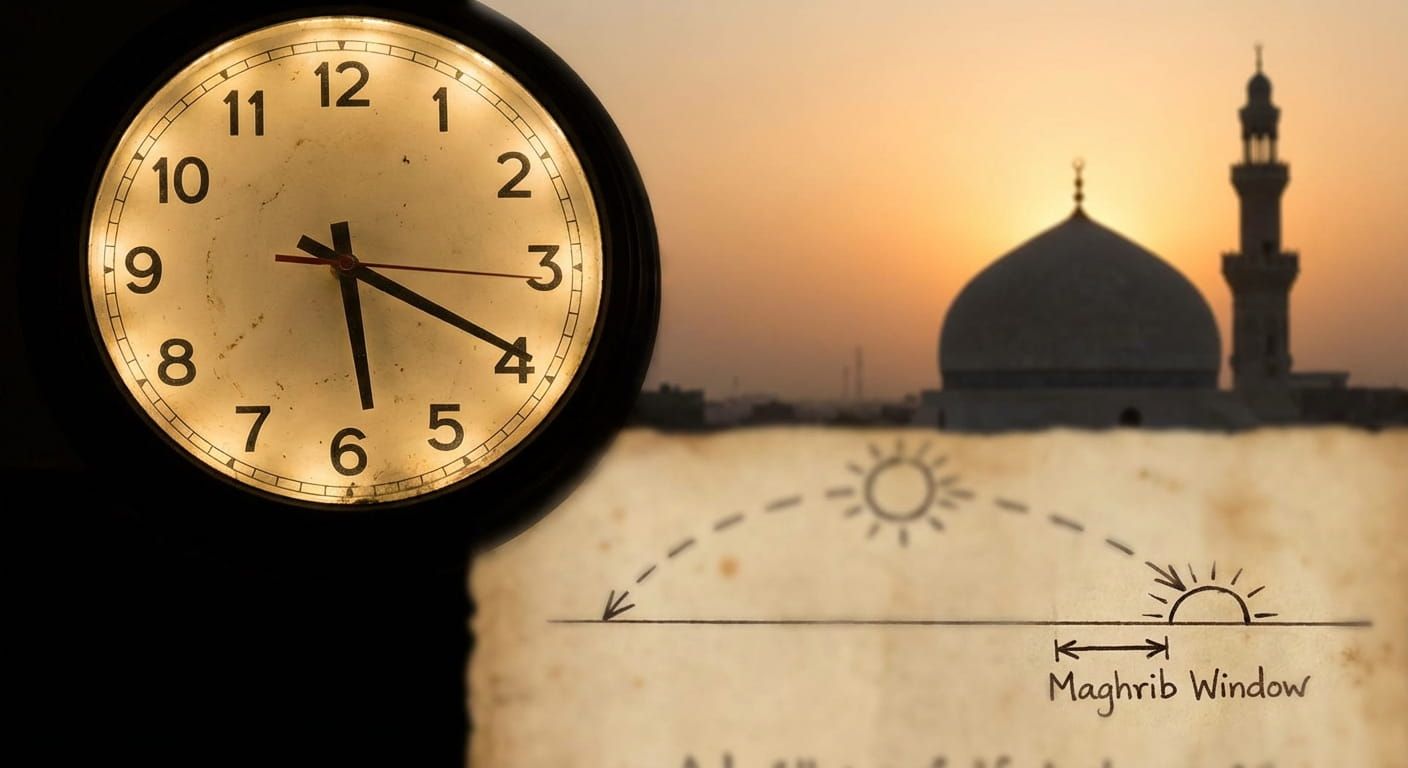
Why Maghrib Prayer Has the Shortest Time Window
Sunset arrives, the sky shifts, and one prayer enters with unusual urgency. Maghrib ...
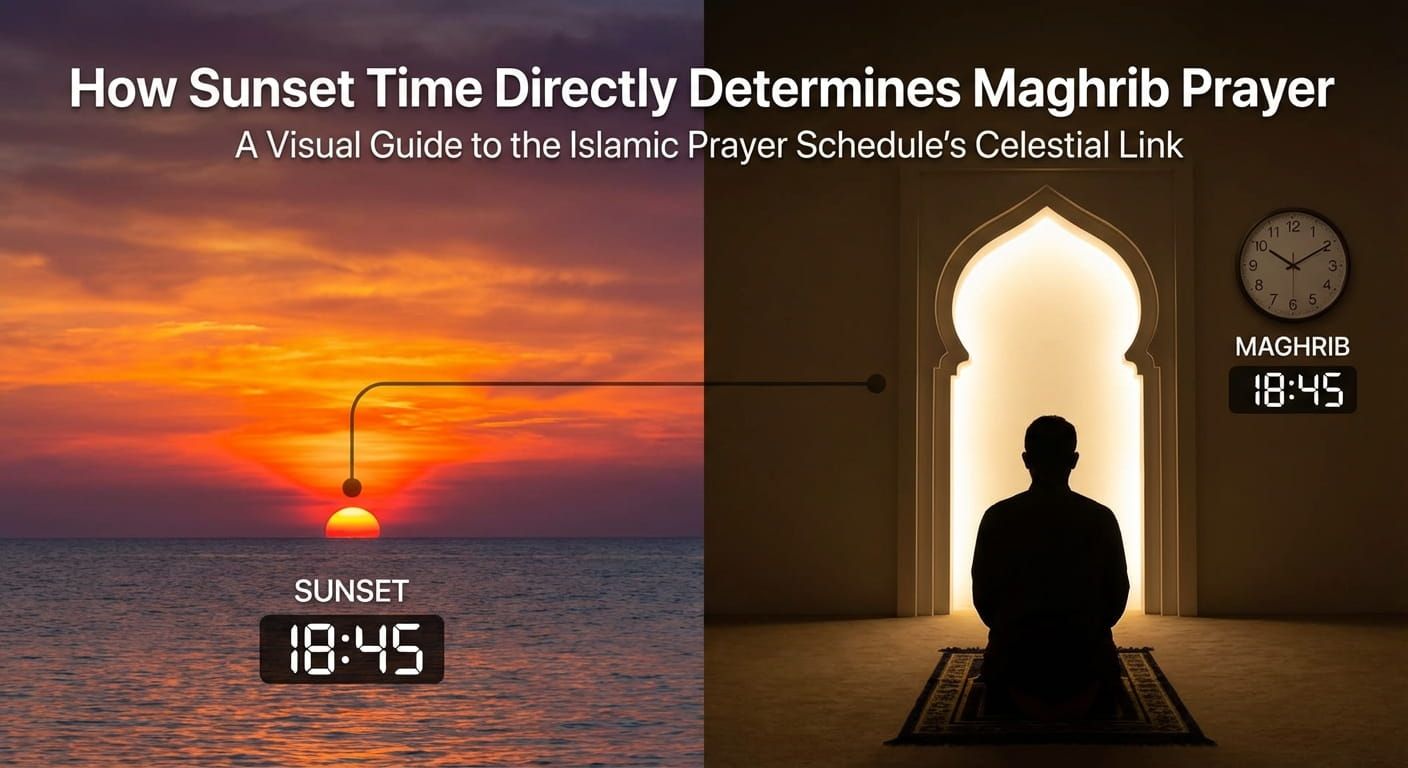
How Sunset Time Directly Determines Maghrib Prayer
Sunset settles the question in a single instant. The moment the sun fully drops below the horizon, Maghrib begins. That simple link between what yo...
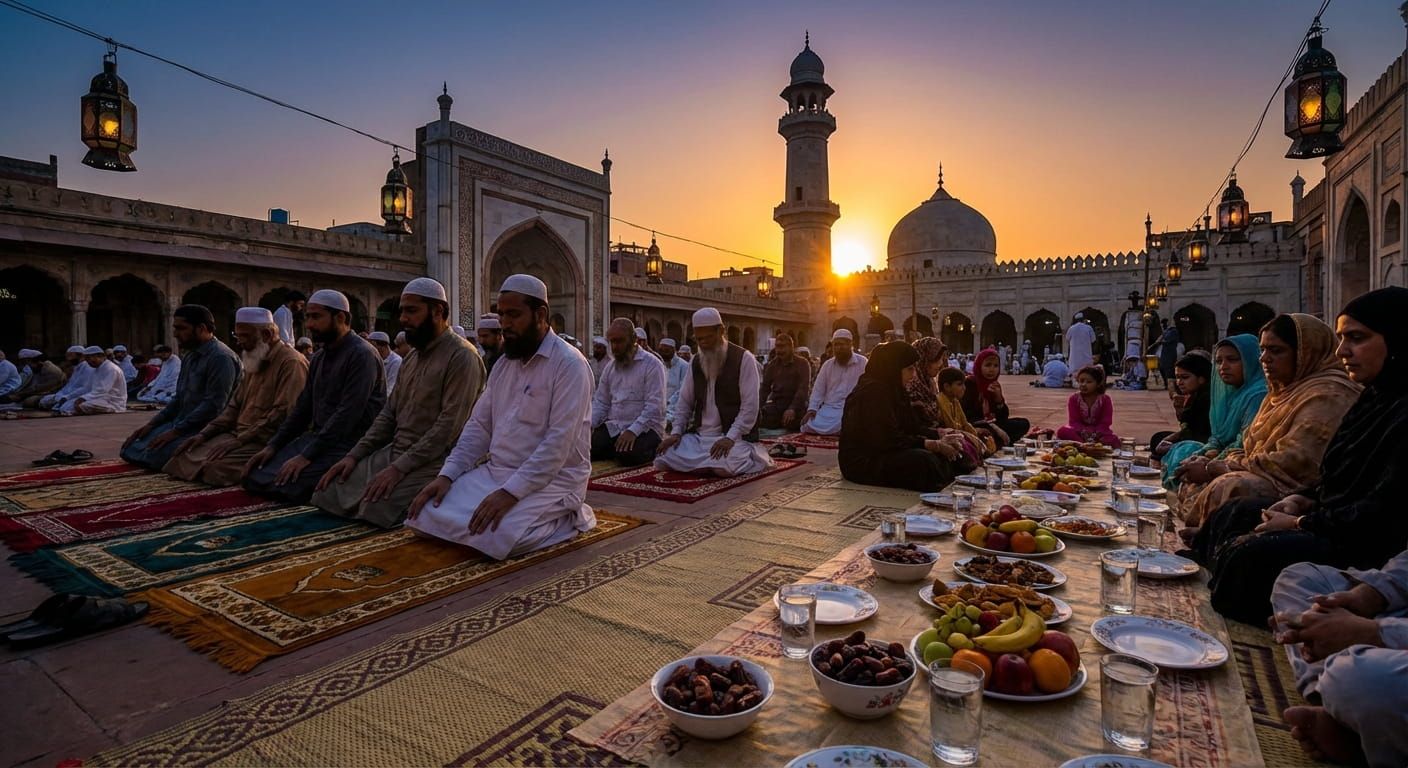
Maghrib Prayer and Iftar Timing During Ramadan
The moment of iftar is one of the most loved moments in Ramadan. Hunger eases, thirs...
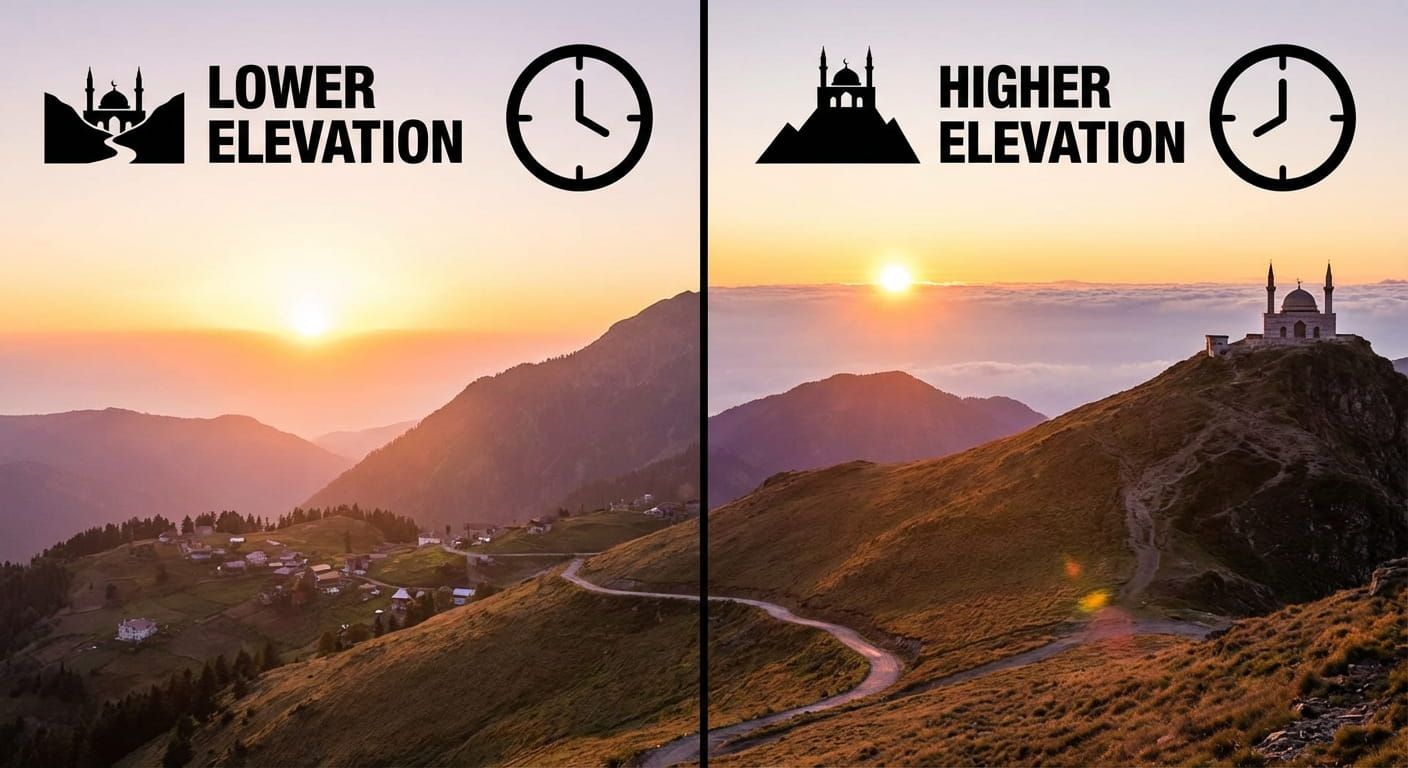
Does Elevation Affect Maghrib Prayer Time at Sunset
Sunset looks simple from the street. It is not always simple from the top of a tower or halfway up a mountain. Maghrib begins when the sun has actu...
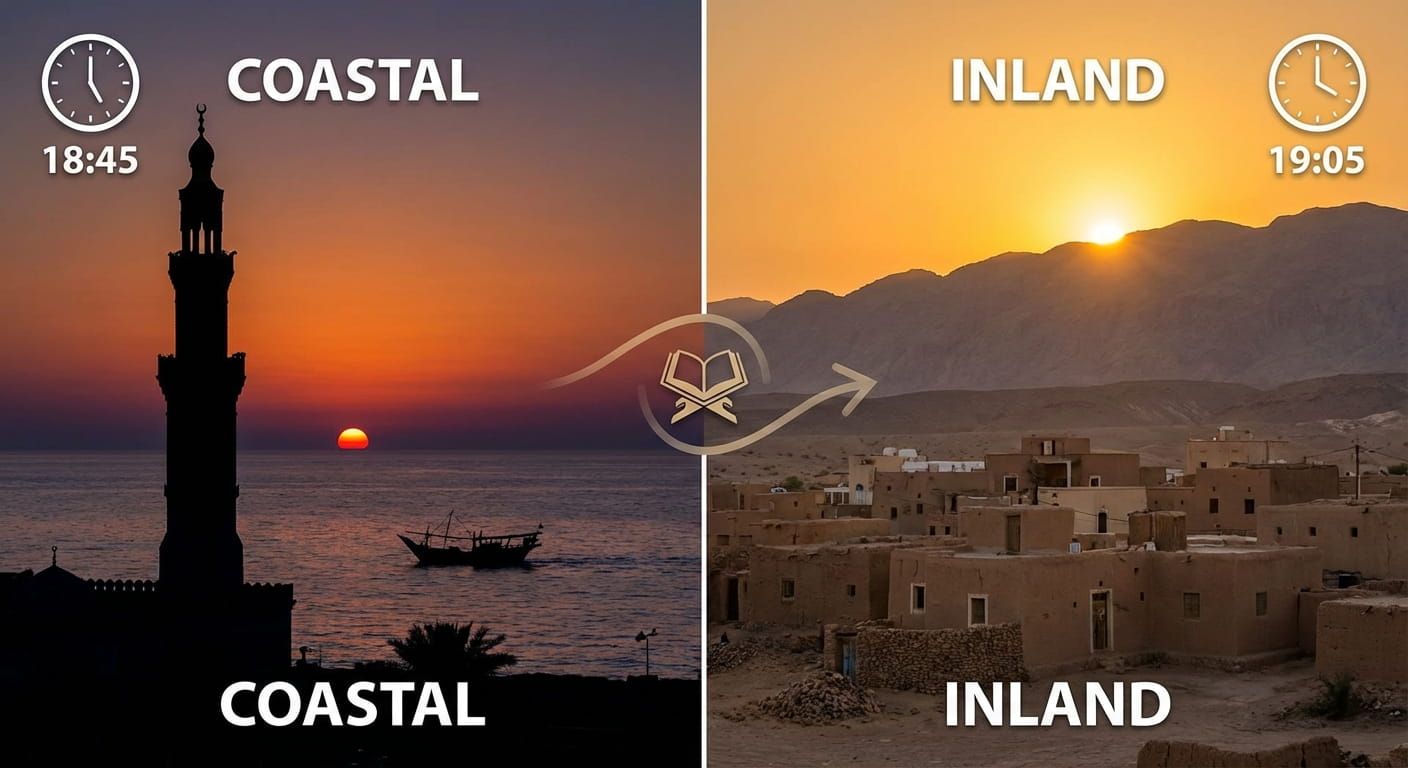
Maghrib Prayer Times in Coastal vs Inland Locations
Geography can change the way sunset feels. Stand by an open shoreline and the sun may sink along a clear line with very little in the way. Stand de...

Weather Conditions and Their Impact on Maghrib Timing
Clouds can hide the horizon, fog can soften the sky, and heavy overcast can make sunset feel uncertain. Yet the start of Maghrib does not bend to m...