Retirement age sounds simple until you try to define it across countries, jobs, and decades. One person stops working at 55 with a lifelong pension. Another keeps going to 70 because the rules changed mid career. Some systems reward early exits, others punish them. And more people now mix part time work with partial benefits. If you have ever wondered why your grandparents retired “earlier” than your parents, the answer sits in a long history of policy, demographics, and money.
Retirement ages have shifted because people live longer, work has changed, and pension budgets face pressure. Many countries began with lower ages tied to shorter lifespans and male breadwinner jobs. Over time, they raised ages, aligned men and women, and added early and delayed options. Today, pensions blend public and private plans, with more means testing and automatic adjustments. Understanding your timeline helps you plan with fewer surprises.
Quick quiz to test your pension instincts
Answer these five questions. Your score suggests a practical next step for planning. It is interactive, and it keeps you honest.
1) A country raises its pension age from 65 to 67. What is the most common reason?
2) In many systems, claiming earlier usually means:
3) A “notional defined contribution” approach mainly tries to:
4) Automatic adjustment rules in pensions often track:
5) If your plan includes a target retirement date, the first practical tool to use is:
How retirement age became a policy tool
Modern retirement age rules did not appear because someone finally solved aging. They appeared because industrial societies needed a predictable exit ramp from work. Before pensions, many people worked until they could not. Family support filled the gaps, and poverty in old age was common. The rise of formal pension systems created a shared promise: contribute while you work, receive support when you stop.
Early public pension systems often set an age that fit the realities of the time. Lifespans were shorter. Work was more physically demanding. Jobs were structured around factories and offices, with clearer “career arcs.” A fixed age simplified administration, and it made the promise feel real. For workers, a number on paper turned into a milestone they could plan around.
Quote to keep in mind: retirement age is less about your body clock and more about how a society shares the cost of long life.
The timeline that shaped today’s retirement ages
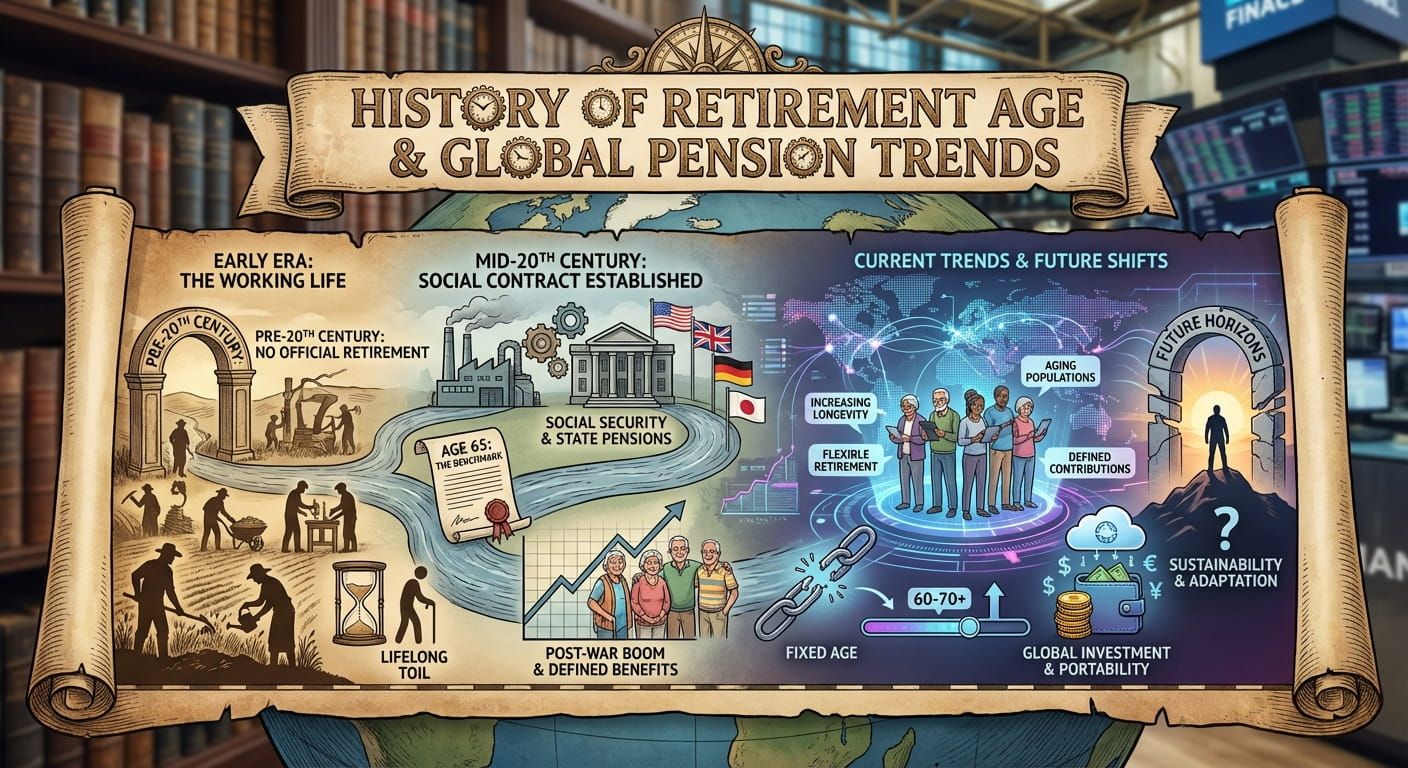
Retirement ages shifted in waves. If you want a simple way to remember it, think in three broad eras: creation, expansion, and recalibration. Each era brought new expectations, and new constraints.
- Creation era: Governments built first generation pension promises. Eligibility ages were often set with administration in mind, not perfect fairness.
- Expansion era: Coverage widened, benefits improved, and early retirement paths became popular in some places as a way to handle unemployment or industrial restructuring.
- Recalibration era: Longer lives and lower birth rates strained pay as you go financing. Many countries raised ages, tightened early routes, and encouraged later claiming.
These shifts show up in family stories. A grandparent might have retired at 60 with a defined benefit plan. A parent might have faced an age increase, plus a switch toward defined contribution savings. A younger worker might see flexible claiming windows, partial pensions, and rules that adjust automatically over time.
What “retirement age” really means in practice
In everyday talk, retirement age sounds like a single number. Policy uses several different numbers at once. That is why people get confused, and sometimes angry. Here are the common versions, explained in plain terms.
- Normal pension age: the age for full or standard benefits under a public scheme.
- Early claiming age: the earliest age you can start benefits, often with a permanent reduction.
- Late claiming incentives: a higher monthly benefit if you delay past the standard age.
- Occupational ages: special rules for certain jobs, sometimes with earlier exit options.
- Means tested access: benefits tied to income and assets, not only age.
These layers exist because one number cannot fit every life. Someone with a long career in a physically tough job faces different realities than someone with a desk job. And people do not age at the same pace. If you enjoy tracking your timeline with different viewpoints, biological vs chronological age adds useful perspective without turning planning into a medical project.
Global pension models and the tradeoffs they create
Countries fund pensions in different ways, and that changes how retirement ages move. Two big approaches dominate, plus hybrids.
Here is the quick version in one paragraph with bullet points for scanning:
• Pay as you go: current workers fund current retirees, it is sensitive to population age structure.
• Funded savings: contributions build assets over time, it is sensitive to investment returns and fees.
• Hybrids: a base public benefit plus workplace and personal savings, it spreads risk across pillars.
Pay as you go systems often raise retirement age when the worker to retiree balance shifts. Funded systems may not need age increases for the same reason, but they can still push later retirement because longer lives mean savings must stretch further. Hybrids try to share risk, but they can be complex, and complexity often hides who is winning and who is losing.
Pension trends you can feel in your own planning
Even if you never read a policy paper, you can spot the trends in how retirement planning conversations sound today. Here are the big patterns that keep repeating around the world.
- Later eligibility ages: often phased in slowly so near retirees are less affected.
- Equalization: many places have aligned retirement ages for men and women, or are moving that direction.
- Flexible windows: systems offer a range, with rewards for delaying and reductions for early claiming.
- Indexing rules: benefits adjust with inflation or wages, but the exact formula matters.
- Targeted support: more focus on minimum pensions or supplements for lower income seniors.
- Work longer nudges: policies that reduce penalties for combining work and pension income.
Many of these trends are driven by the simple arithmetic of time. Longer life means more years on benefits. Lower birth rates mean fewer workers supporting each retiree. If you like translating time into different units, age in seconds can be a surprisingly grounding way to feel how long a retirement can last, without getting stuck in abstract decades.
A professional snapshot of retirement ages and policy levers
The table below is not a list of every country, and it is not legal advice. It is a clean way to compare how systems typically manage the same problem: how to balance fairness, affordability, and real life work capacity.
How to calculate your own retirement timeline with less stress
Policy history is interesting, but your plan still needs dates. A timeline turns fuzzy goals into something you can act on. This is where age tools help, not as gimmicks, but as a way to reduce mental load.
- Start with your exact age: use age calculator to pin down years, months, and days. Small differences matter for eligibility rules.
- Set a target date: pick a realistic retirement month, not just a year. If you need to compare you and a partner, age difference helps you see how staggered claims might work.
- Check milestone pressure points: use age milestones to map key eligibility ages, then add personal milestones like mortgage payoff.
- Audit your “work optional” date: retirement is not one cliff. It can be a slope. Figure out when work becomes optional, then when full stop feels right.
- Revisit yearly: a plan is a living thing. Life changes, rules change, markets change.
If you enjoy seeing how close you are to a big birthday marker, birthday countdown can make long term planning feel more real. A date on a calendar is easier to respect than a vague “someday.”
The human side of raising retirement ages
When retirement ages rise, it can feel unfair. That reaction is not irrational. It is a clash between how policy sees populations and how people live in bodies. Someone who started full time work at 18 has a different story than someone who started at 28. Someone with caregiving breaks has a different contribution record than someone with a straight career line.
That is why many reforms add carve outs. Some aim to protect long contribution histories. Some add disability routes or caregiver credits. Some support partial pensions while working fewer hours. The details vary, but the goal is similar: keep the system solvent while avoiding cruelty.
Reality check: a higher retirement age is not the same burden for everyone. Fair reform tries to see the difference between a long, hard working life and a later start in a safer job.
How private pensions and public pensions now interact
In many places, public pensions are no longer meant to replace most of your salary. They are a foundation. Workplace plans and personal savings fill the gap. That shift changes how people think about retirement age. You might reach the public pension age at 67, but your personal savings might make you work optional earlier, or later if markets disappoint.
Defined benefit plans once made retirement age feel fixed. Defined contribution plans make it feel personal, sometimes uncomfortably personal. Your retirement becomes a set of tradeoffs: risk, fees, contribution rates, and how long your money must last. This is why pension conversations now include longevity risk, not just “am I old enough.”
Population aging and the quiet math behind reform
Policy debates often sound ideological, but the engine underneath is time. When people live longer and have fewer children, the share of older adults rises. That changes budgets. It changes health spending. It changes how many workers support each retiree. Raising the retirement age is one lever among many. Taxes, benefits, and immigration can also shift the balance, but age rules are visible and easy to adjust.
Even the calendar matters in small ways. Eligibility dates rely on exact birthdays, and leap years can nudge day counts. If you care about precise counting, leap year math accurate calendar age counting is a useful reminder that “one year” is not always the same number of days.
Retirement ages are not the only “age rules” that shape adult life
Retirement eligibility is one of many age gates. Voting, school start, legal adulthood, and benefit access all sit on the same idea: time since birth as a policy shortcut. The shortcut works most of the time, but it can be blunt.
- Age rules reduce administrative complexity.
- They can hide differences in health and job strain.
- They can feel arbitrary when you are near the cutoff.
- They can shift cultural expectations about “the right time” for life stages.
Even age itself is not treated the same everywhere. Some cultures have used different counting traditions, and that can affect how people talk about milestones. If that topic intrigues you, international age korean age gives context that makes those differences feel less strange.
Common retirement planning mistakes people regret
These mistakes show up across countries and income levels. The names change, but the pain feels the same.
- Assuming the retirement age will stay fixed: many reforms are phased in. Your “expected” age can move.
- Underestimating inflation: a long retirement means prices have time to rise.
- Ignoring health and job flexibility: the ability to keep working can matter more than the desire.
- Skipping the partner plan: different ages and career paths can change household timing.
- Counting on a single income source: mixing public benefits, workplace plans, and savings spreads risk.
- Not testing early versus late claiming: the monthly difference can shape your whole later life.
The next chapter of retirement age policy
Future reforms will likely keep moving in the same direction, but with more nuance. Expect more flexible claiming windows, more automatic adjustment formulas, and more targeted support for those who cannot work longer. Expect more debate about fairness for people with long contribution histories. Expect more attention on caregivers, because unpaid work props up economies too.
At the same time, work itself is changing. Remote work, self employment, and portfolio careers blur the boundary between working and retired. That could make retirement age feel less like a finish line and more like a benefit activation point. The number still matters, but it may matter in a different way than it did for a factory worker in the mid twentieth century.
Turning history into a date you can live with
Retirement age history is really a story about how societies turn time into rules. Those rules change, but your planning can stay steady if you focus on what you control: savings rate, flexibility, and a clear timeline. A good plan respects both policy and personal life. It also leaves room for surprise. That is not pessimism, it is realism, and realism tends to age well.