Your birthday is a date, but it is also a moving target that depends on which clock you choose. Earth uses one orbit. Space offers many, each tied to a different planetary path around the Sun. That is how a normal birthday question turns into a clean bit of physics, with a fun outcome: you can celebrate a birthday on Mercury, Mars, or Saturn without changing a single second of your life.
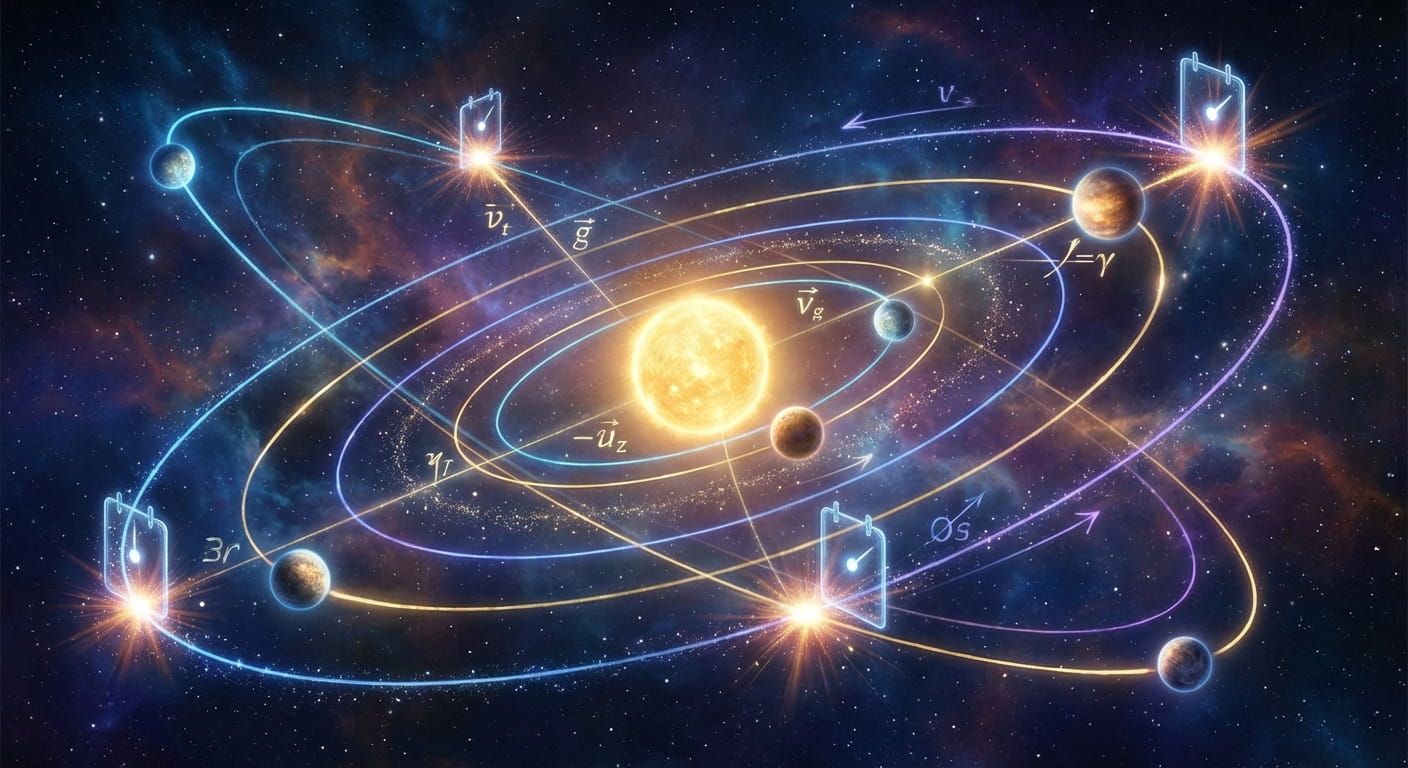
A space birthday happens when a planet completes one orbit around the Sun, using that planet’s own year length as the ruler. Fast orbits create more birthdays. Slow orbits create fewer. The physics is simple: distance and gravity set orbital speed, and orbital speed sets the year. Your lifetime in seconds stays the same, only the unit label changes.
Space birthday basics, one idea, many calendars
On Earth, your birthday arrives after one Earth orbit around the Sun. That is already a planetary orbit anniversary. The twist is switching the orbit you use for the count. Instead of asking how many Earth years you have lived, you ask how many Mercury years, Mars years, or Neptune years fit into the same time span.
That translation is exactly what age on other planets is built to show. You supply your birth details, it returns your age in the year lengths of other worlds. You will notice the pattern instantly. Shorter years make the number bigger. Longer years make the number smaller.
Orbital physics that makes years long or short
A planet’s year is the time it takes to complete an orbit around the Sun. Two things push that time upward as you move outward in the solar system. The path is longer, and the planet moves more slowly because the Sun’s pull is weaker at larger distances. Those two effects combine into a strong trend: farther planets have longer years.
If you want a way to keep the conversation grounded, translate everything into one neutral unit. Seconds do the job nicely. Age in seconds turns your lifetime into a number that does not care about calendars, leap days, or orbit lengths. Once you see that number, it becomes easier to accept that planet year ages are just different labels on the same time span.
How to compute your planet age in four steps
You can calculate a space birthday by hand. The tool makes it smoother, but the math is friendly.
- Start with your exact Earth age. If you want it down to the day and time, age calculator gives you a precise baseline.
- Get the planet’s year length expressed in Earth years. Mercury is under one Earth year. Mars is a bit longer. Jupiter is much longer.
- Divide your Earth age by the planet year length. The result is your age in that planet’s years.
- For your next space birthday, look at the next whole number above your current planet age. Convert the remaining fraction back into Earth time to find an Earth date to celebrate.
A colorful table that makes orbit birthdays easy to compare
This table is about feel, not memorization. Short years mean frequent birthdays. Long years mean rare birthdays. Your life length does not change, the calendar ruler changes.
| Planet | Orbit distance trend | Year length feel | Birthday frequency | Best use |
|---|---|---|---|---|
| Mercury | Very close in | Very short | Many birthdays | Feeling the fast orbit effect |
| Earth | Middle | Familiar | Standard birthdays | Your daily calendar life |
| Mars | Outside Earth | A bit longer | Fewer birthdays | Comparing near neighbor years |
| Jupiter | Farther out | Very long | Rare birthdays | Feeling the slow orbit effect |
| Neptune | Very far out | Extremely long | Almost never | Perspective and patience |
A quiz that turns orbit facts into muscle memory
This quiz is for fun, but it reinforces the real rule: orbital period sets the birthday rhythm. Pick your answers, then check your score.
Practical ways to plan a celebration on Earth
A space birthday is fun, but you still celebrate on Earth. The smoothest approach is to keep one Earth anchor date, then layer the space calendar on top. Choose a planet, compute your current planet age, then target the next whole number as your celebration marker.
If you want the date to feel real, set a timer. Birthday countdown keeps everyone synced to the same moment, even if your theme is Mars cupcakes or a Mercury playlist.
A listicle of orbit birthday ideas that stay true to the physics
You do not need complicated astronomy software to make this memorable. You just need a clear unit and a fun angle.
- Pick one planet and celebrate every time your age hits a whole number in that planet’s years.
- Make a small card that shows your Earth age, your seconds lived, and your chosen planet age.
- Use a friend group challenge, predict who gets the next Mercury birthday first, then check.
- Create a theme that matches the orbit mood, fast and bright for inner planets, slow and cozy for outer planets.
The calm truth behind the playful number
Space birthdays feel wild because the number changes a lot, but the underlying time interval does not change at all. The physics is the same physics that keeps seasons steady on Earth. The only shift is the ruler you measure with.
If you want to keep the whole topic anchored in one place, age info maps the different ways Time.now measures age and time intervals. The planet option sits naturally beside the seconds view and the Earth based calculator, because they are all translations of the same lifetime.
When your birthday becomes a tiny astronomy lesson
The nicest part of planetary birthdays is that the science is honest and the mood stays light. Orbits are not abstract once you tie them to your own timeline. A year becomes a path. A birthday becomes a lap marker.
Choose a world. Count its laps. Celebrate the next one. It is the same life, the same seconds, and a fresh way to feel connected to the moving clockwork of the solar system.