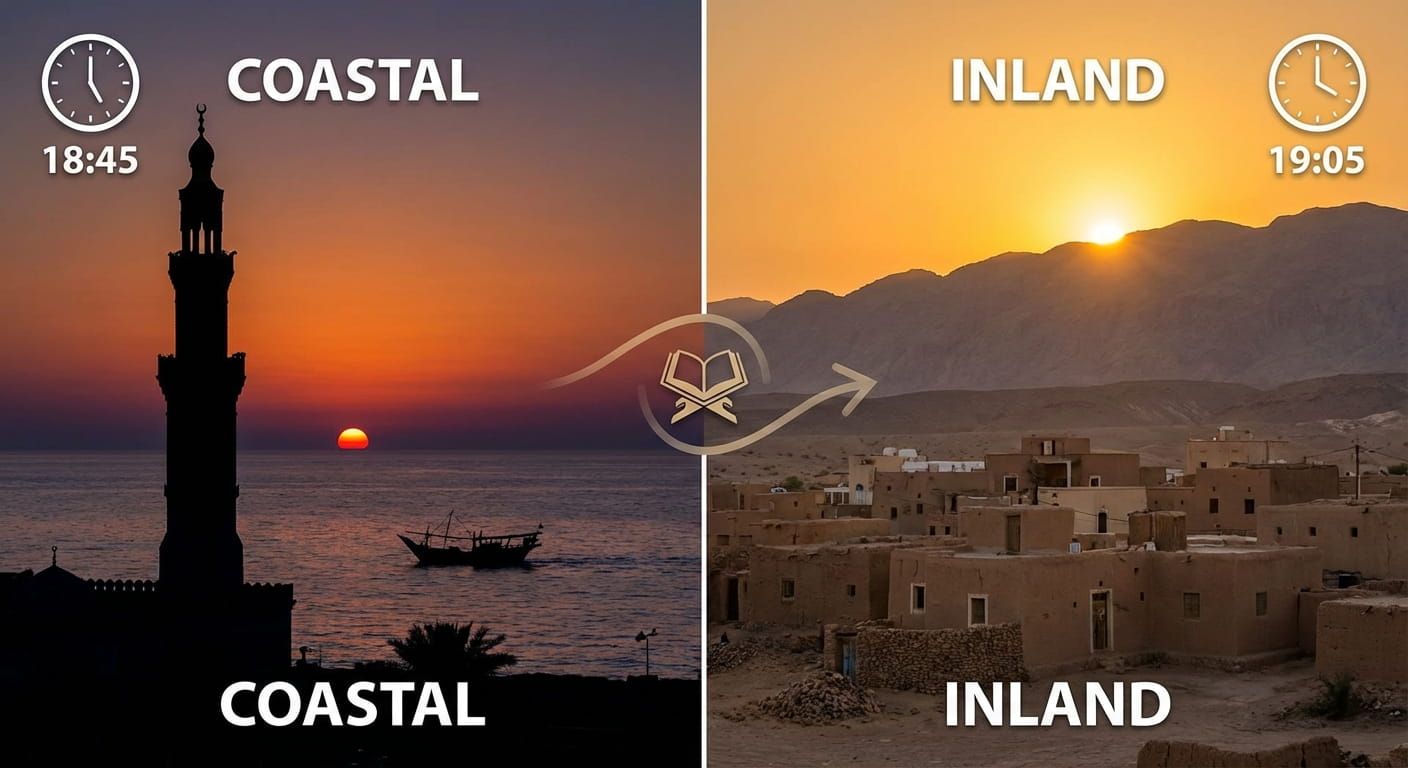
Geography can change the way sunset feels. Stand by an open shoreline and the sun may sink along a clear line with very little in the way. Stand deep inland, especially near rising terrain, and that same sun can seem to vanish behind land long before the true horizon would matter in calculation. That difference is why Maghrib can feel simple in one place and less obvious in another, even when the official prayer time is accurate and consistent.
Key takeaway
Coastal locations often have a clean western view, which makes sunset easier to identify by sight. Inland areas may have hills, ridges, or mountains that block the sun before it reaches the true horizon used in standard calculations. That is why coastal cities may seem to enter Maghrib a little earlier in lived experience. Miami often feels more visually direct than Denver, while the timetable still follows the true horizon rather than local obstacles.
Why The Coast Often Feels Simpler At Sunset
A coastal city has one major advantage at sunset, a broad horizon. If you are standing near the water with a west facing view, the sun usually drops toward a long, open line with fewer natural barriers. That can make the start of Maghrib feel clear and immediate. The eye sees the last part of the sun disappear, and the evening prayer time feels easy to understand.
Miami is a strong example. The local setting often gives residents and visitors a cleaner visual relationship with sunset than many inland places. Readers checking prayer times for Maghrib in Miami may notice that the lived experience of sunset near the coast often matches what they expect to see.
This does not mean every coastal place is identical. Clouds, haze, sea mist, and urban buildings can still affect visibility. Yet an open ocean horizon removes one common source of confusion, land based obstruction. In many shoreline cities, the visual cue for sunset feels more natural because the western view is less interrupted.
Quoted thought
A clear ocean horizon does not change the rule for Maghrib, but it often makes the rule easier to see with your own eyes.
Why Inland Places Can Feel Less Straightforward
Inland cities often come with a more complicated visual story. A ridge, a mountain wall, or even a line of elevated terrain can hide the sun from view before the sun reaches the true horizon used in standard timing methods. This is where people sometimes feel that sunset arrived early, even though the official timetable has not yet reached Maghrib.
Denver helps show this well. The city is associated with high terrain and nearby mountains, and the wider region has elevation changes that shape what people see at the end of the day. Residents checking Maghrib in Denver may notice that the visual disappearance of the sun can feel different from what someone on an open coast expects.
That difference matters because human observation is local. Your eyes respond to the skyline in front of you. A timetable responds to a defined astronomical standard. Those are not always the same thing.
What The True Horizon Actually Means
The true horizon is the reference line used in formal sunset calculations. It is not every hill, tower, apartment block, or mountain edge that might cut across your own personal view. It is the geometric horizon tied to your position on the earth. This shared standard keeps prayer times consistent across neighborhoods, rather than letting every obstruction produce a different result.
That consistency is useful. Without it, one person standing beside a tall building could claim an earlier sunset than another person a few streets away. A city wide prayer time would become hard to maintain. This is why standard Maghrib timetables rely on the true horizon rather than blocked local sight lines.
- Open coastlines often give a clearer sunset view.
- Inland terrain can block the sun early from your personal angle.
- Official timetables use the true horizon.
- Local visibility and official timing can feel different without being contradictory.
- This becomes especially noticeable during Ramadan, when people watch sunset closely.
Why Coastal Cities May Seem Slightly Earlier
The phrase slightly earlier needs care. A coastal city is not automatically earlier than an inland city on the clock in every case. Clock time also depends on longitude, latitude, date, and time zone structure. The better point is that coastal cities may feel earlier in practical observation because the sunset event is easier to see cleanly.
In a place with an unobstructed ocean horizon, people often witness the final drop of the sun very close to the calculated sunset. In a mountain affected inland setting, a person may lose sight of the sun before the calculated sunset because local terrain interrupts the view. That creates the impression that the day ended sooner than the timetable says. The difference is often more about sight line than rule.
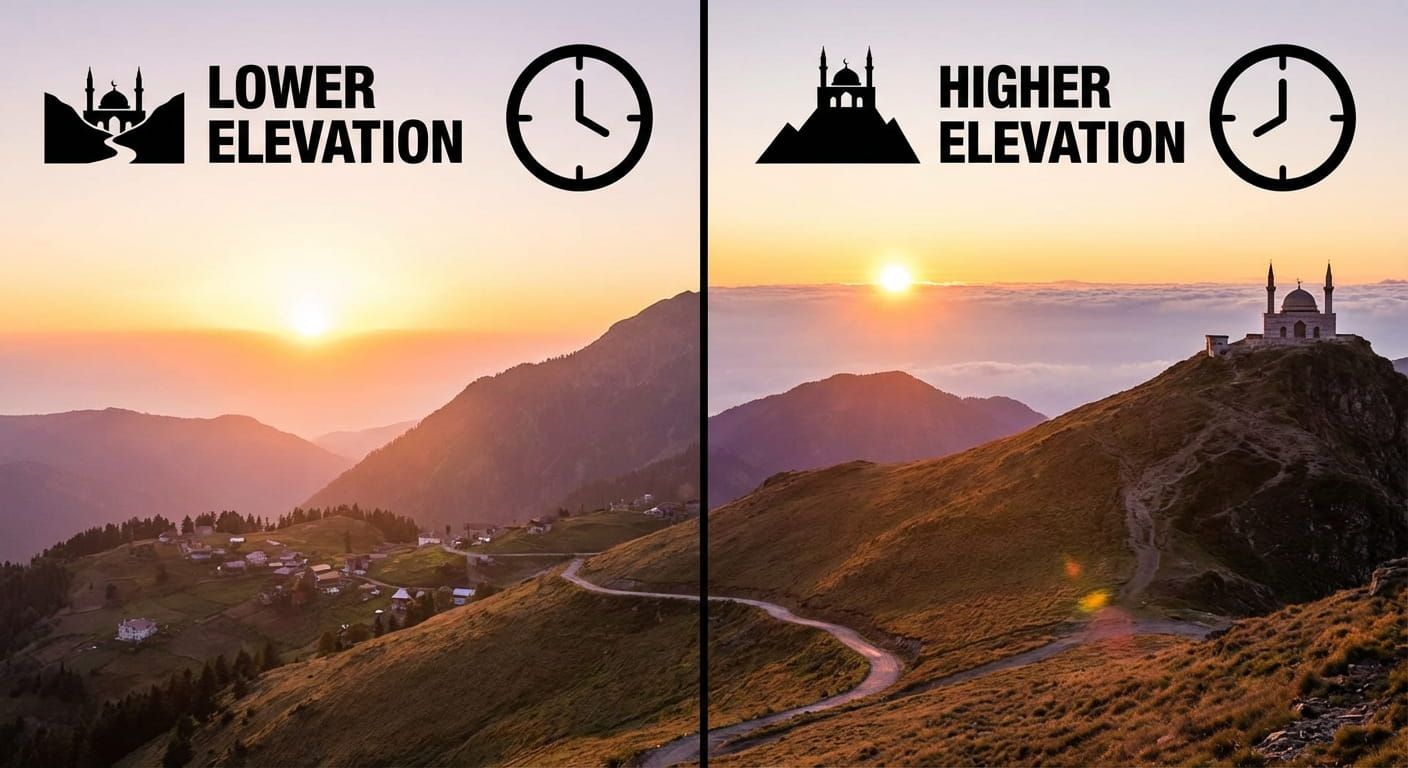
Another factor is elevation. A higher vantage point can extend what you see because your horizon stretches farther. That means one elevated location may see the sun for a bit longer than a lower nearby location.
Miami And Denver Show The Contrast Clearly
Miami and Denver are useful because they create a vivid comparison. Miami gives many people an image of open water, flat horizons, and direct sunset views near the coast. Denver brings to mind high ground, inland geography, and a more layered western landscape. The result is not a simple contest over which city has the earlier clock time. The result is a contrast in how sunset is perceived.
- Miami often offers a clean western horizon near the coast.
- Denver often involves a more complex visual environment shaped by elevation and terrain.
- Maghrib calculations still rely on the true horizon in both places.
- The person watching from ground level may feel more certainty in Miami than in Denver.
This matters a great deal during fasting months. A person waiting to break the fast wants confidence in the exact transition from day to evening. Readers interested in practical daily timing may also compare the experience of Maghrib in Los Angeles and Maghrib in New York City, where water access and city skylines shape sunset in very different ways.
How Other Cities Fit The Same Pattern
This coast and inland contrast appears all over the world. Some cities have open shorelines. Some sit on plateaus. Some combine hills, water, and dense urban skylines all at once. Each setting shapes what people see, even while the timing method remains grounded in the true horizon.
Across very different regions, Maghrib in Cairo, Maghrib in Istanbul, Maghrib in Karachi, and Maghrib in Dubai each show how air clarity, urban form, nearby water, and surrounding land can shape the lived experience of sunset.
South and Southeast Asia add more variety. Readers comparing Maghrib in Singapore and Maghrib in Tokyo can see how coastal exposure, humidity, skyline density, and seasonal changes all influence how easily sunset can be observed.
The same principle holds elsewhere too. A city near a wide coast often gives a stronger visual cue than a city hemmed in by rising land. The timetable stays stable, but the local experience can feel very different from place to place.
Comparing Coastal And Inland Sunset Conditions
| Setting | What people often see | Effect on perception of sunset | How standard timing works |
|---|---|---|---|
| Open coastline | Long, clean horizon across water | Sunset often feels direct and easier to verify | Uses the true horizon |
| Inland plain | May be open, but not always uniform | Can still feel clear if western view is unobstructed | Uses the true horizon |
| Mountain affected inland area | Ridges or peaks interrupt sight line | Sun may seem to set earlier than timetable | Uses the true horizon |
| Dense urban skyline | Buildings may hide the sun | Street level visibility may differ from open areas nearby | Uses the true horizon |
What This Means For Everyday Practice
For most people, the simplest approach is to trust a reliable local timetable built on sound calculations. That timetable uses a stable reference and avoids the problem of every neighborhood producing its own separate sunset. If your street, balcony, hill, or skyline makes the sun disappear sooner, that does not usually replace the underlying calculation.
Still, local experience matters because it explains why some places feel easier. A beach city with a clean western view gives many people a direct visual confirmation. An inland city near rising terrain may not. That is not a contradiction. It is the difference between a personal sight line and the true horizon used for timekeeping.
Where Sea And Land Tell Different Stories At Dusk
Coastal and inland locations do not just change the scenery, they change the way sunset is experienced. An ocean horizon often gives a cleaner visual cue, which is why places like Miami can make Maghrib feel immediate and easy to confirm. Inland settings, including regions around Denver, may place hills, mountains, or changing elevation between the viewer and that clean horizon. The timetable stays rooted in the true horizon, while the eye responds to local terrain. Once that distinction is clear, the contrast between coast and inland stops feeling confusing and starts making sense.