Age feels simple until you need to compare two people born in different time zones, fill out a form that uses “as of” dates, or talk with someone who grew up with a different cultural rulebook. Then age turns into a story about calendars, counting conventions, and the moment a society chooses to call a person “one year older.” This guide walks through international age systems and the traditional Korean age rules, with clear examples and practical ways to convert between them.
Internationally, age usually means your completed years since birth on a specific date. Traditional Korean age adds one year at birth and often adds another at the New Year, so people can appear one or two years older than their birth based age. Korea now widely uses the international method for official use, but traditional counting still shows up in conversation. Converting is straightforward once you know the date and the rule in play.
Quiz to test your age system instincts
Answer three short questions. You will get instant feedback, plus a plain language explanation.
What most countries mean by age in everyday life
In many places, age is the count of full years since birth. Your “age today” changes on your birthday, not on January 1. That is the version used on passports, school forms, job applications, and most official records.
Even inside this common approach, details matter. Some systems care about the exact time of birth. Others only care about the date. Some rules ask for your age “as of” a deadline. That is where confusion can start, especially when people compare ages across cultures.
If a document says “age as of a date,” it is asking you to freeze time. That date might be a school cutoff, an election day, or a benefit application deadline. Your birthday might be close, but the “as of” date is the one that decides.
Traditional Korean age rules and why they feel different
Traditional Korean age, often called “Korean age” in English conversations, is built on two ideas. The first is that a person starts at one year old at birth. The second is that everyone becomes a year older together when the calendar year changes.
This can produce a number that is one or two years higher than the international count. If you were born late in the year, the change can feel dramatic. A baby born in December might be “one” at birth by the traditional method, then “two” when January arrives, even though only weeks have passed.
The two rules in plain language
- At birth: You begin at 1, not 0.
- At the new year: Add 1 when the calendar year changes, regardless of your birthday.
This method made practical sense in times when birth records were less precise, and when age was used more as a social position than a precise measure of time lived. It also matched a rhythm of life that followed the year as a shared milestone.
How conversions work, without headaches
Converting between systems is easier than it sounds. You need two pieces of information: the person’s birth date, and the date you are measuring on. Then you decide which rule is being used in that context.
If you want a fast check, a regular age calculation can get you the international number. You can do that with age calculator. Once you have the international age, the traditional Korean age is often close to international age plus 1 or plus 2, depending on whether the birthday has already happened this year.
A conversion recipe you can remember
- Calculate international age as of the date you care about.
- If you want traditional Korean age, start with international age plus 1.
- If the person has not had their birthday yet this calendar year, add one more.
This recipe matches the way many people explain it informally. It is not magic. It is just a different choice about when the “year older” label appears.
Comparison table for international and Korean counting
The table below shows how the same person can have different ages depending on the system and the timing in the year. It uses a single birth date and looks at two moments in time.
| What you are counting | International age | Traditional Korean age | What it feels like |
|---|---|---|---|
| Person born on October 20, measured on January 10 | Birthday not yet reached this year, age is based on last birthday | Often two higher than international at this point in the year | A shared new year upgrade |
| Same person, measured on November 10 | Birthday already passed, age just increased on October 20 | Commonly one higher than international after the birthday | The gap shrinks later in the year |
| Why people get confused on forms | Forms expect “full years lived” on a specific date | Conversation may use the traditional number | Same person, two different labels |
Where each system shows up in real life
Age is not only about birthdays. It is also about eligibility. And eligibility rules often pick one system and stick to it. If you are filling out an official document in Korea today, you will usually see the international method. In everyday talk, you may still hear the traditional number, especially from older relatives or in casual introductions.
It helps to ask one simple question: “Is this for an official rule, or a social label?” That single split solves many misunderstandings.
One paragraph, easy scan: Passports and IDs, international age School cutoffs, age as of a date Casual intros, traditional Korean age may appear Medical notes, exact dates matter
Age differences are easier than conversions, if you anchor to dates
If your goal is to compare two people, start with dates, not labels. The cleanest way is to compute the gap between birth dates. Then you can express it as years, months, and days. That avoids the trap of mixing systems.
Age difference works well for this, because it compares two dates directly. This stays clean even when the two people use different cultural conventions. Dates do not argue. They just sit there.
New Year birthdays, leap years, and other calendar surprises
Calendars are polite most days. Then leap years show up, and people born on February 29 get a special kind of math. Even without that rare birthday, leap days can affect “days lived” and precise time intervals.
For the calendar mechanics behind accurate counting, leap year math keeps the focus on how calendars count days, so your age calculations stay consistent when a year has 366 days.
Cutoff dates turn age into a pass or fail question
Some rules ask “How old are you?” but what they really mean is “Were you old enough on the deadline?” School enrollment is the classic example. A child might turn the right age one week after the cutoff, but that can push entry back a whole year.
School start age helps you reason about cutoffs without guesswork. It is also a reminder that the same child can be “the right age” in one system and “not yet” in another if the rule depends on calendar timing.
Keep the rules straight in your head
- International age: changes on your birthday, counts full years lived.
- Traditional Korean age: starts at 1, often increases when the calendar year changes.
- Gap size: traditional Korean age is often 1 or 2 higher than international age.
- Best practice for forms: follow the system the form expects, usually international age.
- Best practice for comparisons: compare birth dates, then translate if needed.
- Best practice for deadlines: calculate age as of the cutoff date, not today.
Biological age, adjusted age, and why one number is not always enough
Sometimes the question is not “How many birthdays?” but “How is the body doing?” That is where biological age comes in. It tries to reflect health markers rather than calendar time. biological vs chronological age lays out the difference without turning it into a lab report.
There are also situations where you adjust age to match development. Premature birth is the big one. In pediatric settings, “adjusted age” can be more informative than chronological age for milestones. adjusted age is useful when timing and development need a fairer frame.
Age is a label. Time lived is a measurement. Health and development add another layer. Once you notice the layers, it gets easier to pick the right kind of age for the moment.
Gestational age is a different timeline, with its own logic
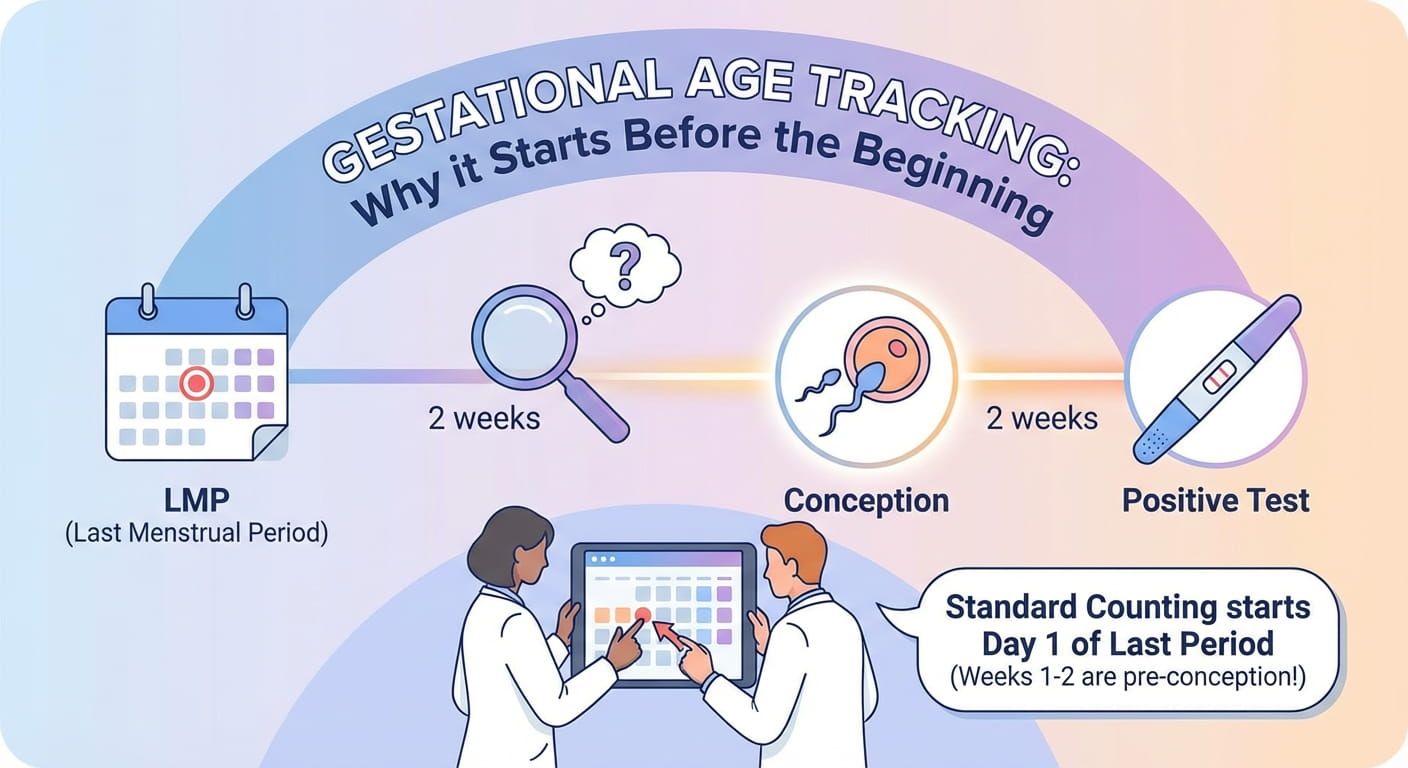
Pregnancy tracking uses weeks and days in a way that looks familiar but works differently than birthdays. Gestational age is usually counted from the first day of the last menstrual period, not from conception. That detail matters for appointments and test windows.
Gestational age supports that context, where the goal is not a single age number, but a reliable timeline.
Age measured in seconds feels strange, but it makes comparisons clean
Sometimes you want a number that changes smoothly, especially for countdowns and time interval curiosity. Measuring age in seconds gives you that. It also strips away the ambiguity between cultural conventions, because seconds do not care about birthdays or New Year customs.
If you want to see your age in a running counter, age in seconds can be a fun reality check. It is also a reminder that the international system is a practical shortcut, not a perfect representation of lived time.
Birthday countdowns and past date lookbacks make the system visible
A countdown to your next birthday makes the international method feel concrete. You can see the remaining days and watch them shrink. That is helpful when planning travel, parties, or just a personal milestone. birthday countdown fits that kind of planning.
Looking backward is just as useful. People often want to know their age at a past event, graduation, a move, a first job. A past date lookback answers that with less mental math. how old was i makes it easy to pin the number to a specific moment.
Age milestones, half birthdays, and the little markers people care about
Even when official systems are consistent, personal life is full of informal markers. Half birthdays show up in schools and in family routines. Milestones show up in health, sports, and personal goals. These are not required by law, but people love them because they create structure.
Age milestones helps when you want a quick sense of what a given age often represents socially. And half birthday helps with those midyear celebrations that keep kids happy and adults amused.
Eligibility rules, retirement planning, and the age that gates your choices
Many countries tie rights and responsibilities to age. Voting is a big one. Even if you personally use a cultural age label, eligibility is almost always based on the international method and a specific effective date. voting eligibility helps you think in terms of dates and thresholds.
Retirement works similarly. It is less about what age you feel, more about what age the policy defines. If you are mapping out future plans, retirement age can help you sketch the timeline in a simple way.
Generations and historical context add meaning to the number
Age often becomes shorthand for a shared set of experiences. That is where generation labels come in. They do not replace age systems, but they can add social context. generation finder gives a quick check of common generation names based on birth year.
For history lovers, there is also a different kind of question: “How old would someone be if they were born in a historical year?” That is less about policy and more about perspective. historical age supports that kind of time travel thinking using straightforward date math.
Pet ages and planet ages show how flexible the idea of age can be
People switch frames all the time without noticing. We talk about a dog being “seven,” but we also talk about “dog years.” That is a conversion built for empathy, not precision. dog age and cat age translate pet years into human context with simple inputs.
And then there is the playful science angle. If you measure age by orbital periods, your “year” changes by planet. It is a fun reminder that age depends on the unit you choose. age on other planets puts that into numbers in a way that still feels grounded.
Conversions people actually use
This second table keeps it practical. It shows the common relationship between the traditional Korean number and the international number, without pretending there is one single fixed offset. The offset depends on whether the birthday has happened yet this year.
| If today is before the birthday | If today is after the birthday | Plain explanation |
|---|---|---|
| Traditional Korean age ≈ international age + 2 | Traditional Korean age ≈ international age + 1 | The New Year increase already happened, then the birthday may or may not have happened yet |
| International age is still last year’s completed count | International age just increased on the birthday | International counting waits for your own date, traditional counting often follows the shared calendar |
Common mix-ups and quick fixes
Most confusion comes from two simple mistakes. People assume there is one universal definition of “age,” and they assume that all age changes happen on birthdays. Traditional Korean age breaks that second assumption, and deadlines break it too.
- Mix-up: Someone says “I am 21,” and you assume it is international age. Fix: Ask if they mean the traditional Korean number or the international one.
- Mix-up: You use today’s date when a form asks for age on a cutoff. Fix: Recalculate as of the cutoff date.
- Mix-up: You compare two people by their spoken ages. Fix: Compare birth dates, then translate if needed.
- Mix-up: A leap year birthday creates uncertainty. Fix: Use date based calculations and let the calendar handle the day count.
Where to learn more inside the Time.now age toolkit
If you want to go beyond one number, age tools overview is a useful map. It connects different kinds of questions, age at a past moment, time until a birthday, differences between dates, age in unusual units, and more, all in one place. That is helpful because the right method depends on the question you are asking.
A final way to keep the systems friendly in conversation
Age systems can feel personal, because age is tied to identity. A good approach is to treat age like a language choice. You can ask which system someone is using, then match their context. If you need precision, anchor to dates. If you are chatting casually, the traditional Korean number can be part of cultural warmth. Once you know the rules, you can move between them without awkwardness, and the number stops being a trap.