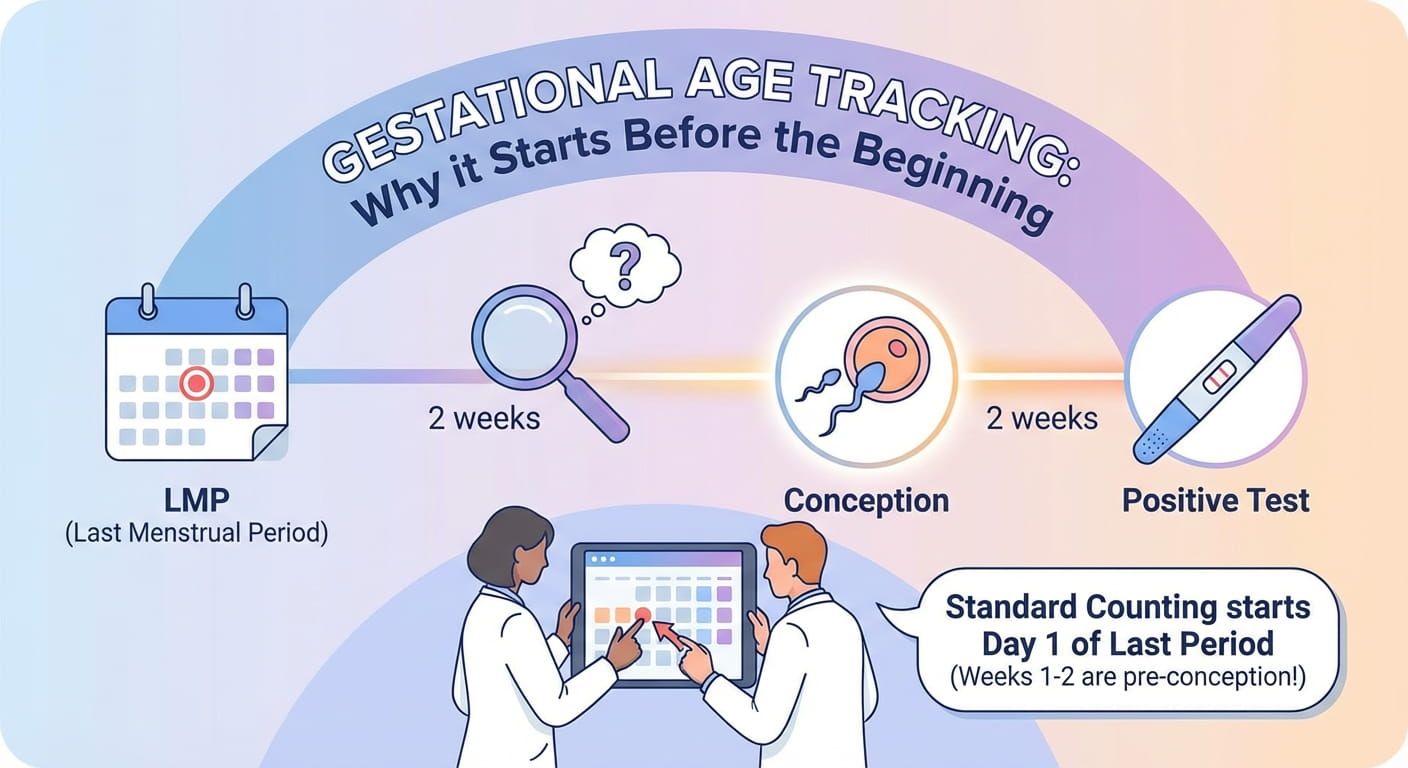
Pregnancy is the only time in life when you can be said to have an official age before you have a birthday. That sounds odd until you see the problem medicine is trying to solve, everyone needs a shared starting point. Conception is private, often unknown, and rarely pinned to a calendar day with confidence. A consistent clock helps doctors compare growth, schedule tests, and talk about risk using the same language. That is why gestational age tracking begins before conception, it starts from a date many people can actually identify.
Gestational age usually starts on the first day of your last menstrual period because that date is easier to know than conception. It creates one shared timeline for appointments, ultrasounds, screening windows, and due date estimates. Even though fertilization happens about two weeks later in a typical cycle, starting earlier keeps care consistent across millions of pregnancies. If you want to track it at home, a gestational age calculator gives a clear week and day count.
1) Why does gestational age commonly start at the last menstrual period date?
2) In a typical 28 day cycle, fertilization often happens about how long after the LMP start date?
3) What is one major benefit of a consistent gestational age timeline?
How A Pregnancy Clock Became Standard
Healthcare uses the same kind of shortcut everywhere. Not because it is perfect, but because it is shared. With pregnancy, the biggest obstacle is that conception is often a guess. Even with a planned pregnancy, timing can vary. Ovulation can shift. Sperm can survive for several days. Implantation does not happen instantly. A single moment is hard to label.
The first day of the last menstrual period, often shortened to LMP, is different. Many people can point to it on a calendar. It is recorded in health apps, diaries, and appointment histories. So it became the anchor.
That anchor also created a simple rule of thumb. A typical pregnancy is described as 40 weeks. That count starts at LMP. It lines up well enough with the average time from ovulation to birth to keep care organized. It does not mean every body follows a 28 day cycle. It just means the system needs one starting line.
Before Conception, There Is Still Biology
Starting the count before fertilization feels backward until you look at what is happening in the body. The follicle that will release an egg is developing. Hormones are rising and falling. The uterine lining is preparing. From a medical perspective, those early weeks matter because they shape the environment the embryo will meet.
That is why the clock begins where the cycle begins. It is the most visible sign that a new cycle has started. Later, once there is an ultrasound measurement, the timeline can be refined. But the early guess still helps plan what comes next.
If you are curious how time is counted in other parts of life too, the broader age-info guide shows how the same idea appears in many tools, one anchor date makes calculations consistent.
Gestational Age Versus Fetal Age
Two terms get mixed up a lot. Gestational age is the one clinicians use most. Fetal age, sometimes called conceptional age, counts from fertilization. Fetal age is usually about two weeks less than gestational age in a typical cycle.
That gap is not a mistake. It is the cost of choosing a date people can identify. It is also why you might hear two different week counts for what sounds like the same pregnancy.
Why The Two Week Offset Usually Works
Many cycles follow a rough rhythm. Ovulation often happens around the middle. If you count from LMP, you land near ovulation at about two weeks. That is the origin of the offset.
Still, bodies vary. Some people ovulate earlier. Some later. Some have irregular cycles. That is where ultrasound steps in. Early measurements can be a more reliable estimator of gestational age than memory alone, especially if periods are irregular or the LMP date is uncertain.
If you want to compare different date anchors for personal planning, the age calculator format is a useful way to see how shifting a start date changes the count.
What Clinicians Need A Shared Timeline For
Gestational age is not trivia. It is a scheduling system. Certain checks make sense only in specific windows. Growth expectations change week by week. A shared timeline lets a clinic run smoothly and helps patients understand what happens next.
Here are the kinds of things a consistent week count supports:
- Screening windows, many tests are recommended in certain ranges of weeks.
- Ultrasound comparisons, measurements are interpreted against expected size for that week.
- Preterm and post term definitions, week thresholds guide monitoring choices.
- Symptom context, what is common at week 7 is different from week 27.
- Communication, the phrase 12 weeks means the same thing in every exam room.
A Simple Way To Track Your Own Timeline
If you have an LMP date, tracking can be straightforward. If you do not, you can still estimate using the date of a positive test and your cycle patterns, then refine after an ultrasound. Tracking is not about perfection. It is about having a usable picture.
Many people find it calming to see time laid out in plain numbers. One way is to convert time into different units, for example, seeing age in seconds can make long stretches feel concrete. Pregnancy can feel both fast and slow, switching the unit can change how it lands emotionally.
List Of Common Questions People Ask
- Does starting earlier mean my baby is older than it is? No. It means the timeline is anchored to a known cycle date, not to fertilization.
- Is my due date exact? No. It is an estimate. Even with the best dating, babies arrive across a range.
- What if I have long or short cycles? LMP based dating can be less accurate, and early ultrasound can refine it.
- What if I do not remember my LMP? That is common. Clinicians can use ultrasound or other cues to estimate.
- Why does everyone talk in weeks? Because changes are rapid early on, weeks are a practical unit.
- Can I compare my timeline with someone else’s? Yes, but be gentle. Bodies and cycles vary, and even due dates shift.
Where Adjusted Dating Fits In
Sometimes LMP is not a solid anchor. That is normal. If cycles are irregular, if bleeding was unusual, or if the date is uncertain, ultrasound measurements can offer a better estimate. This is often called adjusted dating.
If you want a clearer picture of how adjustment works for time based milestones, reading about adjusted age can help. The idea is similar, you pick the timeline that best matches reality for the purpose you are using it for.
The Emotional Side Of Numbers That Start Before You Feel Pregnant
There is a quiet emotional twist in this system. You might find out you are pregnant and be told you are already several weeks along. That can feel disorienting. It can also feel exciting. Either reaction is valid.
It helps to remember what the count is doing. It is not telling you when you became a parent in your heart. It is giving a practical framework for care.
How Time Tools Help When Life Depends On Intervals
Pregnancy is one example of why humans keep inventing ways to measure time. We also use age for eligibility, planning, and identity. Sometimes we need the exact difference between two dates, and age difference makes that easy. Sometimes we are looking forward, and a birthday countdown scratches the same itch as a due date countdown, it turns waiting into a number you can hold.
Even looking back matters. People often ask how old they were at a big moment, and how old was I turns memory into a timeline. Pregnancy tracking sits inside that bigger human habit, we use time to make uncertainty feel manageable.
When Your Timeline Does Not Match The Average
If your cycle is not typical, you might notice the early week count feels off. That does not mean anything is wrong. It may only mean the LMP anchor is less precise for you. Adjusted dating can bring the timeline closer to what ultrasound suggests.
It also helps to keep the purpose in mind. A pregnancy timeline is not a grade. It is a guide. If your clinician updates your due date, it is usually about improving accuracy for planning and monitoring.
The Calendar Is Not The Body
One more reason gestational age starts where it does is that calendars are messy too. Months have different lengths. Leap years exist. Timekeeping is an agreement humans make so we can coordinate, not a perfect mirror of biology.
If you enjoy the behind the scenes math of dates, leap year math and accurate calendar age counting is a fun reminder that even ordinary age calculations rely on conventions. Pregnancy dating is another convention, built for clarity.
A Timeline You Can Use Without Overthinking It
Here is a practical approach that keeps the system helpful, not stressful:
- Use LMP if you know it, it is a good first anchor.
- Expect refinement after an early ultrasound, especially if cycles vary.
- Treat the due date as a range, not a deadline.
- Track weeks and days if it helps, ignore it if it adds anxiety.
- Ask your clinician what dating method they are using, it can calm confusion.
If you like seeing milestones laid out, age milestones offers a familiar way to map time into stages, which is exactly what pregnancy weeks are doing in practice.
Let The Weeks Be A Guide, Not A Ruler
Gestational age tracking begins before conception because medicine needs a starting point people can identify, and LMP is often the best candidate. From there, the timeline becomes a shared language. It supports care decisions, keeps screening windows aligned, and helps everyone communicate clearly.
Your body is still doing its own work on its own schedule. The calendar is simply the map. Use it for orientation, then look up and live your days too.