Generations get talked about like they are neat little boxes, but the truth is messier, and more interesting. People use generational labels to make sense of shared moments, shared pressures, and shared culture. Yet no label arrives with a universal rulebook. Different researchers, publishers, and workplaces draw the lines in slightly different places. That is why two people can be told they are in different generations even when their birth years are close.
Generations are broad cohorts defined by shared historical context, not by biology. Birth year labels are assigned using published ranges that can vary by source. A label is usually based on your birth year alone, but edge years can shift depending on the cutoff a chart uses. The safest approach is to treat labels as helpful shorthand, then pair them with real age math for dates, eligibility, and milestones.
Quiz Time
Pick answers, then tap check. This quiz uses one common set of ranges shown in the table below, so your results may differ from other charts.
How Generation Labels Really Work
Generational labels are a human shortcut. They group people who grew up under similar conditions. Think of technology, economic cycles, major events, and shifting norms. None of that is tied to your exact birthday. It is tied to your general era. That is why generations are usually defined in year ranges, not month ranges.
Those ranges come from researchers, demographers, and sometimes media outlets. They pick boundaries that match their story about social change. A label is not a medical diagnosis. It is a cultural category. That is also why labels can feel accurate for one person and off for another person born in the same year.
Plain language version
A generation label is assigned by matching your birth year to a published range. If the range changes, your label can change too, even though you did not.
Birth Year, Age Math, And Why They Get Mixed Up
People often mix up two different ideas. One is your age right now. The other is your generation label. Age changes every year. A generation label does not. It stays attached to your birth year, as long as the chart you use keeps the same boundaries.
If you want your exact age, you need date math, not labels. That is why a simple age calculator is useful for real life tasks. It tells you years, months, and days based on your birth date and today. It is also handy for forms, school deadlines, and eligibility checks.
Generational talk is better for context. For example, two people can share a generation label while being five years apart. That gap can matter for life stage. If you want to measure the gap cleanly, age difference tools help you see the distance between two birthdays in years and days. That can be more honest than guessing from labels alone.
Common Generation Ranges You Will See Most Often
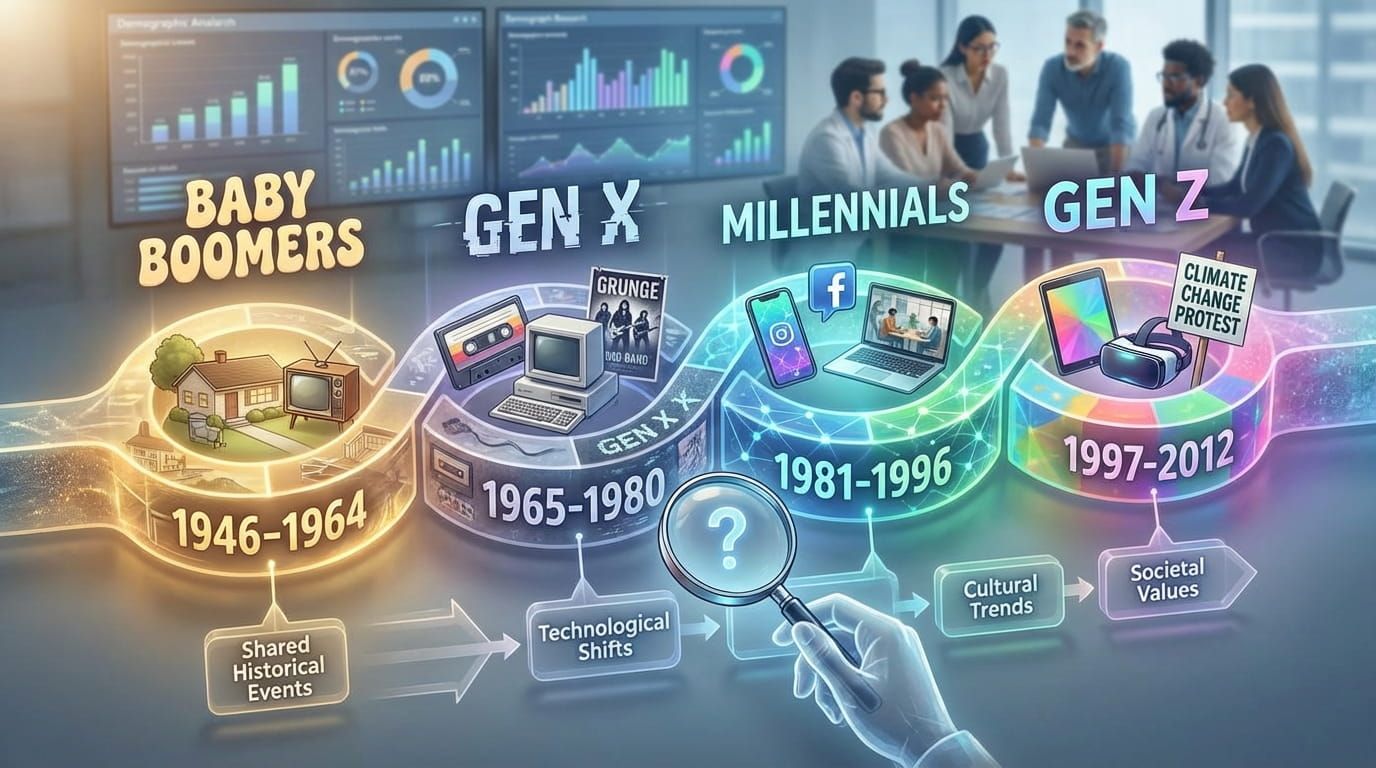
The table below shows a widely used set of ranges. It is not the only set. Still, it matches what many people expect in everyday conversation. If you are on the boundary, treat it as a shared border, not a hard wall.
Edge Years, Micro Cohorts, And The Feeling Of Not Fitting
If you were born near a boundary, you might feel pulled both ways. That is normal. A person born in 1996 and a person born in 1997 can share many experiences, especially if they grew up in the same place. Yet a chart can label them differently. The label changes, but the lived story might not.
That is why people sometimes use micro cohort ideas. You may have heard terms like xennial or zillennial. These are informal blends meant for boundary years. They are not official, but they often capture a real shared vibe, especially around tech adoption and schooling timing.
If you want a label that matches a specific set of ranges, it is better to use a single consistent tool. That way you are not swapping charts mid conversation. A generation finder helps you map your birth year to a label using one coherent set of boundaries.
Why Cutoff Years Change Between Sources
Cutoff years shift for a few practical reasons. Some sources use a fixed year span, often fifteen or sixteen years, because it keeps the cohorts even. Others anchor boundaries to major events, because it fits the narrative. Some adjust the end year when new data arrives, because the youngest members are still growing up and patterns become clearer over time.
- Different goals, researchers may focus on economics, marketing, health, or education.
- Different events, one chart may anchor to a tech shift, another to a political era.
- Different data, surveys and census groupings can push boundaries a year or two.
- Different regions, a global chart can differ from a country specific chart.
- Different life stage markers, schooling start ages and graduation years vary.
Age Systems Around The World Can Shift The Story
Even the concept of age is not always counted the same way everywhere. That matters because generation talk often assumes a shared age counting system. In some cultures, traditional systems count age differently from the international standard. A person may be considered a year older under a local method, especially around the new year.
If you have ever been confused by that, international age and korean age can help you understand why two ages can both be correct, depending on the rule set. This does not change your birth year, but it can change how people talk about your age in everyday life.
Leap Years And The Tiny Math That Can Create Big Confusion
Generation labels do not depend on leap years. Still, real age calculations do. If you were born on February 29, your birthday moves across calendars in a special way. Even if you were not, leap days add real days to the calendar, and that can affect exact counts between dates.
For people who want clean math, leap year math and accurate calendar age counting is worth a read. It explains why calendar math is not just dividing days by 365. This matters for legal thresholds, timelines, and personal milestones.
Legal Milestones, Eligibility, And The Limits Of Labels
Sometimes people try to use generations as a shortcut for eligibility. That can be risky. Laws usually care about your exact age on a specific date. If you need to check a milestone, you should rely on date math and local rules, not a label.
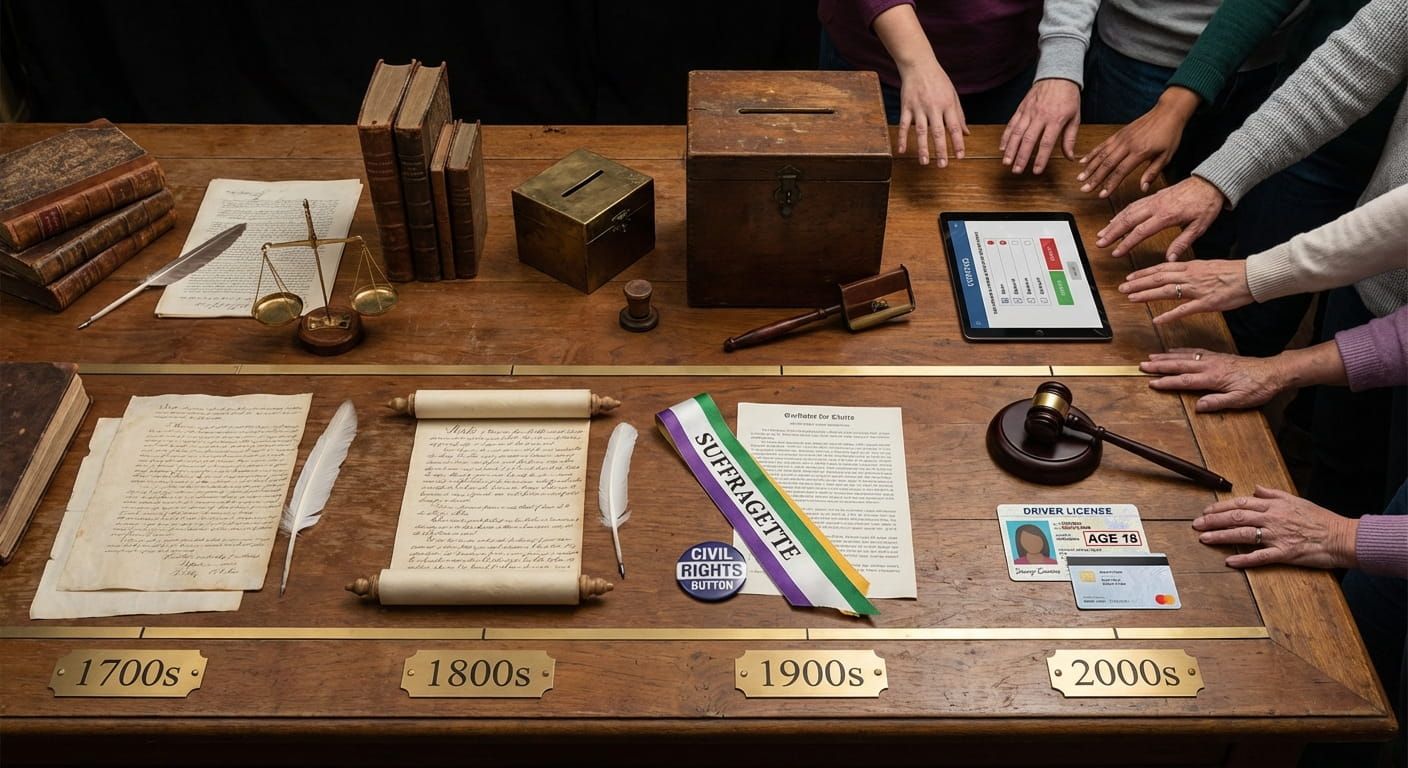
Voting is a clean example. Voting eligibility is usually tied to a specific birthday, sometimes with registration deadlines. A generational label cannot tell you whether you can vote in your jurisdiction. If you are checking the age requirement, voting eligibility gives a clearer answer based on actual dates.
- Labels are for shared context and shared culture.
- Age calculations are for deadlines, forms, and rules.
- Cutoffs depend on the chart, not on your identity.
- Boundary years often relate to both cohorts.
- Region can shape which events mattered in your childhood.
How Time Tools Make Generational Talk More Useful
Generations can be fun, but they become far more useful when you pair them with time tools. That is the heart of how the age tools on Time.now are meant to work. You can use a label to place yourself in a broad cohort, then use date math for everything that needs precision.
One playful way to feel time is to view your age in a different unit. Seeing your timeline in seconds turns the abstract into something you can feel. It also highlights that age is not just a number in years, it is an accumulation of moments. If you want that perspective, age in seconds gives you a vivid count that updates based on the calendar.
Using The Table With Confidence In Real Conversations
If you want a practical way to talk about generations without getting trapped in arguments, try this approach. State the range you are using. Then acknowledge that other charts exist. People tend to relax when they realize you are not claiming a single universal truth.
Here is a simple script you can use in a friendly chat. It keeps things light, and still accurate.
Conversation line
I use the 1981 to 1996 range for millennials, but I know some charts shift the edges by a year. What matters more to me is what you grew up with, not the label.
A Simple Checklist For Assigning A Birth Year Label
If you want a repeatable method, use this checklist. It keeps you consistent and avoids mixing charts.
- Pick one source table and stick to it for the whole discussion.
- Match the birth year to the range, ignore months and days for labels.
- Flag boundary years, mention that the label can vary by chart.
- Add context, region, school timing, and tech access can shift lived experience.
- Use exact date math for anything official, deadlines, eligibility, milestones.
Closing The Loop Between Labels And Real Time
Generations are a map, not the territory. A map is useful because it simplifies. It is also limited because it simplifies. If you treat a label as a starting point, it can help you connect your story to a wider era. If you treat it as a strict identity badge, it can turn into a pointless argument about the border.
The best balance is simple. Use year ranges to pick a label. Use time math to answer real questions about age. That way you can talk about culture with ease, and still handle dates with precision.