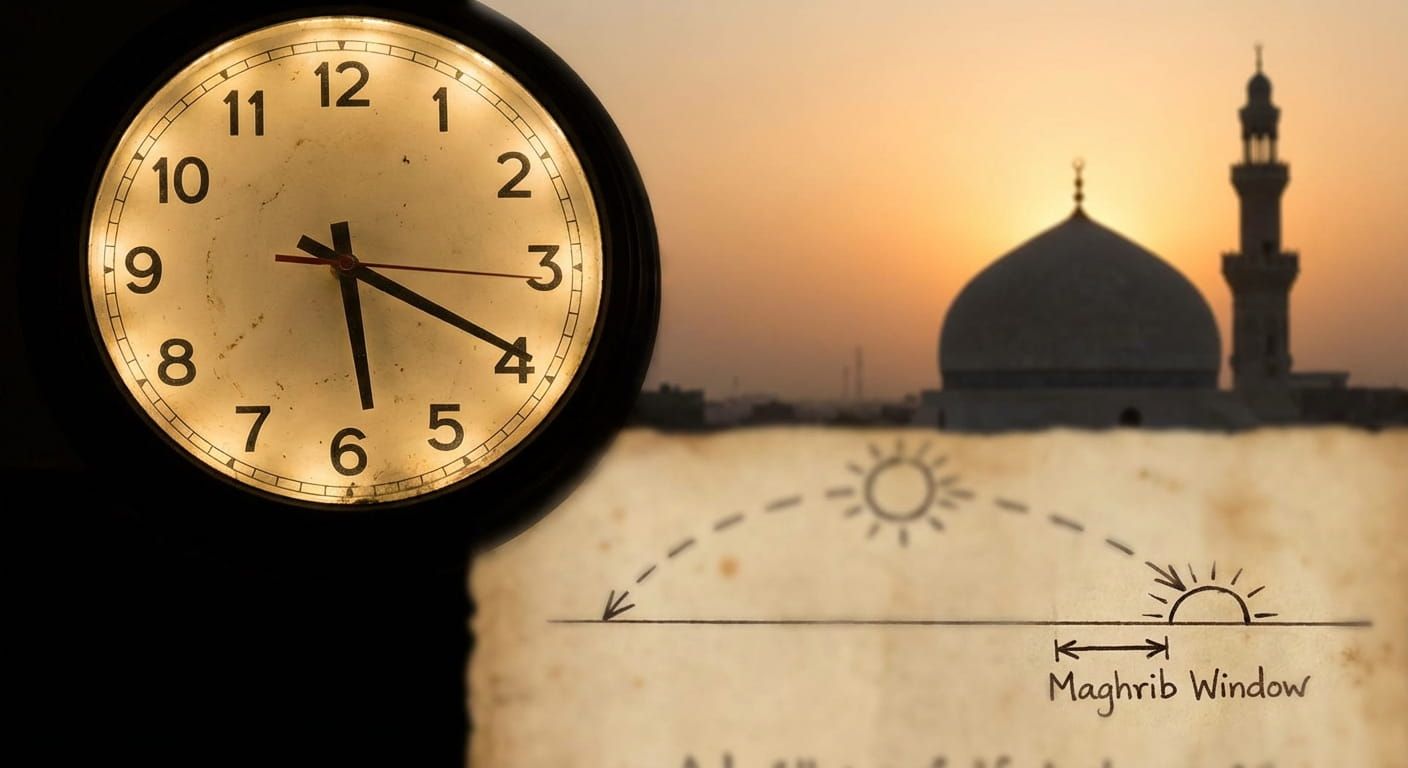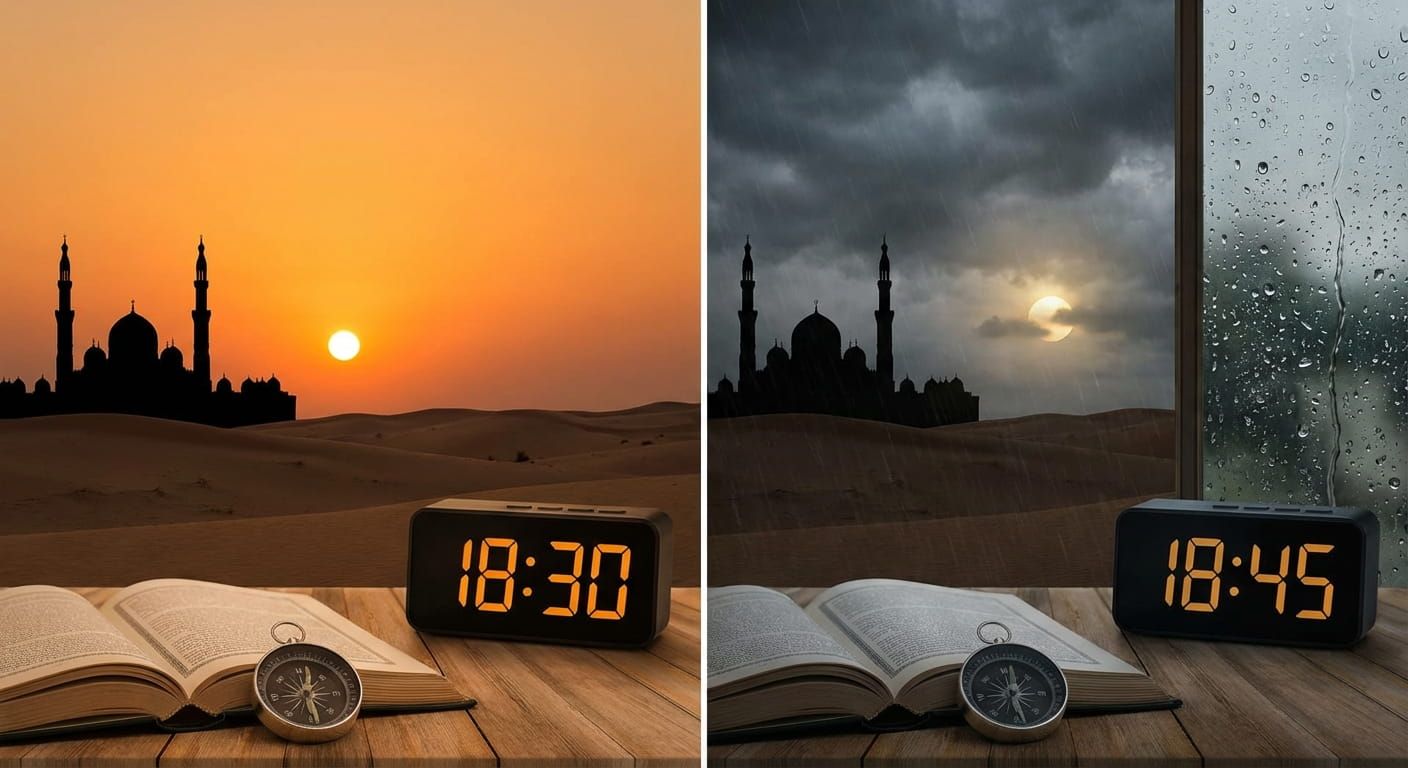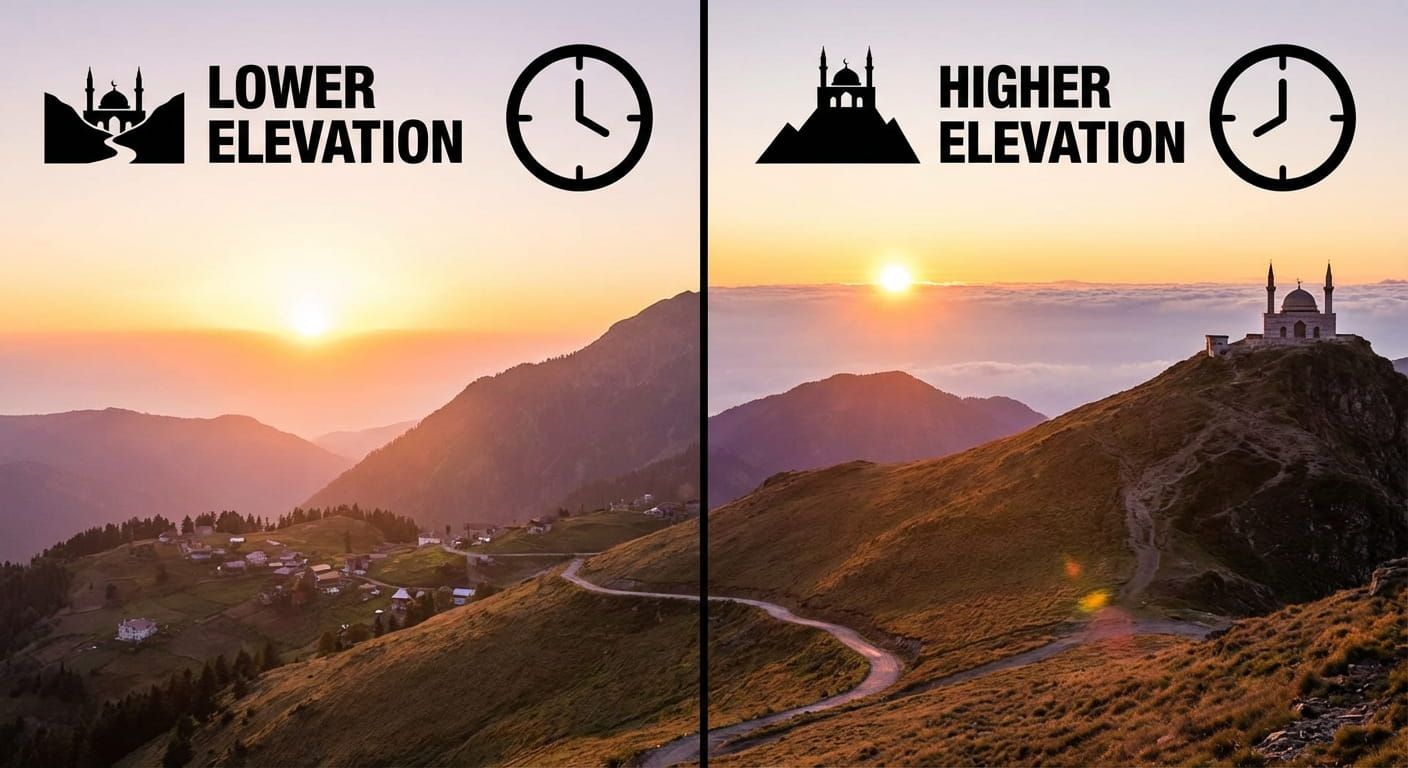
Sunset looks simple from the street. It is not always simple from the top of a tower or halfway up a mountain. Maghrib begins when the sun has actually set for the person who is praying, and that moment can shift a little if you are far above ground level. A higher viewpoint lets you keep seeing the sun for longer, which means Maghrib can begin later than the time shown for people at lower elevation.
Key takeaway
Yes, elevation can affect Maghrib prayer time at sunset. The higher you are, the later the sun disappears below your horizon. A useful rule of thumb is about 1 minute of delay for every 150 meters to 170 meters of elevation, or roughly 35 to 40 seconds per 100 meters. Small height differences rarely matter, but very tall buildings and mountain viewpoints can make a real difference.
Try this sunset check
Pick the best answer, then tap the button.
How A Higher View Delays Sunset
Maghrib is tied to sunset. That point sounds fixed, yet your visible horizon changes when your height changes. From a rooftop, the horizon drops slightly. From a mountain ridge, it drops more. From a very tall tower, the change becomes large enough to notice with a watch.
The reason is geometry. Earth curves away from you. As your eye level rises, your line of sight stretches farther before it meets the curved surface. That lets you keep seeing the sun a bit longer. The effect is tiny at ordinary heights, stronger on mountain roads, and very clear in supertall buildings.
How Much Later Per 100 Meters
A practical rule helps more than a heavy formula. For everyday use, you can think of the delay as roughly 35 to 40 seconds for every 100 meters of extra height. Another way to say it is about 1 minute for every 150 meters to 170 meters. The exact figure moves a little with latitude, atmospheric refraction, and the season, but that rule is good enough to explain the pattern.
Here is the simple idea in plain terms.
- At ground level, sunset is recorded for a standard local position.
- Go higher, and your visible horizon drops.
- The sun needs extra time to sink below that lower horizon.
- The extra time builds gradually with height.
- In very tall buildings, the delay can become several minutes.
That means a balcony on the fifth floor is rarely a major issue. A prayer room on the 120th floor is a different story. A mountain lookout above a city can also shift the timing enough to matter.
A useful line to keep in mind
If you can still see the disk of the sun, Maghrib has not started for you yet, even if people below have already broken fast or started prayer.
Should You Adjust Maghrib For Altitude
In ordinary daily life, many people simply follow the local timetable. That works well for homes, shops, streets, and normal apartment heights. Timetables are made for general use, and the difference across a typical neighborhood is often too small to create hardship.
Adjustment becomes more relevant in places where elevation is far above the local baseline. A few common cases stand out.
- Mountain roads or hilltop residences above the city plain
- Observation decks and upper floors in very tall towers
- Restaurants or prayer spaces in supertall skyscrapers
- Locations where people can clearly still see the sun after the posted time
Islamic practice centers on the actual setting of the sun. That is why some high rise buildings adopt their own internal guidance for upper floors. If the sun is still visible at your level, waiting until it disappears is the safer approach. If you cannot observe the horizon yourself, a trusted building guideline can help.
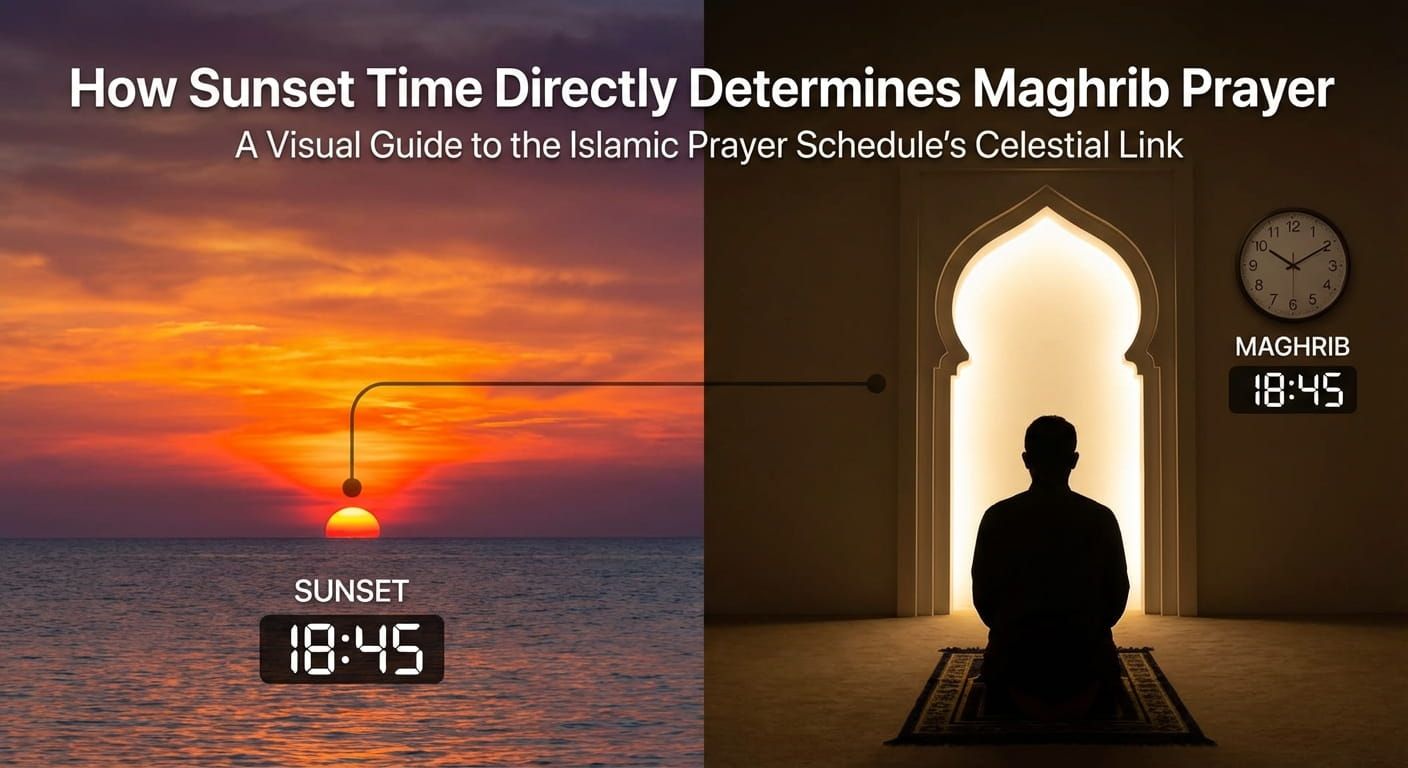
Anyone comparing sunset and prayer timing may also benefit from reading how Maghrib is tied directly to sunset, because that principle sits at the heart of the altitude question.
What Happens In Burj Khalifa
Dubai gives one of the clearest modern examples. Burj Khalifa is tall enough that sunset is not one single moment from bottom to top. People on lower levels lose sight of the sun earlier than people on the upper levels. That gap is not academic. It is visible and measurable.
Using the rule of roughly 35 to 40 seconds per 100 meters, the delay becomes meaningful fast. Burj Khalifa rises well past 800 meters. Even if you only compare public or occupied zones rather than the full structural height, upper floors can be several minutes behind the ground. That is why different floor bands may follow slightly different Maghrib times.
For daily checks in the city, Maghrib in Dubai gives a strong baseline. The same idea can matter in other skyline heavy places too, including Maghrib in Istanbul, Maghrib in London, Maghrib in New York City, and Maghrib in Singapore, where tall buildings can change what residents actually see at sunset.
Practical Examples From Cities And High Ground
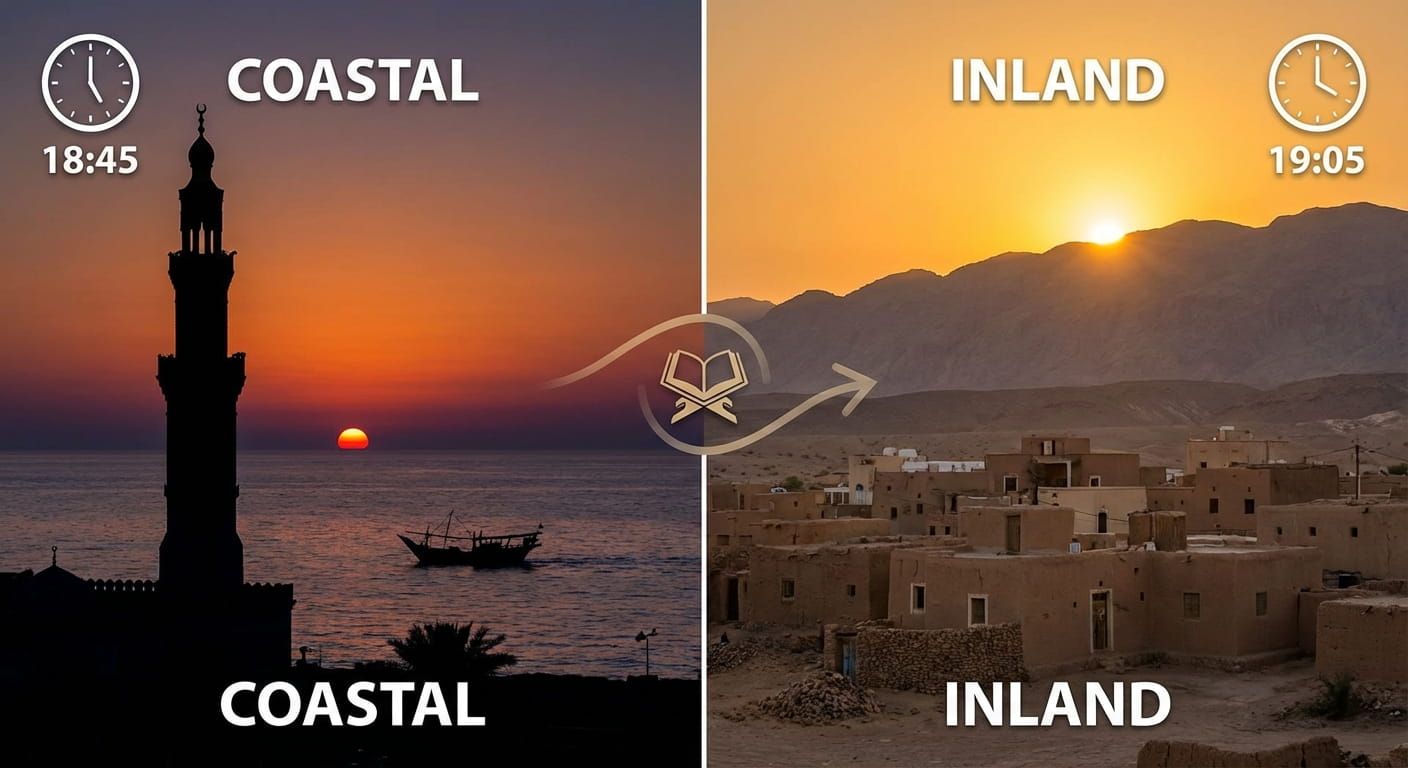
A person at street level in Riyadh and another person on a much higher floor may not lose sight of the sun at the same instant. The gap may be small, yet the principle remains the same. The effect becomes stronger in mountain cities and plateaus. That is why someone overlooking a valley may still see sunlight after people below have entered Maghrib.
Think about these settings.
- A hilltop home above Cairo with a broad western horizon
- A tower apartment in Kuala Lumpur facing open sky
- A hotel deck in Mecca during a clear sunset
- A high residential block in Karachi or Lagos
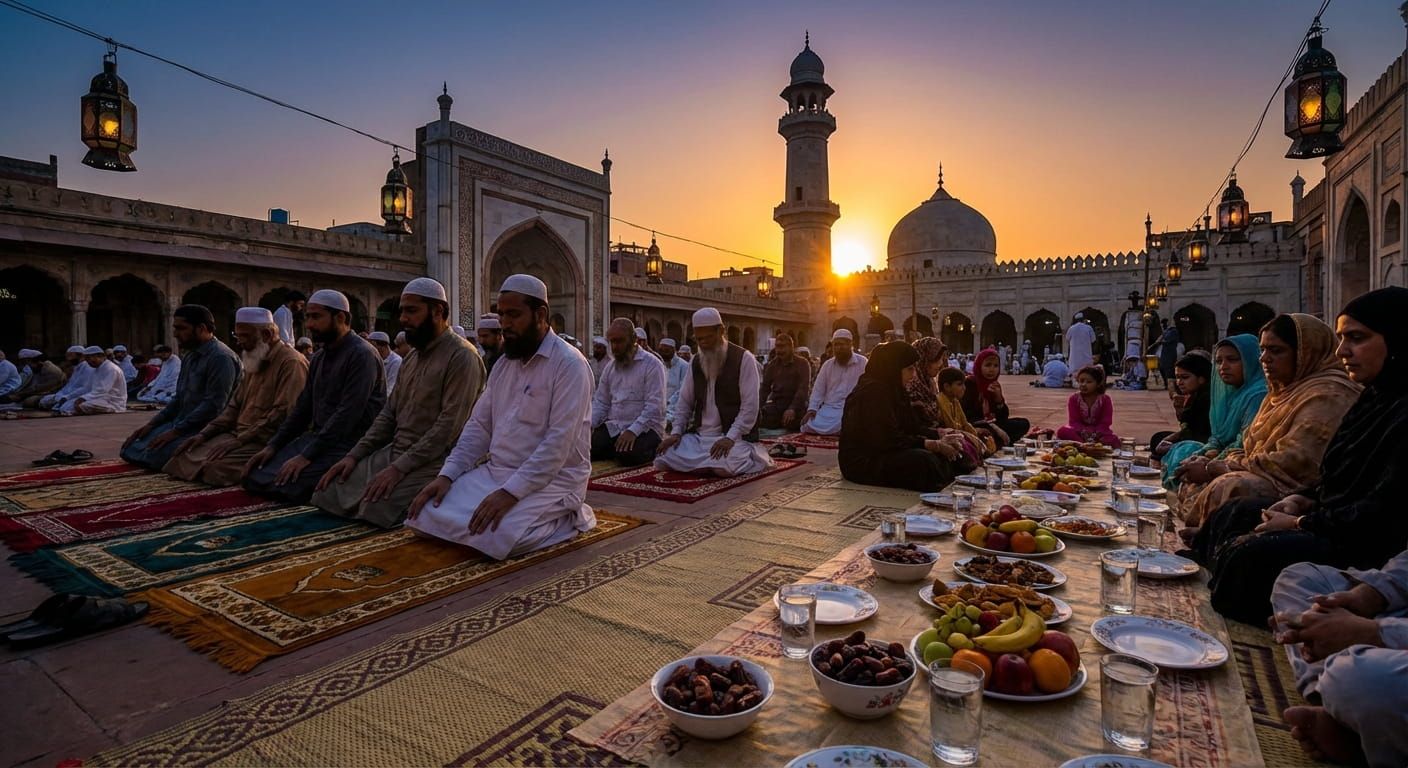
For people fasting in Ramadan, this can feel especially sensitive, because iftar follows Maghrib. That is why many readers also compare altitude questions with Ramadan timing through Maghrib and iftar timing. The concern is not just theory. It affects the moment someone breaks the fast.
Reading tip
If you live or work high above ground, compare the posted local time with what you can actually observe. If the sun is still visible, wait for it to disappear. If you cannot observe it, check whether your building or local mosque has floor specific guidance.
Does This Change The Prayer Window
The start of Maghrib may move later with altitude, but the prayer itself remains short in relation to the evening schedule. In places where twilight moves fast, that small delay can make the window feel tighter for those at high elevation. Readers thinking about that side of the issue may want to read how Maghrib often has the shortest prayer window.
For city by city references, it can also help to compare posted prayer times in Maghrib in Cairo, Maghrib in Riyadh, Maghrib in Mecca, and Maghrib in Kuala Lumpur. Those pages give a useful base, while your actual viewpoint explains small differences in real sighting.
The Sunset Rule That Keeps It Clear
The cleanest answer is also the oldest one. Maghrib starts at sunset for the person observing it. Height can delay that moment because higher places keep the sun in view for longer. In everyday life, the delay is often tiny and most posted timetables work just fine. In mountains and supertall towers, the delay can stretch into real minutes, enough to justify a careful adjustment.
That is why altitude does affect Maghrib, though not always in a way you notice. A street, a low roof, and a modest apartment block may show almost no meaningful gap. A summit road or a place like Burj Khalifa can show a gap large enough that ignoring it would miss the point of sunset itself. Keep the principle simple. If the sun is still visible from where you are, Maghrib has not begun for you yet.