Understanding Dhuhr Prayer Times and Calculation Methods

Midday prayer seems simple until you notice that the clock and the sun do not always agree. Dhuhr begins after the sun passes its highest point in the sky for a specific place on a specific day. That single rule explains why one city can pray earlier than another, why the time changes during the year, and why 12:00 PM is often only a rough social label rather than the true start of Dhuhr.
Key takeaway
Dhuhr starts just after solar noon, the moment when the sun reaches its highest daily point and begins to decline. That is why Dhuhr is not always at 12:00 PM. Longitude, time zones, daylight saving time, and local calculation preferences all affect the clock reading. Different madhabs agree on the core principle, while some schedules add a small safety margin after zenith before showing the posted Dhuhr time.
Test Your Understanding Of Dhuhr Timing
These questions reinforce the main ideas and keep the article practical.
1. What marks the beginning of Dhuhr?
2. Why is Dhuhr often not at 12:00 PM?
3. Do madhabs disagree about the basic start of Dhuhr?
How Solar Noon Sets The Start Of Dhuhr
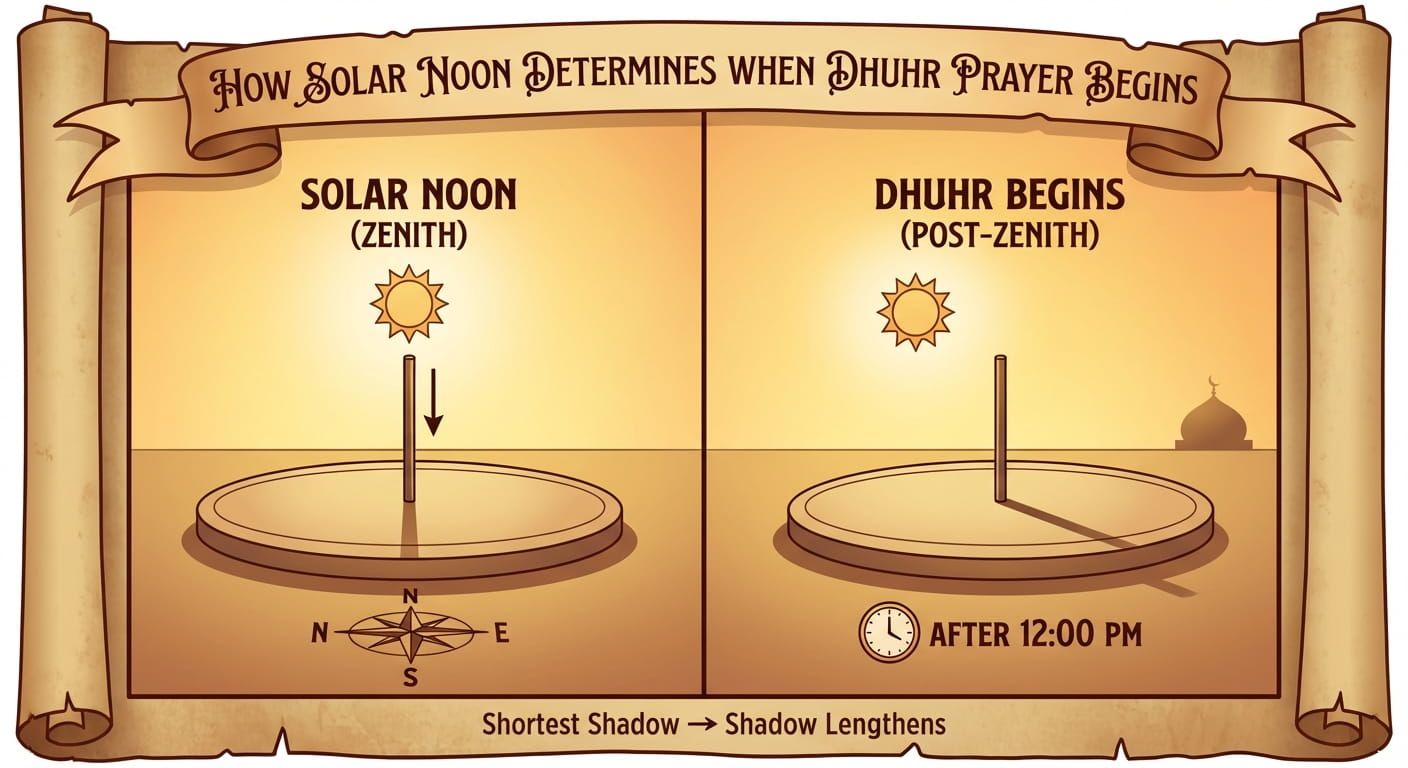
Dhuhr is tied to the movement of the sun, not to a fixed label on a watch. Solar noon is the moment when the sun reaches its highest point in the sky for your location on that date. At that instant, the sun stops climbing higher and begins its decline. That shift from ascent to descent is the point that matters for Dhuhr.
This is the reason prayer time charts use astronomy in the first place. The beginning of Dhuhr is not based on a general sense that the day feels bright or warm. It depends on a measurable solar event. Once the sun has passed its local highest point, Dhuhr has entered.
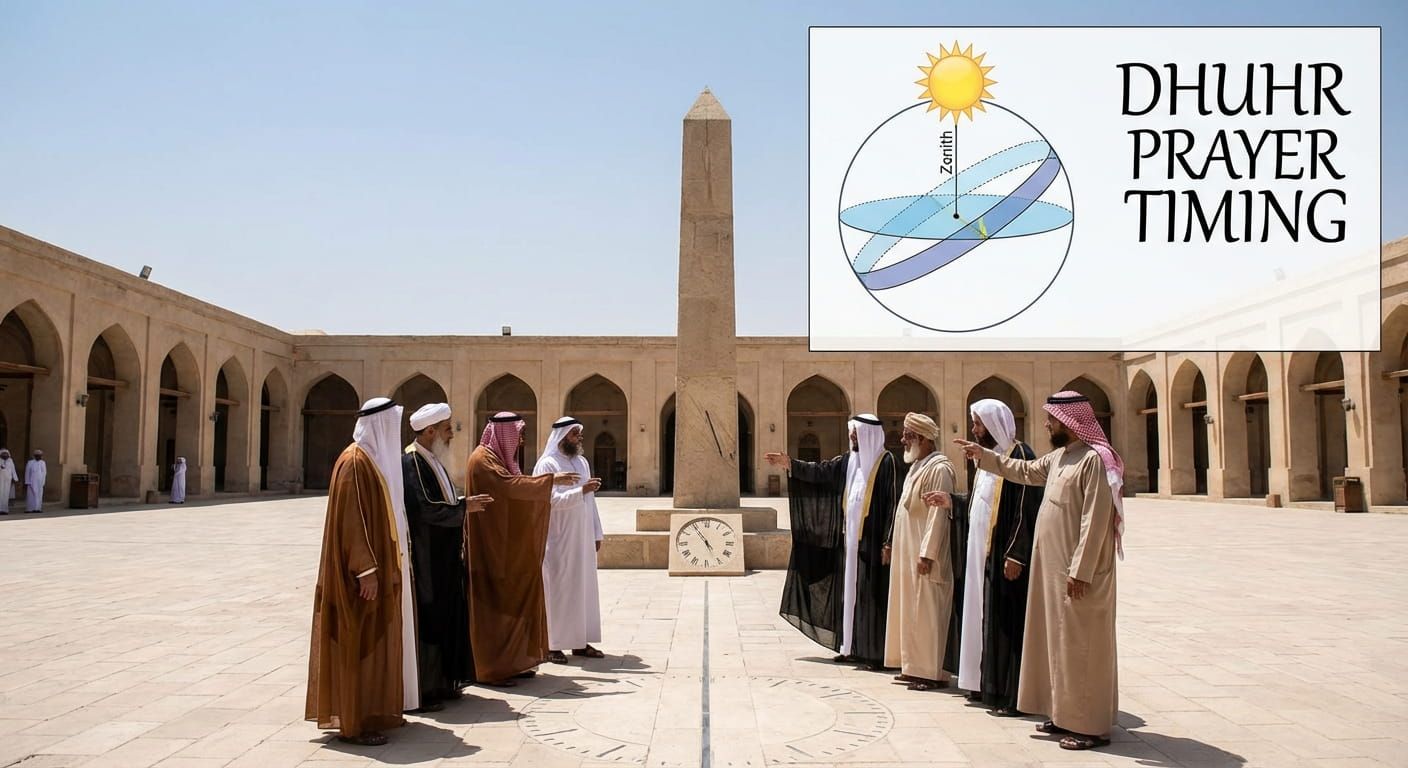
Many people picture solar noon as the moment the sun is directly overhead. That can happen in some places at certain times of year, yet the more important rule is local culmination, the highest altitude the sun reaches for that place on that day. Whether you are checking Dhuhr prayer times for a major city or a smaller location, the core principle remains the same.
That highest point does not last as a wide block of time. It is a precise boundary. Prayer charts then translate that boundary into a posted local time for ordinary use. This is where careful calculation becomes useful, because the exact clock reading will vary by location and date.
Quoted idea: Dhuhr belongs to the sky before it belongs to the clock. The clock is only the local translation of the sun’s turning point.
Why Dhuhr Is Not Always At 12:00 PM
The most common misunderstanding about Dhuhr is the belief that it must always begin at 12:00 PM. That sounds reasonable at first glance because many people use noon as a casual label for the middle of the day. Yet civil noon and solar noon are not the same thing.
Clock time is built around time zones, political boundaries, national standards, and seasonal rules. Solar noon is built around the actual position of the sun over your location. Those two systems overlap only loosely. In some places they may sit fairly close together. In others they can differ by a large margin.
Several factors explain the gap:
- Time zones are broad. A single time zone covers many longitudes. That means people on the eastern edge and western edge of the same zone do not experience solar noon at the same clock minute.
- The equation of time shifts apparent solar time. Earth does not orbit the sun in a perfect circle, and its axis is tilted. Because of that, the sun does not cross the local meridian at the same clock offset every day of the year.
- Daylight saving time can move the displayed clock forward. The sun does not change its path, yet the local watch changes by law.
- Prayer charts often add a slight post zenith margin. This helps ensure that the exact zenith moment has passed before Dhuhr is shown as having entered.
That is why a person checking Dhuhr time London may see a result that differs clearly from 12:00 PM, while a person checking Dhuhr time Cairo may find another figure entirely. Both are still correct because both are based on local solar reality.
The Brief Period Right After Zenith
One detail deserves special attention. Dhuhr begins after the sun passes zenith, not during the exact zenith moment itself. The point of culmination is a boundary. Because of that, many prayer schedules treat the start of Dhuhr as beginning just after the sun has clearly moved into decline.
This short interval can look tiny on the clock, yet it matters in legal and practical terms. In daily life, many worshippers simply follow the posted time in a trusted prayer schedule. Behind that posted time, though, there is often a deliberate effort to avoid uncertainty right at the boundary.
The idea is simple:
- The sun reaches its highest point.
- That highest point marks the turning boundary.
- Once the sun begins to decline, Dhuhr enters.
- Timetables may add a small buffer to represent that safely.
This is why some charts do not show Dhuhr at the exact computed solar noon minute. Instead, they show it a minute or two later. That does not change the rule. It is a careful application of the rule.
Longitude And Why Local Midday Changes From Place To Place
Longitude is one of the clearest reasons Dhuhr shifts between locations. Earth rotates from west to east. Because of that, places farther east experience local solar noon earlier than places farther west. The sun reaches each meridian at a different time.
People often miss this because official clocks smooth over local differences. The watch makes a wide region feel uniform, yet the sun still follows local geography. If two cities share the same time zone, they can still have noticeably different Dhuhr times because they sit at different longitudes.
This becomes easy to see with real examples. A reader comparing Dhuhr time Istanbul with Dhuhr time Riyadh is comparing two distinct longitudes, two local solar patterns, and two posted midday prayer times. The same is true when comparing Dhuhr time Dhaka with Dhuhr time Karachi.
Longitude also explains why two people in one nation may not share the same exact Dhuhr minute. Countries are not solar points. They are geographic spaces. Prayer time calculation respects that by using coordinates, not just a country name.
How The Equation Of Time Changes Dhuhr During The Year
Even if you never leave your city, Dhuhr still moves through the calendar. A major reason is the equation of time. This term describes the difference between the apparent movement of the real sun and the even pace of mean solar time used in clocks.
Earth’s orbit is slightly elliptical, and Earth’s axis is tilted. Those two features combine to make the sun appear faster on some parts of the yearly cycle and slower on others. Because of that, solar noon is not pinned to one clock minute all year long.
This explains why a person following Dhuhr time Singapore will still see modest movement from month to month, even though day length near the equator is less dramatic than in high latitude regions. The same pattern shows up in Dhuhr time Jakarta, Dhuhr time Kuala Lumpur, and Dhuhr time Manila.
In other words, Dhuhr changes for two main reasons. One is location. The other is date. A reliable schedule must account for both.
How Different Madhabs Approach Dhuhr Calculation Preferences
The four Sunni madhabs agree on the central rule that Dhuhr starts after the sun passes zenith. That agreement is the foundation. The variation people notice in prayer charts usually comes from timetable practice rather than a disagreement over the basic start of Dhuhr.
Some schedules add a short delay after calculated solar noon to make sure the zenith boundary has passed cleanly. Some communities follow official regional calendars or mosque board standards. Others use digital services with built in settings. These differences are often small, yet they matter because prayer time must be both accurate and usable.
Many readers also hear about madhab differences in relation to Asr. That discussion is more directly tied to the end of Dhuhr and the beginning of Asr than to the actual start of Dhuhr. Still, it can influence how prayer applications present a full daily chart. A person reviewing Dhuhr time Mecca or Dhuhr time Medina may be seeing a timetable shaped by trusted local standards that are consistent with juristic practice.
Practical differences can appear in these areas:
- A slight post zenith buffer in the displayed start time
- Settings that pair Dhuhr with a chosen Asr method
- Regional habits based on mosque authorities or national religious institutions
- Published timetables that favor clarity for the public
The important point is that the solar basis stays the same. The timetable details sit on top of that stable core.
The Role Of Daylight Saving Time In Dhuhr Schedules
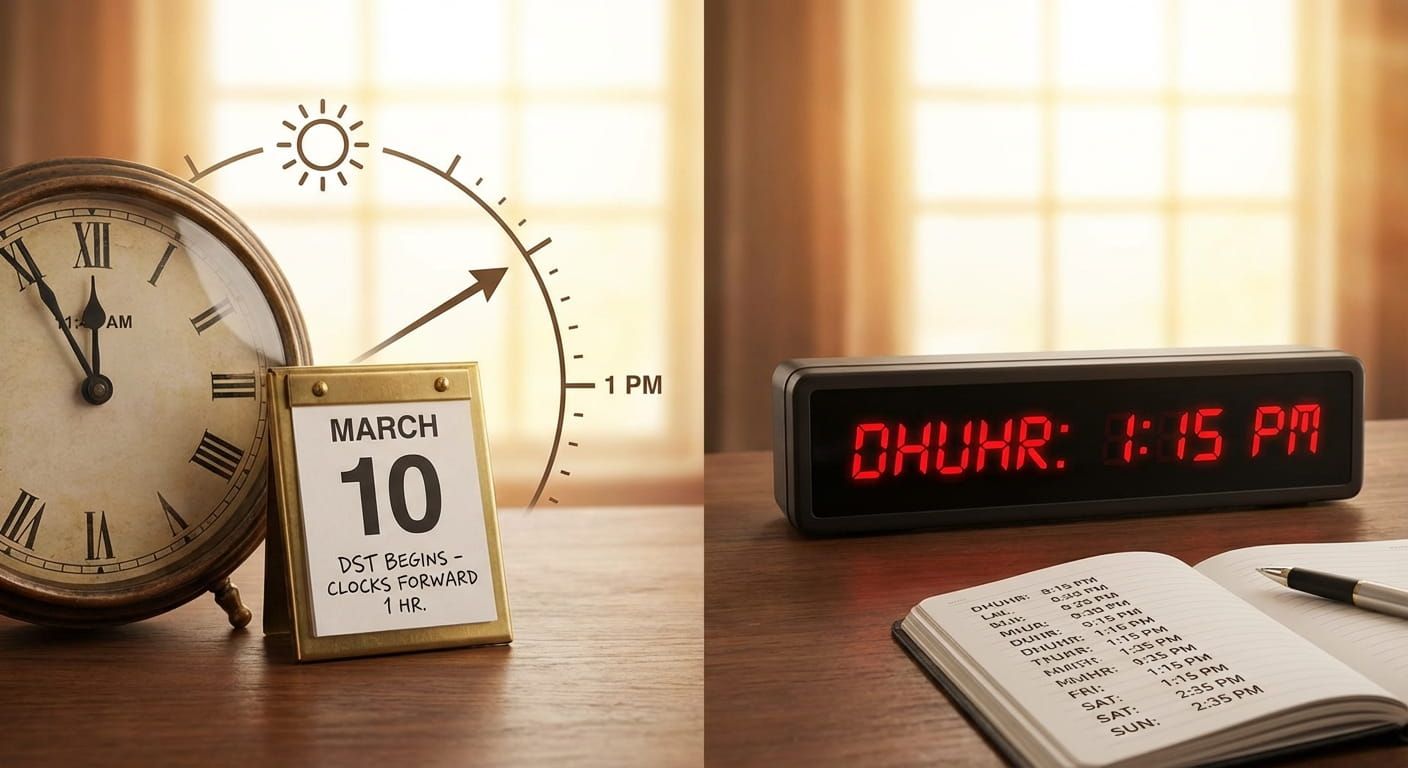
Daylight saving time can make Dhuhr look confusing because it changes the civil clock while leaving the sun untouched. When the clock moves forward by one hour, the posted Dhuhr time also appears one hour later in daily life, even though the sun still reaches its highest point according to the same astronomical pattern.
This matters in many parts of Europe and North America. A reader checking Dhuhr time Paris, Dhuhr time Berlin, or Dhuhr time Rome may notice a strong seasonal jump on the posted schedule. That jump is not a sign that the prayer has drifted away from solar noon. It is a sign that the legal clock has changed.
The same issue appears in western cities across the Atlantic. Comparing Dhuhr time Chicago with Dhuhr time Houston during a daylight saving period shows how civil law interacts with local solar calculation. The prayer remains rooted in solar noon. The public display is converted into the legal time now in force.
Key point: Daylight saving time does not alter the sun’s highest point. It only changes the number shown on the clock that people use to organize the day.
Why Nearby Cities Can Show Different Midday Prayer Times
Two nearby cities can still show different Dhuhr times for sound reasons. Longitude is the main one, but local coordinate choices, regional standards, and timetable settings also play a part. The differences are usually small, yet they are meaningful.
Compare Dhuhr time Mumbai with Dhuhr time Delhi. The two cities do not share identical solar conditions, even though both belong to the same country. Compare Dhuhr time Tokyo with Dhuhr time Seoul. Their posted times also differ because local noon is not universal.
This is why city pages matter. A prayer timetable that ignores place would flatten real solar variation. A careful timetable keeps the local character of midday intact.
How Modern Prayer Tools Calculate Dhuhr
A digital prayer time service turns a solar event into a readable daily schedule. The process usually starts with coordinates for the chosen city, the calendar date, the local time zone, and any calculation preferences used by the platform or community.
After that, the service calculates local solar noon. Then it translates that result into the civil clock used in that city. If a post zenith margin is part of the method, that is added before the time is displayed. The result is the Dhuhr time that appears on the page.
The sequence usually looks like this:
- Find the exact location of the city.
- Apply the correct date and time zone rules.
- Calculate solar noon for that location and date.
- Add any local cautionary offset after zenith.
- Display the final Dhuhr time in the local clock format.
This method is what makes city specific pages genuinely useful for travel and daily life. A person checking Dhuhr time Los Angeles needs a different result from a person checking Dhuhr time New York City. The sun demands it.
Examples From Major Cities Across The World
The global spread of Dhuhr times makes more sense once you compare real places. A reader reviewing Dhuhr time Dubai is dealing with a different longitude and civil structure from someone following Dhuhr time Lagos. Both schedules are valid because both are local.
In Africa, the pattern continues with Dhuhr time Khartoum, Dhuhr time Nairobi, and Dhuhr time Cape Town. These cities sit in different regions, different longitudes, and different seasonal patterns, yet the rule remains steady. Dhuhr begins after solar noon.
Asia shows the same principle vividly. A person checking Dhuhr time Bangkok may notice that the posted time does not match the posted time in Dhuhr time Beijing or Dhuhr time Shenzhen. National systems, longitudes, and local solar behavior all shape the final clock reading.
In the Americas, city comparison is also revealing. Dhuhr time Toronto, Dhuhr time Mexico City, and Dhuhr time Bogota all point back to the same principle while showing different local outcomes. South of the equator, Dhuhr time Rio de Janeiro and Dhuhr time Sydney remind readers that hemisphere changes do not alter the legal basis of Dhuhr.
Europe adds a valuable lesson because time zones and seasonal clock rules can create a wider gap between solar noon and civil noon than many expect. A person comparing Dhuhr time Madrid and Dhuhr time Amsterdam can see how legal clock structure shapes the posted result without changing the solar foundation.
Common Misunderstandings About Dhuhr Calculation
Clear explanations help because several myths keep returning in conversation and online writing.
- Myth: Dhuhr must start at 12:00 PM. Reality: Dhuhr begins after local solar noon, which often does not match 12:00 PM.
- Myth: All cities in one country should share one exact Dhuhr minute. Reality: Longitude and local calculation settings create real differences.
- Myth: Daylight saving time changes the prayer itself. Reality: It changes the displayed legal clock, not the solar basis.
- Myth: Small differences between prayer charts prove one must be wrong. Reality: Small differences often come from local coordinates, regional standards, or cautionary offsets.
- Myth: Madhab related discussions mean the start of Dhuhr is uncertain. Reality: The shared basis is stable. Dhuhr starts after zenith.
What To Look For In A Reliable Dhuhr Time Source
A dependable source for Dhuhr should do more than publish a generic noon figure. It should reflect the city itself, the date itself, and the real local time rules in force.
- City specific location data instead of broad national estimates
- Correct handling of time zones and daylight saving rules where relevant
- A clear relationship to solar noon rather than a fixed 12:00 PM assumption
- Consistent daily updates across the calendar year
- A method that can support trusted community use
This matters for workdays, school schedules, travel plans, and mosque coordination. A person moving between cities should not assume noon prayer will feel identical on the clock. A traveler comparing Dhuhr time Melbourne with Sydney, or Dubai with Riyadh, will benefit from checking a city based source rather than relying on memory.
How To Think About Dhuhr In Daily Life
A useful mental model is this: Dhuhr begins just after the sun has peaked for your city and started to decline. That keeps the concept grounded and easy to remember. The watch then tells you the local civil expression of that event.
If the posted time is a little after what you casually think of as noon, that is normal. If a nearby city differs by a few minutes, that is normal too. If a summer clock change seems to push everything later, that is also normal. None of this weakens the connection between Dhuhr and the sun. It actually proves that the calculation is respecting real conditions.
That is part of what makes Dhuhr deeply meaningful. It ties worship to the natural order of the day while still allowing people to use modern tools with confidence. The prayer keeps its solar anchor. The timetable makes that anchor practical.
Reading The Midday Sky Through The Clock
Understanding Dhuhr becomes much easier once the core pieces are in place. Solar noon is the key turning point. Dhuhr begins after that point, not at a generic 12:00 PM label. Longitude changes local midday from one place to another. The equation of time moves solar noon through the calendar. Daylight saving time changes the legal clock without changing the sun. Different madhabs agree on the basic start, while published schedules may reflect small cautionary preferences after zenith.
Once those ideas come together, Dhuhr time stops looking random. It becomes readable. The posted figure on the screen is no longer just a number. It is the local clock translation of a real event in the sky, shaped by faith, geography, astronomy, and careful calculation all at once.
More Dhuhr Related Articles:

Why Dhuhr Prayer Time Is Not Always at 12 PM
Many people expect Dhuhr to begin right at 12 PM because that feels like the middle of the day on a clock. Real life is not that tidy. The Sun does...
How Solar Noon Determines When Dhuhr Prayer Begins
Stand outside near midday with a straight stick in the ground, and you can watch one of the clearest signs in daily life. The sun climbs, the shado...

The Role of Longitude in Calculating Dhuhr Prayer Times
Clock time looks neat on a map, but the sun does not move in neat blocks. That gap ...
How Daylight Saving Time Impacts Dhuhr Prayer Schedules
Twice a year, many people glance at the clock and feel a small jolt. Dhuhr looked settled, then daylight saving time arrived and the prayer seemed ...

Dhuhr Prayer Time Differences Between Major World Cities
Stand in New York City at midday in January, then check Dhuhr in Singapore on the same date, and the contrast tells a bigger story than a simple cl...
Understanding the Sun's Zenith and Dhuhr Prayer Timing
Midday feels simple until you look up and realize the Sun is doing something very exact. There is a brief moment when it reaches its highest point ...