Many people expect Dhuhr to begin right at 12 PM because that feels like the middle of the day on a clock. Real life is not that tidy. The Sun does not follow your wall clock with perfect loyalty. It follows the sky. That is why Dhuhr can arrive a little before noon in one place, a little after noon in another, and at noticeably different times across the year, even inside the same city.
Key takeaway
Dhuhr begins after solar noon, not simply when a clock shows 12 PM. Solar noon shifts because the Sun runs slightly fast or slow through the year, which can change by about 16 minutes, and because places within the same time zone sit east or west of the time zone center. That is why London usually does not hit Dhuhr at 12:00 PM, and why cities from Cairo to Sydney show different noon based prayer times.
Check Your Understanding
Pick the best answer, then tap the button.
Which statement explains Dhuhr most accurately?
Clock Noon And Solar Noon Are Not Twins
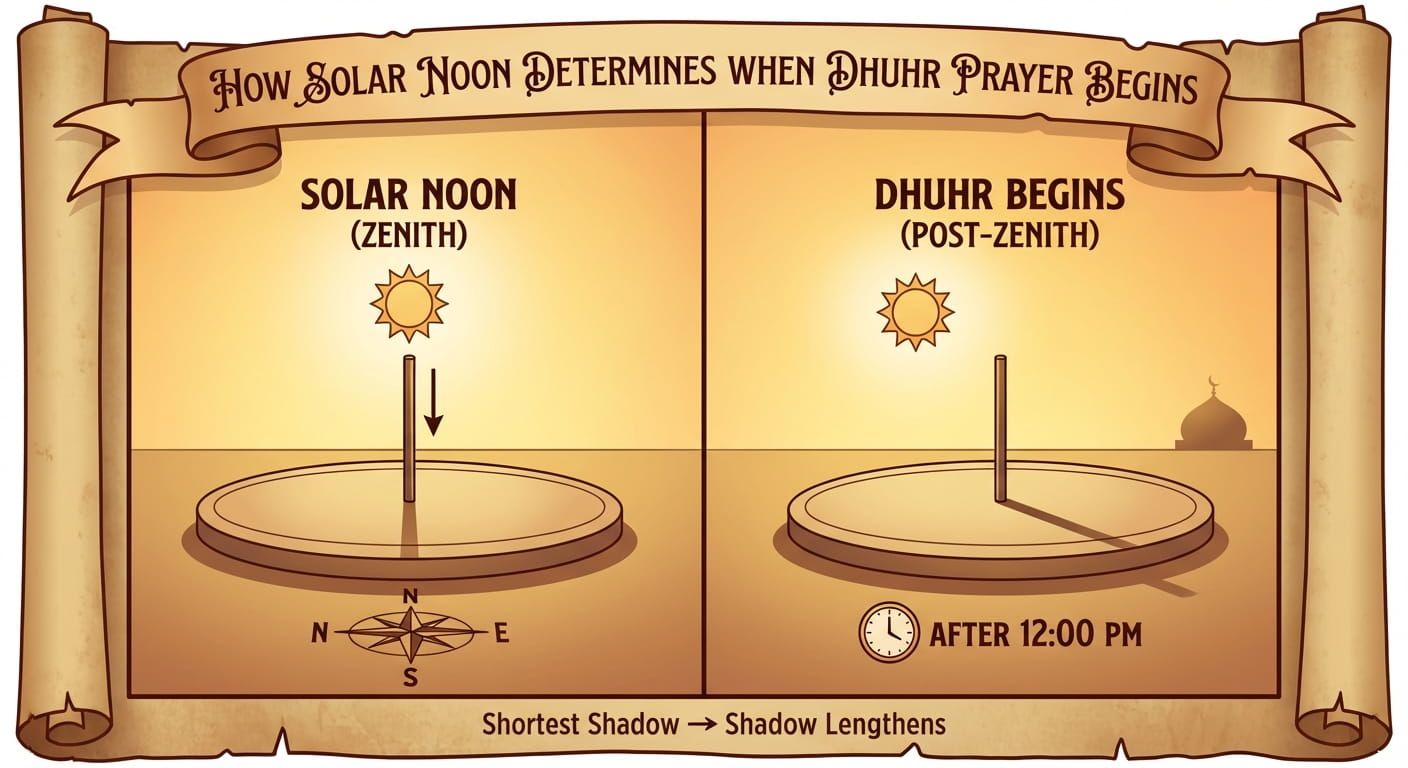
Clock noon is a human agreement. Solar noon is an astronomical event. Your clock reaches 12 PM because a time zone says it is noon. The Sun reaches solar noon when it climbs to its highest point in the sky for your location. Dhuhr begins after that moment.
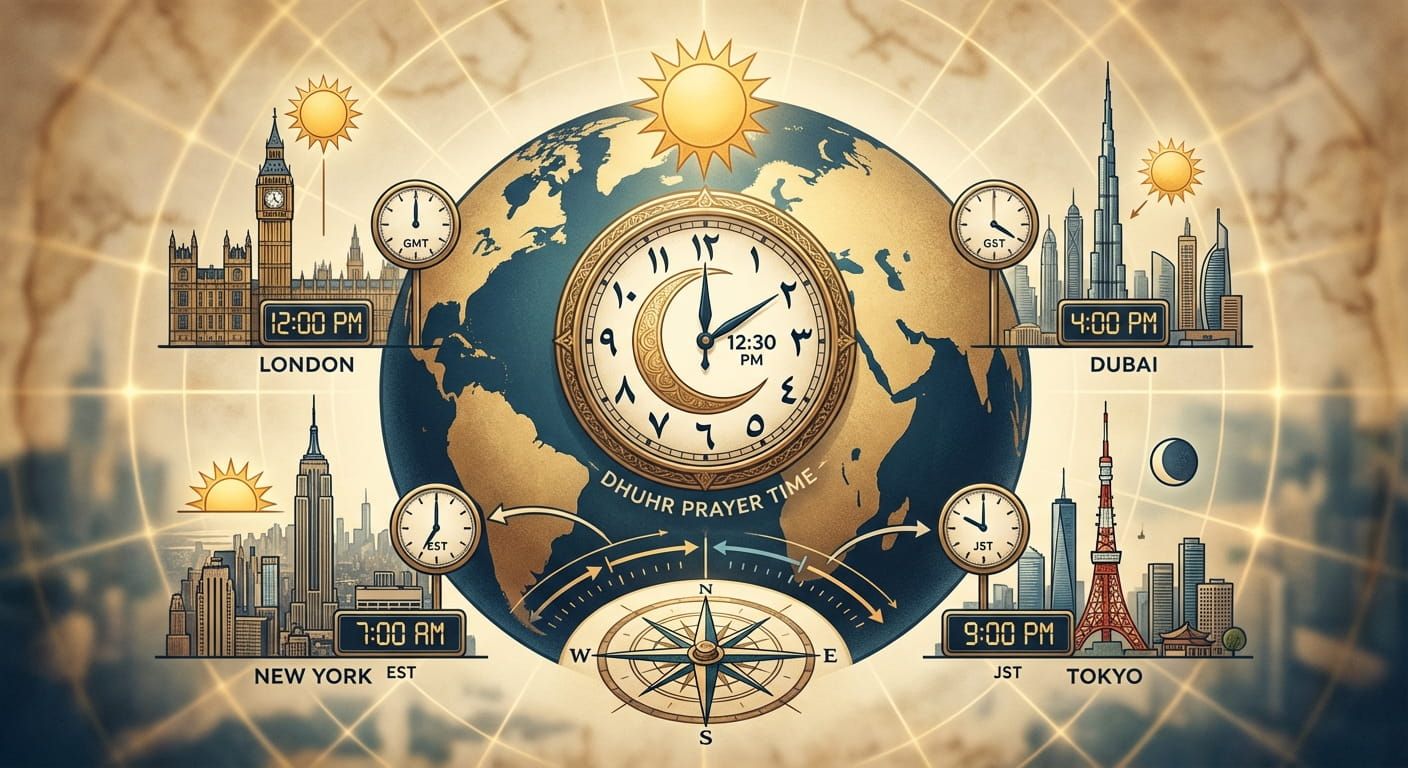
This difference matters more than many people expect. A time zone can cover a broad area. Everyone inside it may share one official time, yet the Sun reaches its highest point earlier in the east and later in the west. That means two cities can read the same clock while the sky tells a slightly different story.
Think of it this way: the clock is a legal schedule, the Sun is a physical event, and Dhuhr follows the physical event.
If you check Dhuhr time in London, you will notice that the listed start usually does not land on 12:00 PM. That is not a glitch. It is the result of how solar time works.
The Equation Of Time Moves Noon Around
One of the biggest reasons for this shift is the equation of time. That phrase sounds technical, yet the idea is simple. A real Sun day is not the exact same length every day of the year. Earth travels around the Sun on a slightly stretched path, and Earth tilts on its axis. Because of those two facts, the apparent Sun can run ahead of clock time or fall behind it.
Across the year, that difference can reach about 16 minutes. In some weeks, solar noon comes earlier than 12 PM local mean time. In other weeks, it comes later. Dhuhr moves with that change because it is tied to the Sun, not to a perfect mechanical noon.
That is why a single city does not have one permanent Dhuhr time. London changes through the seasons. Cairo changes. Jakarta changes. Lagos changes. Even places much closer to the equator still feel the effect, though the overall pattern of daylight differs from high latitude cities.
- The equation of time can push solar noon earlier or later across the year.
- Dhuhr begins after solar noon, which means prayer time also shifts.
- The shift is not an error in the timetable, it is built into how the sky works.
Longitude Inside A Time Zone Changes Local Noon
A time zone is wide. Solar noon is local. That creates a built in gap.
Each time zone is usually centered on a standard meridian. A city sitting east of that center meets solar noon earlier. A city west of that center meets it later. Every degree of longitude changes local solar time by about four minutes. That adds up fast.
Take a country or region with one shared clock but many cities spread across it. Their watches agree. Their skies do not. Someone in the eastern part reaches solar noon sooner than someone in the western part. Dhuhr starts sooner there as well.
This is easy to picture with cities spread across large areas. Prayer schedules in Riyadh, Karachi, Beijing, Mexico City, and Los Angeles all show noon based prayer times that reflect local position, not just the number printed on the time zone label. A person comparing Dhuhr time in Riyadh with Dhuhr time in Karachi can see how local geography shapes the timing, even before seasonal change is added.
Why London Rarely Matches 12:00 PM
London is a strong example because many people assume Greenwich means exact noon. That feels reasonable at first glance. Yet London still does not get Dhuhr at 12:00 PM most days.
There are a few reasons.
- The equation of time shifts solar noon earlier or later through the year.
- Prayer calculations place Dhuhr after solar noon, not simply when the clock flips to 12.
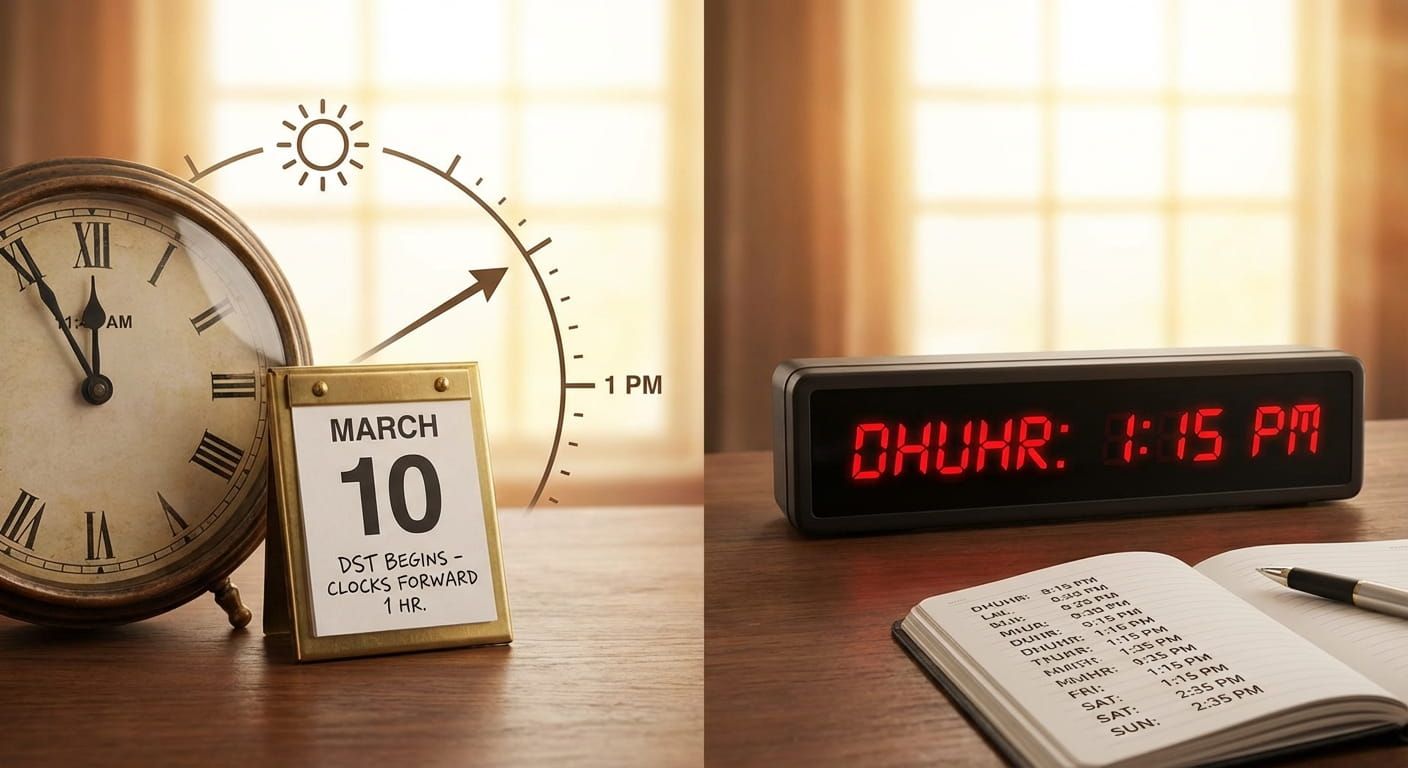
- Daylight saving time can move the civil clock one hour ahead during part of the year, while the Sun keeps following the sky.
During British Summer Time, the clock reads one hour later than standard time. That alone makes any assumption about 12 PM unreliable for prayer. Even outside summer time, solar noon still wanders because the Sun is not perfectly synced to civil time. That is why the daily schedule stays dynamic.
Anyone checking Dhuhr time in Cairo or Dhuhr time in Istanbul will notice the same principle. Noon based prayer is not locked to a single minute on the clock.
How This Looks Across Cities Around The World
The pattern becomes clearer when you place several cities side by side. Different longitudes, different time zones, and different seasonal patterns all leave a mark on Dhuhr.
| City | What shapes local Dhuhr timing | What readers should notice |
|---|---|---|
| London | Equation of time, daylight saving time, local solar noon | Dhuhr usually misses 12:00 PM on the clock |
| Dhaka | Longitude and annual solar variation | Noon prayer follows the Sun, not a fixed noon label |
| Jakarta | Solar noon changes across the year | Smaller seasonal daylight swings do not erase solar variation |
| Mecca | Local meridian and daily solar position | Dhuhr starts from the Sun reaching local midday |
| New York City | Wide time zone, daylight saving time, equation of time | Clock noon is not a safe shortcut |
| Sydney | Southern hemisphere seasons, longitude, solar variation | The same rule applies even with reversed seasons |
Put another way, Dhuhr in one city is not a universal noon stamp for every other city. A reader comparing Dhuhr time in Dhaka, Dhuhr time in Jakarta, Dhuhr time in Mecca, Dhuhr time in New York City, and Dhuhr time in Sydney will see one shared rule applied to very different local skies.
What People Often Mistake About Noon Prayer
A few common assumptions create confusion.
Assumption one: noon means 12 PM everywhere. It does not. Noon on a clock is civil time. Solar noon is local sky time.
Assumption two: the same city should keep one steady Dhuhr minute all year. It should not. The equation of time changes the Sun’s apparent schedule across the year.
Assumption three: daylight saving time changes the Sun. It does not. It changes the clock humans choose to use.
A prayer timetable is not fighting the clock. It is translating the sky into a readable daily schedule.
How Prayer Timetables Turn Astronomy Into Daily Times
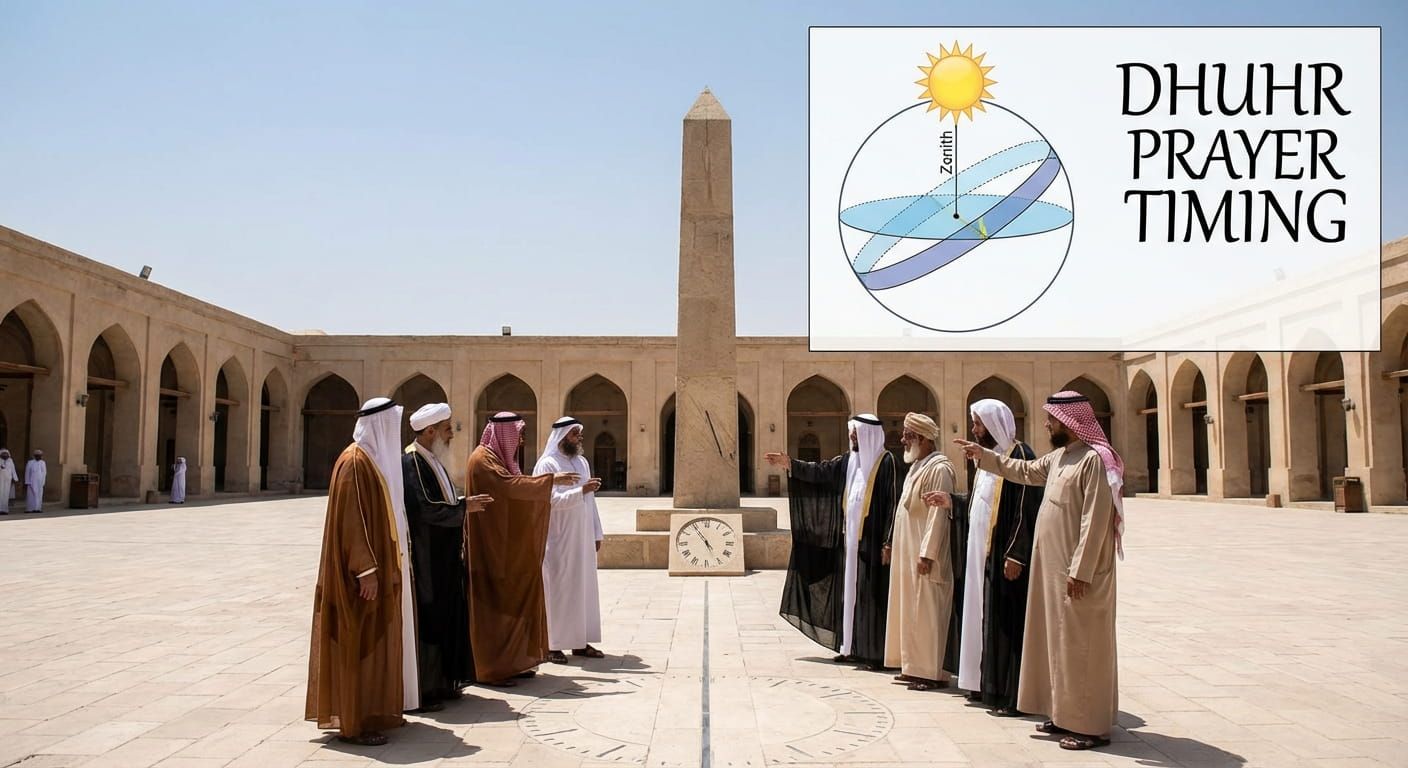
The actual timetable you read on a prayer page takes solar noon and applies calculation methods used for prayer scheduling. For Dhuhr, the core anchor is the Sun passing its highest point. After that, the listed start time is presented in local civil time so people can use it easily in daily life.
That is why a reliable source matters. Time.now brings together clocks, timers, time zones, calendars, and prayer times in one place, which makes it useful for anyone trying to match daily life with accurate timing. A person moving between cities such as Dubai, Medina, Seoul, Toronto, Berlin, Rome, Singapore, Mumbai, Tokyo, or Nairobi can read Dhuhr in a format that reflects the actual location instead of guessing from a generic noon idea.
For another clear example, Dhuhr time in Singapore and Dhuhr time in Tokyo both follow the same principle, even though their local noon and seasonal daylight patterns differ.
Reading Noon With The Sky In Mind
The title question has a simple answer once the sky is part of the story. Dhuhr is not always at 12 PM because 12 PM is a civil label, while Dhuhr begins after solar noon. Solar noon shifts through the year because of the equation of time, which can vary by about 16 minutes, and because longitude changes local noon inside every time zone. London shows this clearly, yet the same rule applies in Cairo, Dhaka, Jakarta, Mecca, Singapore, Tokyo, New York City, Sydney, and many more places. The clock gives a shared public time. Dhuhr listens to the Sun first.