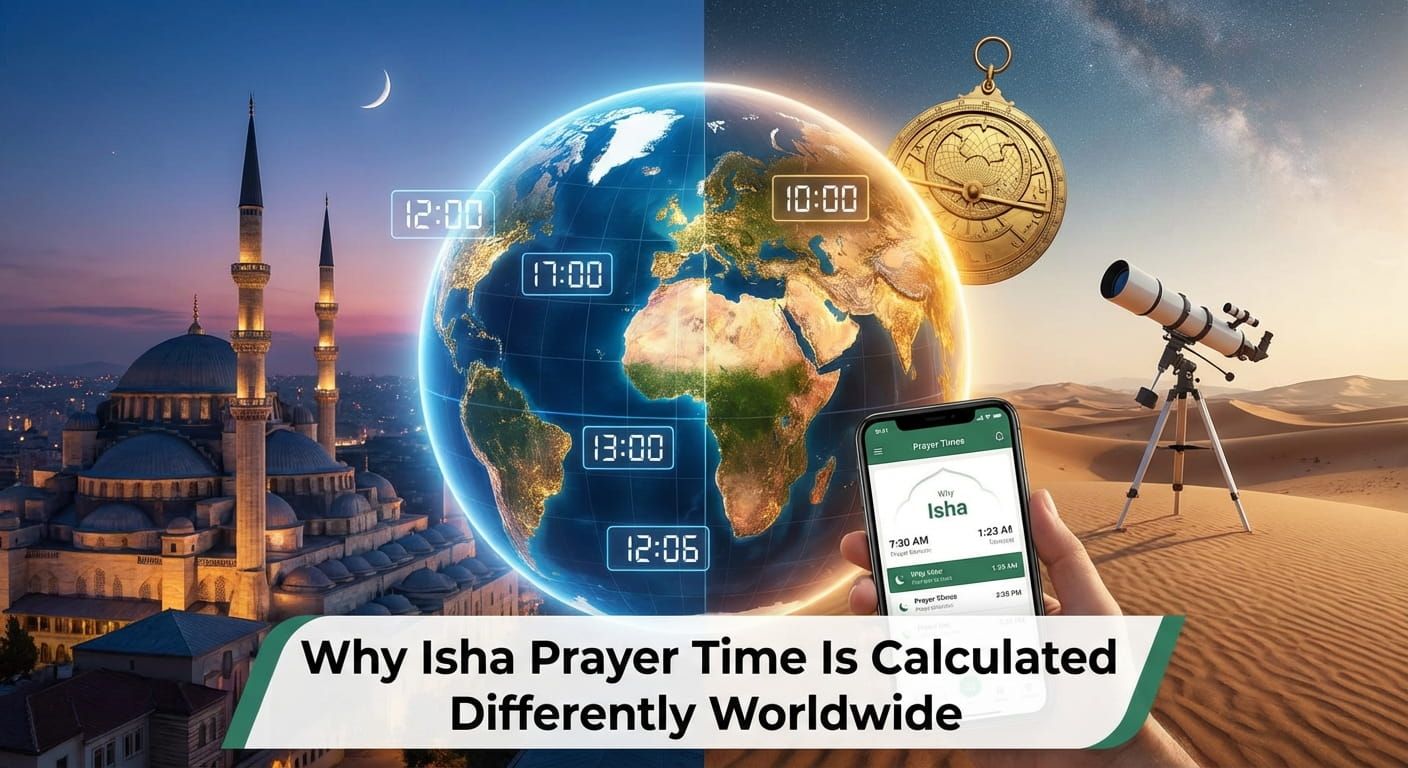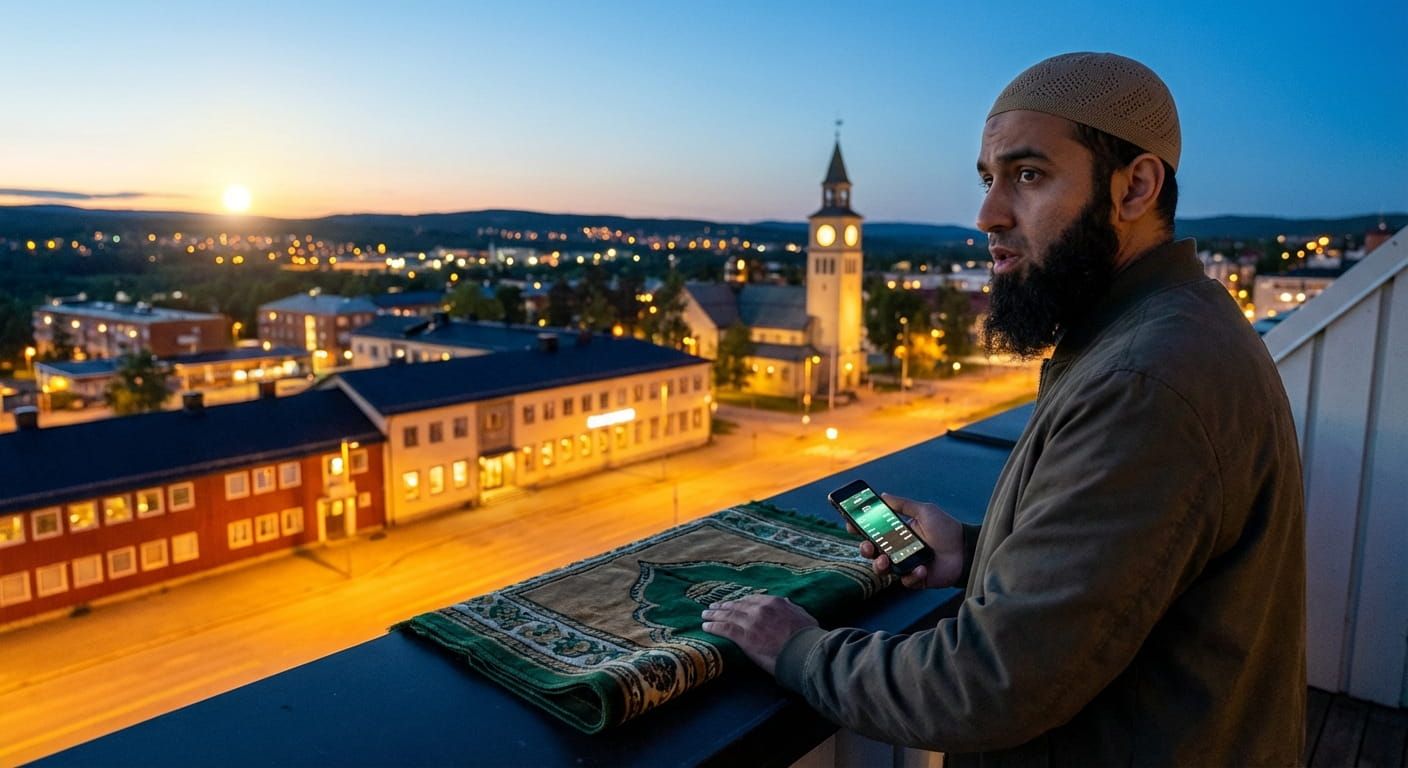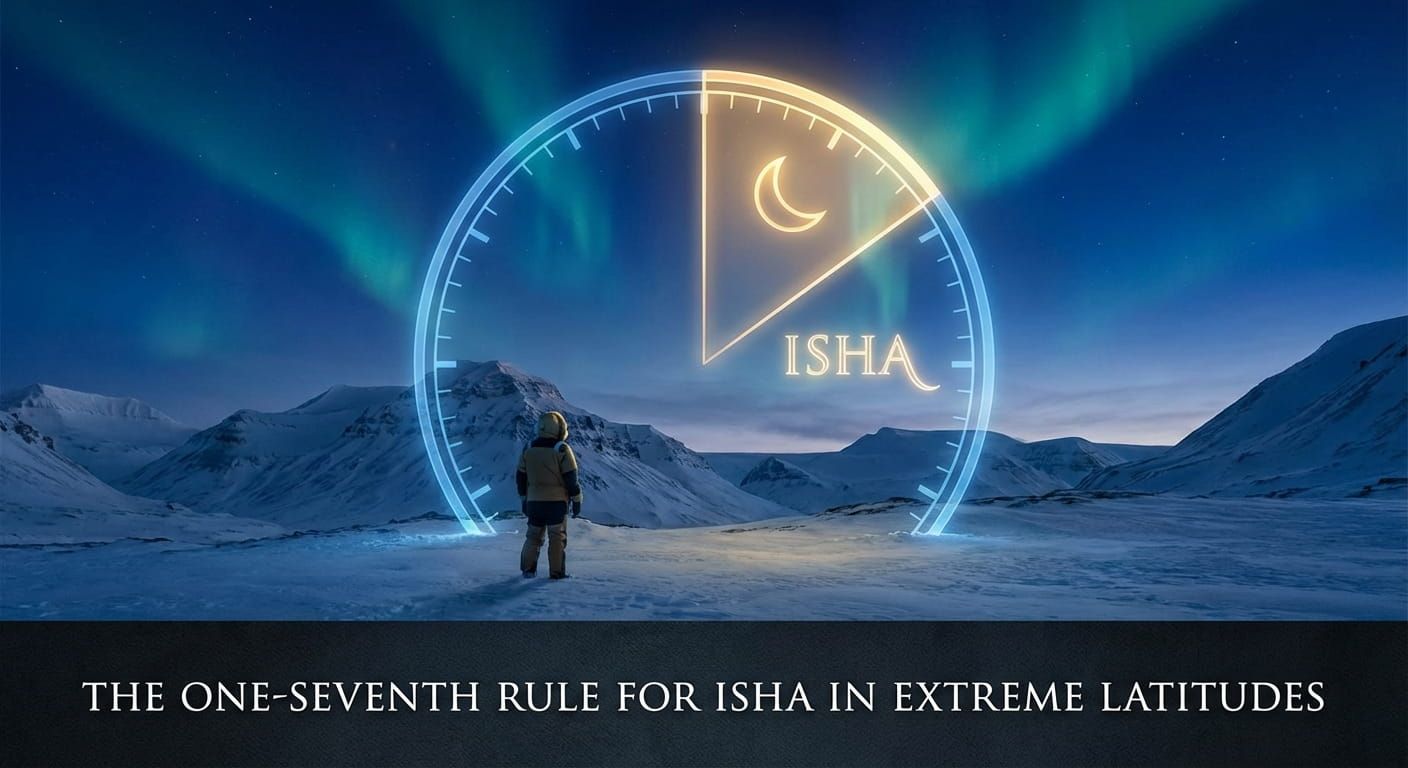
Summer nights in the far north can feel suspended between sunset and dawn. The sky never quite settles. For Muslims trying to determine Isha, that lingering glow is not just a beautiful scene, it is a real legal and practical problem. In many northern countries, the twilight linked to the entry of Isha does not fully disappear for part of the year, which means the usual astronomical sign never arrives.
Key takeaway
Above roughly 48.5° latitude in summer, the sky may remain in continuous twilight and never reach the darkness often used to mark Isha calculations worldwide. Since the normal sign does not appear, scholars use estimation methods, including nearest valid place, nearest valid day, and proportion based timing, to keep prayer practical and faithful in affected regions.
Why Northern Summer Changes The Isha Question
In most places, Isha begins after sunset once twilight has faded enough for night to take hold. That sounds simple until geography changes the sky. In northern countries, the sun drops below the horizon at such a shallow angle during summer that the glow from sunset can continue through the whole night. The result is a long band of light that lingers in the west and then merges into the first signs of dawn.
This is why Muslims in places such as London Isha prayer times, Amsterdam Isha prayer times, Berlin Isha prayer times, and Moscow Isha prayer times often find that summer timetables require more than a simple sunset to darkness sequence.
Picture the sky this way: sunset happens, but the horizon keeps glowing. The darkness many people expect never fully arrives. That lingering light is the heart of the twilight angle problem.
What The Twilight Angle Actually Means
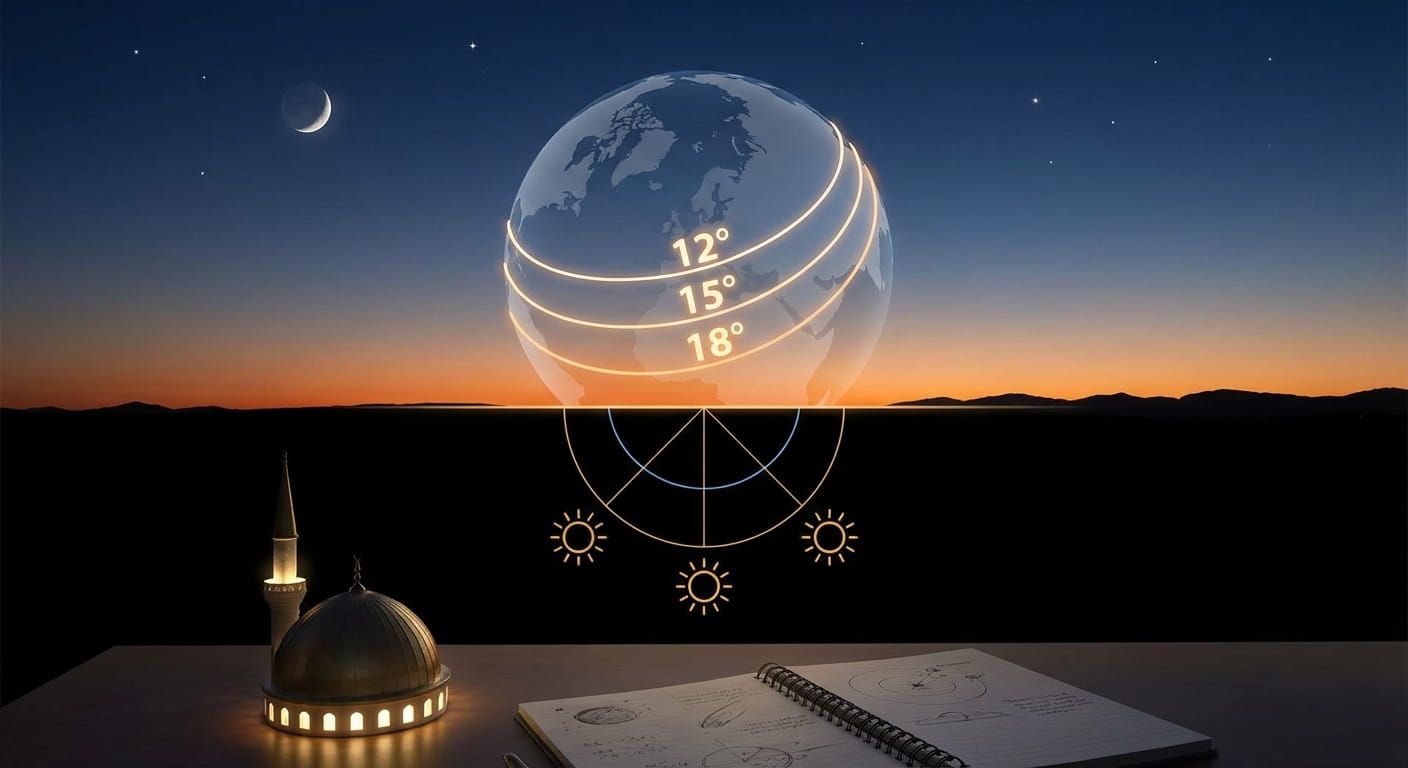
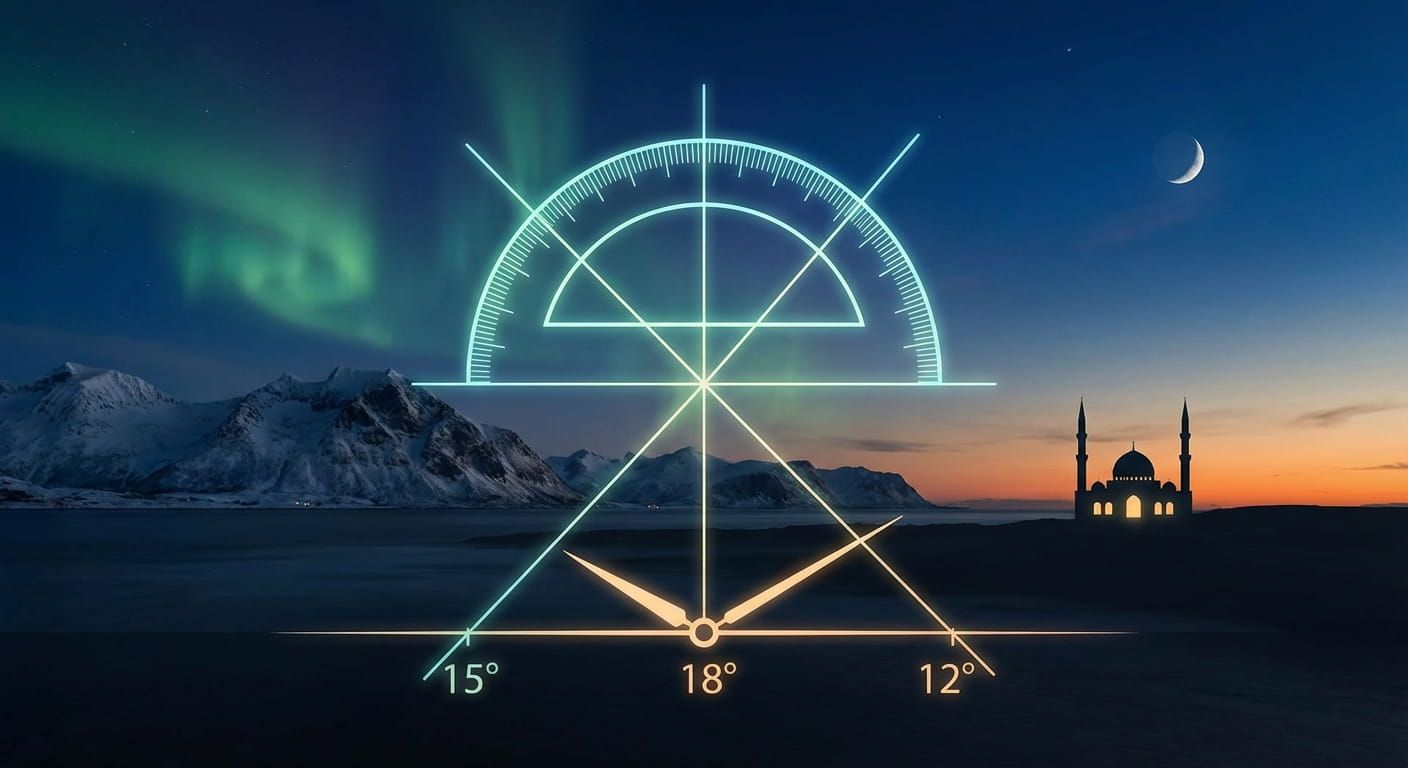
Prayer schedules often translate visual signs into solar angles below the horizon. For Isha, many methods use 18°, some use 17°, 15°, or another adopted standard. The principle remains the same. The sun must sink far enough below the horizon for the twilight linked to day to fade.
At lower and middle latitudes, this usually works without much trouble. Cities including Mecca Isha prayer times, Medina Isha prayer times, Cairo Isha prayer times, Riyadh Isha prayer times, and Karachi Isha prayer times still experience a recognizable sequence from sunset to night.
Farther north, the angle may never be reached during part of the summer. The timetable can still produce a number, but the sky itself is no longer giving the usual marker. That is the crucial distinction. The issue is not that Muslims forgot how to calculate. The issue is that the expected sign does not occur astronomically.
Where Perpetual Twilight Starts To Matter
A commonly cited threshold is about 48.5° latitude for the 18° standard around the summer solstice. Above that line, there are dates when the sun does not descend far enough below the horizon to reach the darkness associated with this method. The exact dates vary by location and by the calculation standard in use, though the broad pattern remains the same.
That helps explain why the issue becomes familiar across parts of the United Kingdom, the Netherlands, Germany, Scandinavia, northern Canada, and Alaska. A city does not need to be near the Arctic Circle to encounter the problem. It only needs to be far enough north for the summer sun to skim too close beneath the horizon.
- Sunset still takes place
- Twilight continues much longer than usual
- The sun does not sink deeply enough below the horizon
- The standard astronomical sign for Isha may fail to appear
- Fajr can also become difficult to identify because dawn signs overlap with the same glowing sky
A useful legal principle appears here: the prayer remains obligatory even when the usual sign is absent. The challenge shifts from observation to estimation.
Why Isha Does Not Occur Astronomically In These Places
The explanation comes from Earth’s tilt and the seasonal path of the sun. During northern summer, the sun sets at a shallow angle. Instead of dropping steeply into darkness, it glides just below the horizon and begins rising again before the deeper twilight phases have ended.
This creates what many people call perpetual twilight. The phrase does not always mean broad daylight through the entire night. It means the sky remains in a twilight state without reaching the full darkness that many prayer methods depend on. That is why the question is described as a twilight angle problem rather than a simple clock problem.
Contrast that with places farther south. The sky over Dhaka Isha prayer times, Jakarta Isha prayer times, Dubai Isha prayer times, Delhi Isha prayer times, and Mumbai Isha prayer times usually progresses through the expected evening stages more clearly, even though local juristic methods can still vary.
How Scholars Built Practical Rulings For Atypical Nights
Classical jurists and modern councils did not treat this as an excuse to abandon prayer. They treated it as an unusual timing situation. The prayer remains due, but its timing must be estimated through a method that respects both the law and the lived reality of the sky.
Several rulings became widely discussed. Different communities adopt different methods, which explains why neighboring mosques can publish different Isha times during summer.
- Nearest valid location. A community uses the timing from the nearest place where twilight still disappears and the normal sign remains visible.
- Nearest valid day. A timetable refers to the last day before the sign vanished, or the next day when it returns, then estimates the affected period from there.
- Proportional night division. The interval between sunset and dawn is divided into parts, then Isha is placed at a proportion similar to a normal night.
- Fixed interval after sunset. Some institutions use a set number of minutes after sunset during the difficult season to support consistency and congregational ease.
Each of these approaches tries to balance faithfulness with practicality. The sky is being taken seriously. Hardship is being taken seriously too. This is one reason Muslims in northern countries often follow local scholars or recognized councils rather than importing a timetable from another part of the world.
Why Timetables Differ Between Northern Cities
A person comparing Paris Isha prayer times, Rome Isha prayer times, Madrid Isha prayer times, and Toronto Isha prayer times may assume one of them is wrong. Often the real reason is method. A city may use a particular twilight angle until it stops working, then switch to an estimated rule. Another city may choose a lower angle year round. Another may rely on a council decision designed for public worship.
That does not mean anything goes. It means the juristic answer depends on both astronomy and method. The farther north a place sits, the more likely it is that estimation becomes necessary for part of the year.
What This Looks Like Across The Wider World
Comparisons become clearer when northern cities are read alongside places in other regions. The pattern in New York City Isha prayer times differs from Chicago Isha prayer times, which differs again from Los Angeles Isha prayer times. Farther east, Istanbul Isha prayer times show another pattern, while cities closer to the equator or in the southern hemisphere move through a different seasonal rhythm entirely.
That becomes even more visible with Sydney Isha prayer times, where June falls in winter rather than summer. The legal discussion around twilight never exists in isolation. Latitude, season, and adopted method all shape the final timetable.
How Muslims In Affected Regions Usually Navigate The Season
For many families and mosque communities, the practical path is straightforward even if the theory is detailed.
- Follow a trusted local mosque or council
- Check whether the timetable uses a seasonal adjustment for high latitude months
- Stay consistent within one recognized method
- Do not assume a timetable from another country will fit local conditions
- Ask scholars how their method handles nights when the twilight sign does not appear
This matters because unity in worship has value. Individual research can be helpful, though a community often benefits most from a shared standard that is both transparent and workable.
Reading The Northern Sky With Honesty And Ease
The twilight angle problem for Isha in northern countries is really a meeting point between astronomy, worship, and mercy. The sky near the top of the world does not always behave in the neat pattern many prayer books assume. During summer, twilight can stretch across the whole night, leaving no true astronomical entry for Isha according to some common methods.
That is why scholarly rulings matter. They acknowledge the absence of the normal sign without treating the prayer as optional. Through nearest valid place, nearest valid day, proportion based estimation, or fixed intervals, Muslim communities found ways to uphold prayer while respecting the realities of the northern summer sky. The horizon may refuse full darkness, yet the path to devotion remains open.