Midday feels simple until you look up and realize the Sun is doing something very exact. There is a brief moment when it reaches its highest point for your location, and that moment shapes the start of Dhuhr in a precise way. Many people assume Dhuhr begins exactly at noon on the clock. It does not. The prayer starts after the Sun passes its peak and begins to move westward, a transition known in Islamic usage as zawaal.
Summary
Zenith is the moment the Sun reaches its highest apparent position in the sky for a specific place. Dhuhr does not begin at that exact instant. It begins just after, once the Sun has crossed the local meridian and started to decline westward, which is called zawaal. That small wait matters because it marks the end of the no prayer moment at peak midday and the true start of Dhuhr time.
Check your understanding
Pick the statement that matches the actual start of Dhuhr.
What Zenith Means In Astronomy
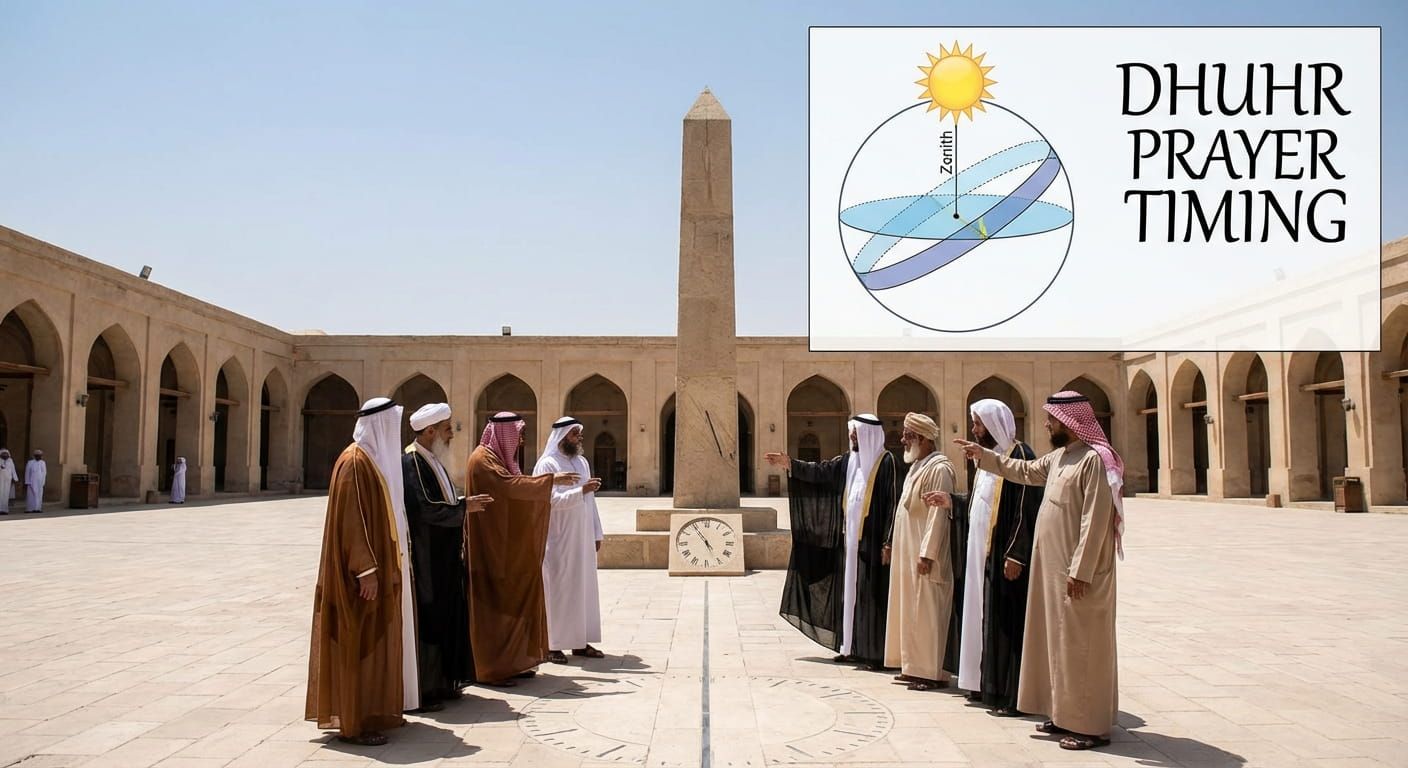
In astronomy, the word zenith has a strict meaning. It is the point in the sky directly above your head. That point is not where the Sun always goes. In most places on Earth, the Sun passes south of that overhead point for part of the year and north of it for another part only if you live within the tropics. Yet in daily speech, many people use zenith to mean the Sun at its highest point for the day. For prayer timing, that everyday meaning is usually what people have in mind.
The Sun appears to move across the sky from east to west because Earth rotates. As it climbs toward midday, its altitude rises. Then it reaches the maximum altitude for that date and location. That peak is local solar noon, often called solar noon or the Sun crossing the meridian. After that, the altitude begins to drop. This change from rising to declining is the key to understanding zawaal and the opening of Dhuhr.
That is why clock noon and solar noon are not always the same thing. Standard time zones cover wide regions. A city on the eastern side of a time zone will meet solar noon earlier than a city on the western side. Seasonal effects also shift apparent solar time. If you want a fuller look at that gap, why Dhuhr is not always noon adds useful context.
How To Tell When The Sun Crosses The Meridian
The meridian is an imaginary north to south line across the sky. When the Sun crosses that line, it reaches its daily maximum altitude. In the Northern Hemisphere, the Sun is generally due south at this moment. In the Southern Hemisphere, it is generally due north. This is the turning point between morning ascent and afternoon descent.
You can identify the crossing in a few practical ways.
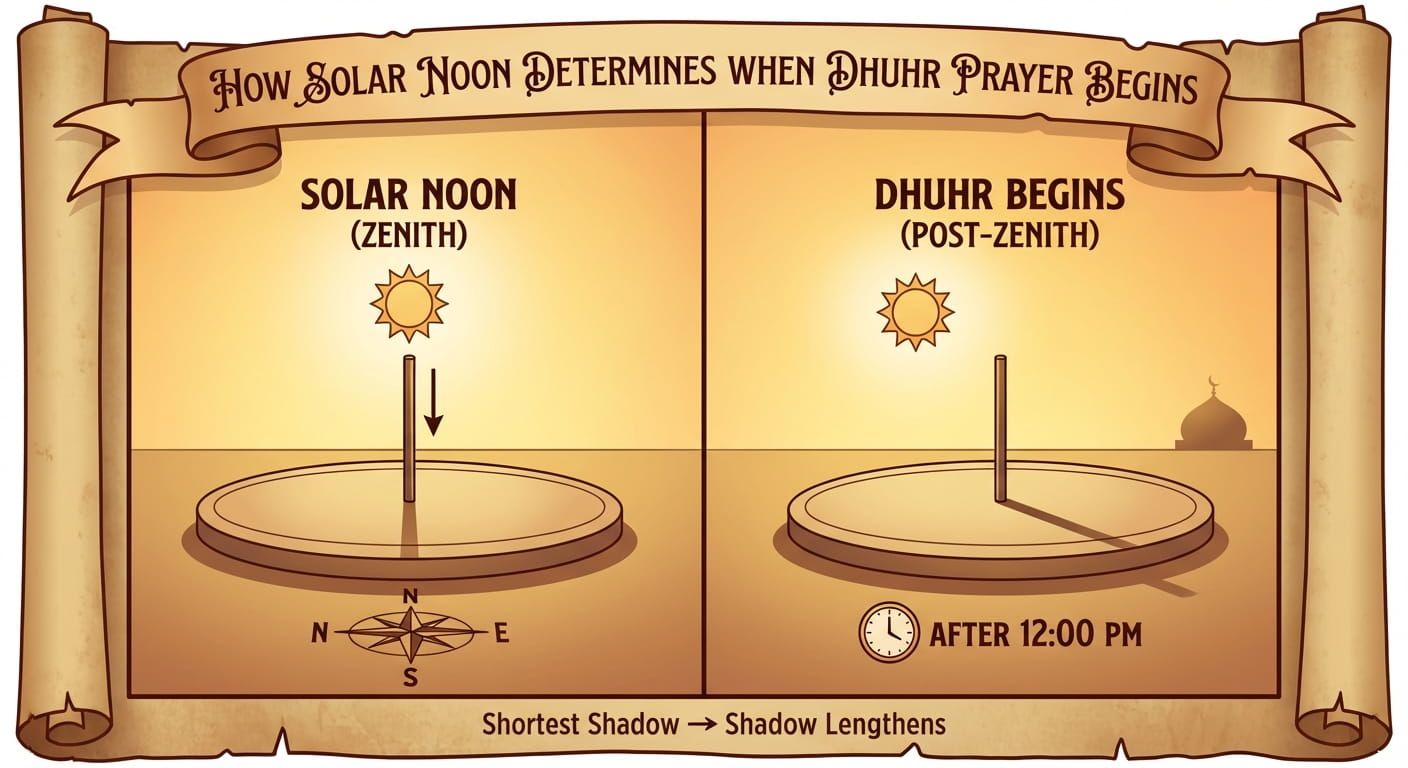
- Watch a straight object and its shadow. As solar noon approaches, the shadow gets shorter and shorter.
- Notice the shortest shadow of the day. That marks the Sun at its highest apparent position.
- Wait a little longer and check the shadow again. Once it begins to lengthen in the opposite direction, the Sun has passed the meridian.
- Compare with a reliable prayer time source. This is the easiest method for daily use and removes guesswork.
In older communities, shadow watching was common. A stick in open ground could tell a lot. The shortest shadow was a natural marker. Yet the shortest shadow itself is not the prayer start. The prayer begins after the decline becomes real, even if only by a small amount. That distinction protects the prayer time from being started at the exact peak.
Quoted idea: The eye notices a short shadow. The law cares about the moment after the turn. That tiny shift from rising to falling is what makes midday prayer time valid.
Zawaal, The Sun’s Decline After The Peak
Zawaal refers to the Sun beginning its decline from the highest point. In simple terms, the Sun has already topped out and is now moving westward in apparent motion. This matters because there is a brief midday interval tied to the peak itself. Dhuhr begins only once that peak has passed.
That is why many prayer calendars place Dhuhr a few minutes after local solar noon instead of at the exact meridian crossing. The added margin is not random. It gives practical certainty that the moment of zenith has finished. This is especially useful because ordinary observation is not perfectly precise, and many people rely on clocks, not shadow instruments.
To keep the concept clear, it helps to separate four ideas:
- Clock noon, 12:00 PM on a watch or phone
- Local solar noon, the Sun at its highest apparent point
- Zenith in common speech, that highest point of the day
- Zawaal, the start of decline after the peak
Many people say zenith and zawaal almost in one breath, yet they are not identical. Zenith refers to the top point. Zawaal refers to what happens after the top point. Dhuhr begins with zawaal, not with the peak itself.
Why There Is A Short Delay Before Dhuhr Starts
This small delay confuses many readers because it seems tiny. A minute or two does not feel dramatic. Still, the logic is strong. At the exact top, the Sun has not yet declined. During that instant, the turning point is occurring. The beginning of Dhuhr is linked to the Sun moving away from that point, not merely touching it.
The delay serves several purposes. It gives certainty. It accounts for observational limits. It aligns practice with the legal and astronomical transition. It also avoids tying prayer to a split second that is hard to identify without careful instruments.
For many readers, the easiest way to think of it is this. The peak is a boundary. Prayer starts only once you are on the afternoon side of that boundary. That is the reason a timetable may show a slight offset after solar noon. For a closer look at the relationship itself, solar noon and Dhuhr prayer fits neatly into the same topic.
Why Dhuhr Changes From City To City
Dhuhr is tied to the Sun over your location, not to a universal noon that applies everywhere. Longitude matters because places farther east meet solar noon earlier than places farther west. That is why Dhuhr in Cairo is not the same as Dhuhr in Lagos, and neither matches London or Karachi on the same date.
Seasonal time systems also affect what appears on the clock. Daylight saving time can move the displayed hour without moving the Sun itself. The sky follows astronomy. The clock follows local civil rules. That difference is why a place can show Dhuhr at a time that feels later than expected. Readers who want the mechanics can continue with longitude and Dhuhr calculation and daylight saving and Dhuhr impact.
Concrete city pages make this easier to see in real life. A person comparing Dhuhr time in Cairo with Dhuhr time in London will notice that local solar conditions shape the schedule. The same applies across a wider range of places, from Dhuhr time in Jakarta to Dhuhr time in Riyadh, from Dhuhr time in New York City to Dhuhr time in Singapore.
How To Think About The Shortest Shadow
The shortest shadow is a useful visual clue, though it needs careful interpretation. At the exact midday peak, a vertical object casts the shortest shadow it will cast all day. After that, the shadow begins to lengthen. In some locations and seasons, the change looks subtle. In others, it is more obvious. Near the tropics, the Sun can get extremely high, which makes noon shadows very small and sometimes tricky to judge without patience.
That visual method still teaches a valuable lesson. Morning is a story of shortening shadows. Afternoon is a story of lengthening shadows. Zawaal is the handover point between the two. Once the shadow has clearly stopped shrinking and begun to extend again, the Sun has passed the meridian.
Helpful note: A person using shadow observation alone should still leave a tiny safety margin. Real world surfaces, object tilt, and visual estimation can all introduce error.
Where The Midday Turn Meets Prayer
The Sun’s zenith is not just an abstract astronomy term. It marks the last instant before the day tilts from ascent into descent. That turn is why Dhuhr begins after the peak, not at a fixed 12:00 and not at the exact top. Zawaal is the signal that the boundary has been crossed. A brief delay after zenith gives certainty and keeps the prayer aligned with the true afternoon side of the Sun’s motion. Once that idea settles in, Dhuhr timing stops feeling arbitrary and starts feeling beautifully exact.