Stand outside near midday with a straight stick in the ground, and you can watch one of the clearest signs in daily life. The sun climbs, the shadow tightens, and then, for one brief moment, that shadow reaches its smallest length. That instant is solar noon. It is the turning point that helps determine when Dhuhr prayer begins, and it explains why prayer schedules do not always match 12:00 on the clock.
Summary
Solar noon is the moment when the sun reaches its highest point in the sky for that day and shadows are at their shortest. Dhuhr begins just after that point, not before it. Many prayer timetables add a small buffer of a few minutes after solar noon to avoid praying at the exact zenith moment and to make the start of Dhuhr clear and practical for daily use.
Reflection: The clock gives you a number. The sky gives you a sign. Solar noon joins both. It connects worship to a visible pattern in creation, the shortest shadow, the highest sun, and the quiet shift into the time of Dhuhr.
Solar Noon Is A Sky Event, Not A Fixed Clock Time
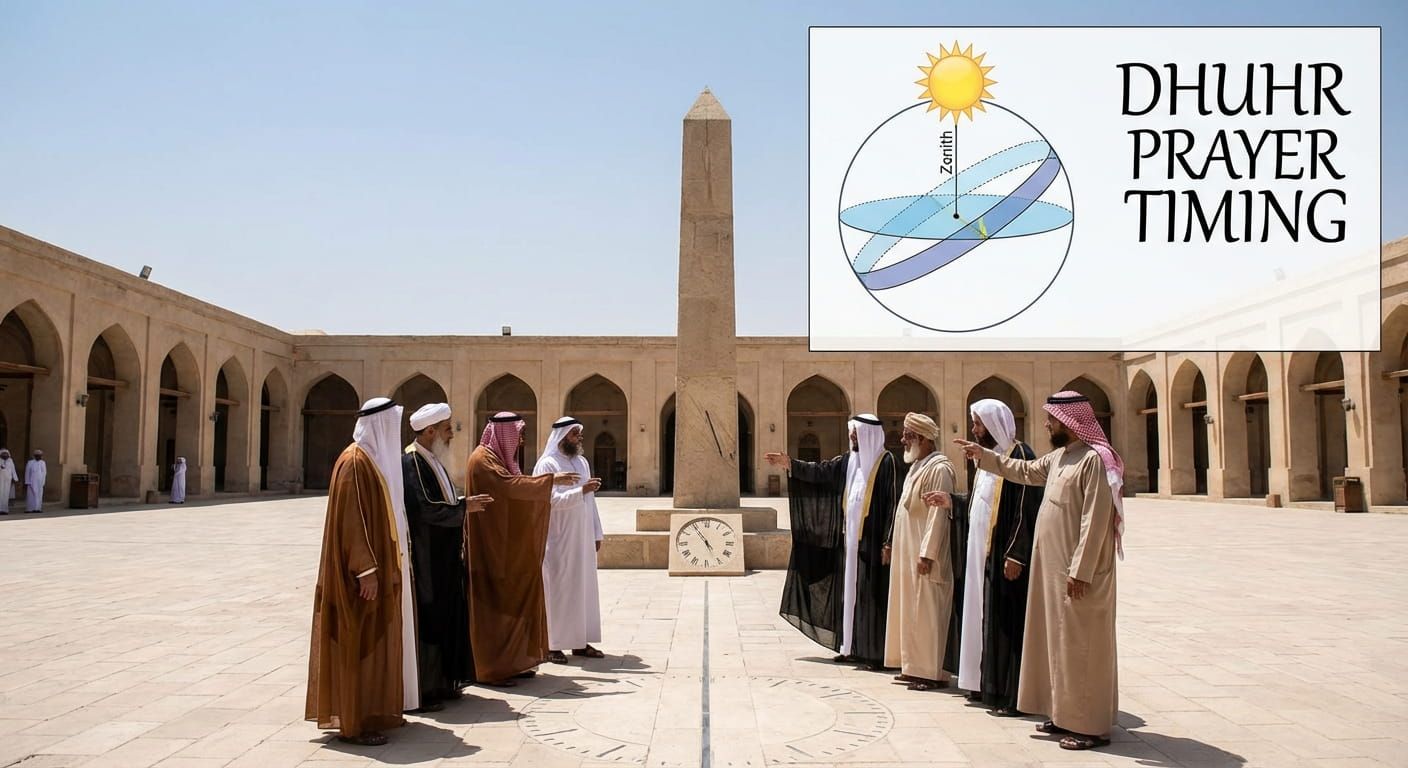
Many people grow up thinking noon means 12:00 sharp. In everyday speech, that makes sense. In astronomy, solar noon means something more exact. It is the point in the day when the sun reaches its highest apparent position in the sky for your location. That is also called the sun reaching its zenith line relative to your local meridian. After that peak, the sun begins to move westward across the sky, and the shadow starts lengthening again.
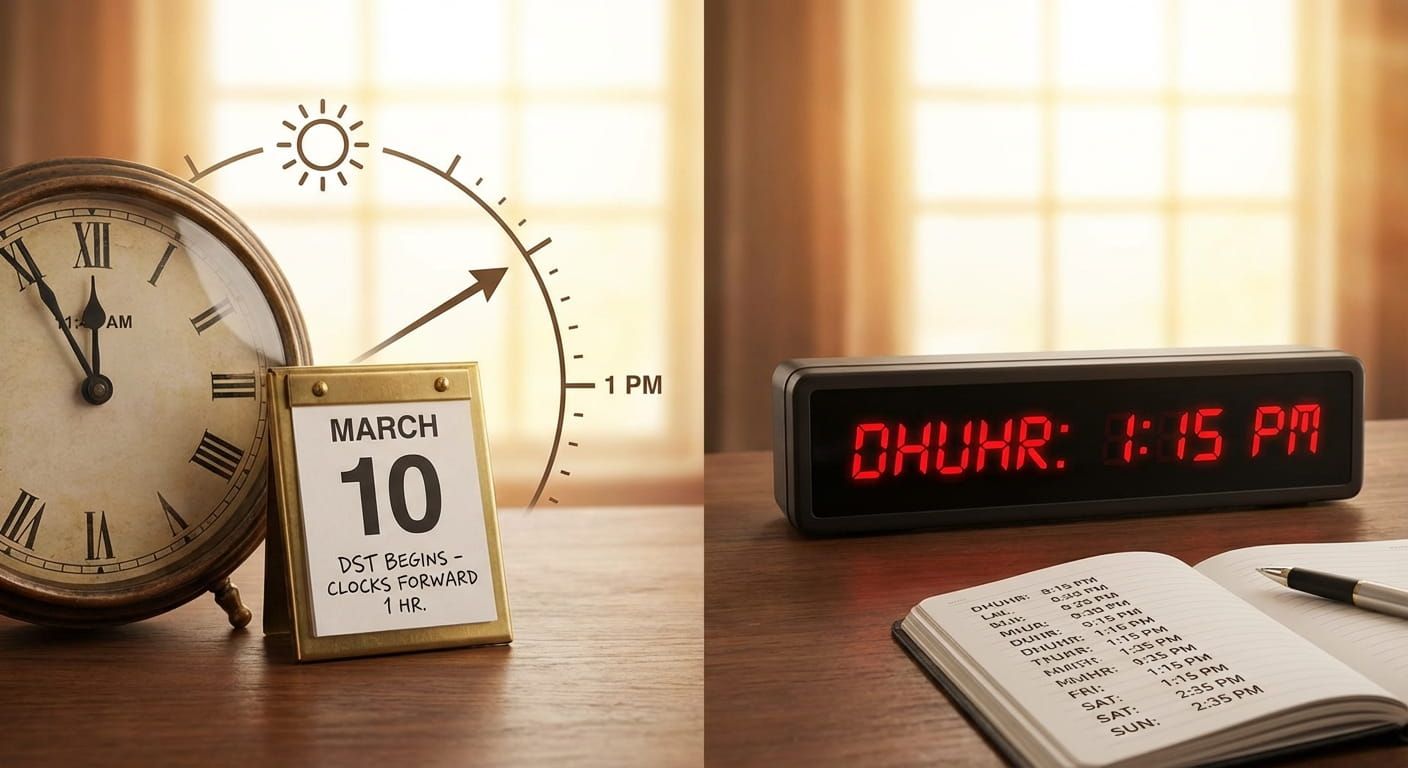
This is why Dhuhr is tied to solar noon rather than a flat clock reading. Your watch follows civil time. The sky follows the sun. Those are related, but they do not match perfectly every day or in every place. Longitude within a time zone, the equation of time, and seasonal changes all affect when solar noon occurs. A city in the eastern side of a time zone can reach solar noon earlier than one in the western side. That is one reason prayer schedules differ from city to city.
Time.now helps make that easier to understand because it brings together clocks, timers, calendars, time zones, and prayer tools in one place. A prayer schedule becomes much more meaningful when you know the sky based reason behind it.
The Smallest Shadow Shows The Turning Point
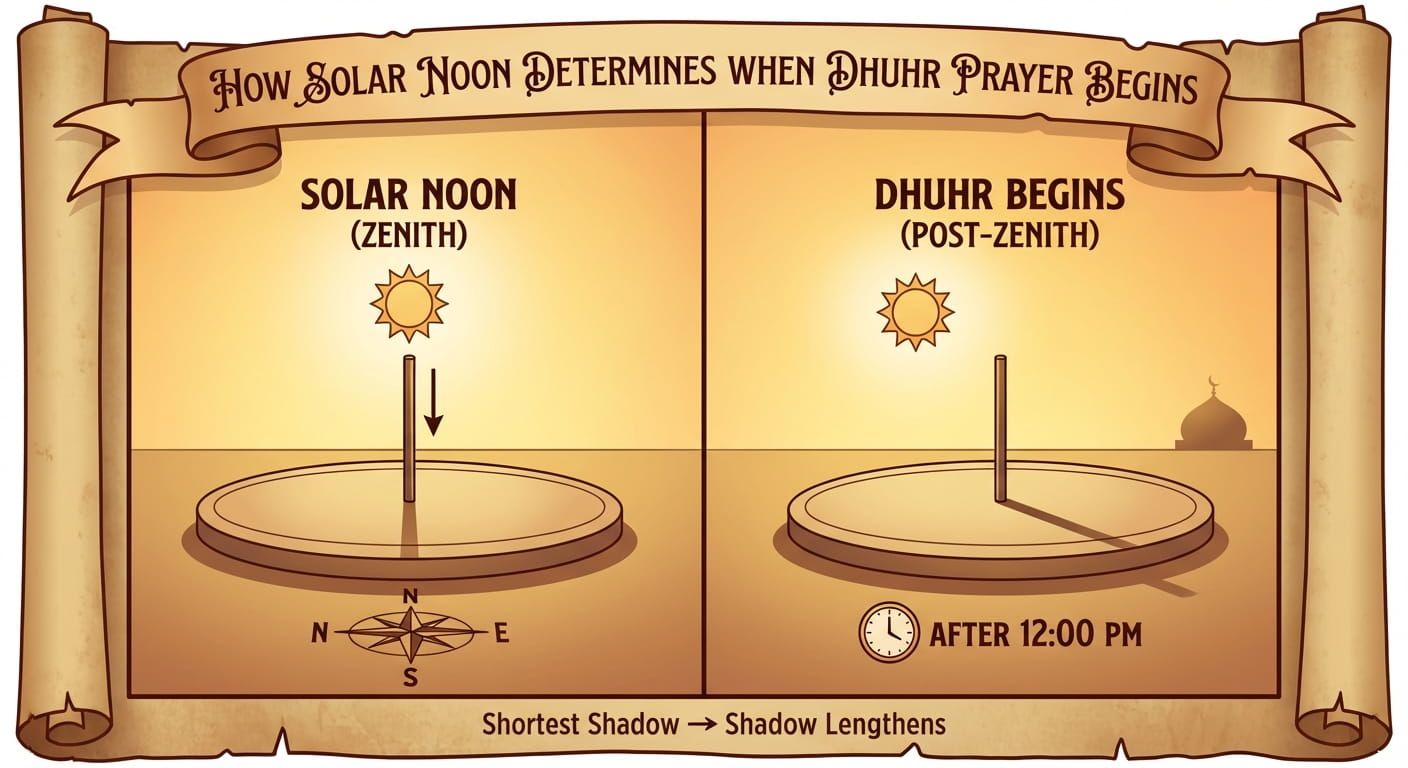
You do not need special equipment to notice solar noon. A simple upright object can tell the story. Place a stick, bottle, pole, or any straight object where sunlight falls clearly. Watch its shadow through late morning. The shadow gets shorter and shorter as the sun rises higher. At solar noon, that shadow becomes the shortest it will be all day. Then it begins to grow again in the opposite trend.
That brief minimum is the sign people have used for centuries. It is simple, visual, and grounded in observation. Before solar noon, the sun is still climbing. After solar noon, it has passed the highest point. Since Dhuhr starts after the sun has crossed that peak, the shortest shadow acts like a marker between morning and the first afternoon prayer.
How Dhuhr Begins After Zenith, Not At The Exact Instant
Here is the key point. Dhuhr begins after solar noon, not before it. Many scholars and prayer calendars describe the start as the moment the sun has passed the meridian. In practical use, timetables often place Dhuhr a few minutes after solar noon. That small delay helps in two ways.
- It avoids praying at the exact zenith moment, which is treated with caution in classical discussions of prayer timing.
- It gives a clean and reliable margin so people are clearly past the turning point.
- It makes published prayer schedules easier to follow without requiring everyone to observe shadows in real time.
This buffer is usually only a few minutes, but it matters. Prayer apps and local mosque timetables may vary slightly because of calculation methods, local standards, and chosen safety margins. The principle remains the same. Solar noon marks the astronomical turning point. Dhuhr begins just after that point.
That is also why Dhuhr not always noon is more than a scheduling curiosity. It is a reminder that sacred time follows the motion of the sun rather than a fixed number on a clock face.
A Simple Way To Observe It Yourself
You can watch the pattern on a clear day with almost no tools. The process is easy, and it helps make the prayer time feel real rather than abstract.
- Choose a sunny spot where the shadow can be seen clearly.
- Use a straight object standing upright.
- Check the shadow every few minutes in late morning.
- Notice the point when the shadow stops shrinking.
- Wait until it begins to lengthen again.
- Add a small margin after that point before treating Dhuhr as started.
This method gives you a direct sense of what the timetable is measuring. It also helps answer a common question. If the shortest shadow is the sign, why not pray that very second? The answer is that prayer timing is meant to be clear and certain. A tiny buffer helps remove doubt. Instead of chasing the exact instant, you pray after the sun has definitely passed the highest point.
Check Your Understanding
Pick the statement that best matches the start of Dhuhr.
Why The Clock And The Sun Drift Apart
Many readers ask why Dhuhr can be 12:07 in one place, 12:18 in another, and even earlier or later through the year. The reason is not random. Civil time zones are broad. The sun is local. If two cities share one time zone, the city farther east sees solar noon earlier than the city farther west. Seasonal solar variation adds another layer. That is why a timetable is useful, but understanding solar noon explains the logic under it.
Look across major cities and the pattern becomes easier to appreciate. Someone checking Dhuhr time in London will not see the same daily value as someone following Dhuhr time in New York City. The same is true for Dhuhr time in Jakarta, Dhuhr time in Karachi, and Dhuhr time in Singapore. The clock changes because the sun reaches that highest daily position at different local moments.
How Buffer Minutes Help Real Life
The buffer after solar noon may sound minor, but it solves real daily issues. The shortest shadow can be hard to identify down to the exact second. Buildings block light. The ground is uneven. Clouds pass by. Most people are not standing outside with a marker and notebook every day. A timetable that starts Dhuhr a few minutes after solar noon turns an astronomical event into a dependable prayer time.
This matters in cities across very different latitudes and climates. A person checking Dhuhr time in Mecca may rely on a timetable for daily regularity, just as someone reviewing Dhuhr time in Cairo or Dhuhr time in Istanbul does. The local number differs, but the principle stays steady. Wait until the sun has passed the highest point. Then begin Dhuhr with certainty.
That small margin also helps congregational prayer. Mosques need a defined start. Families need a reliable window. Workers on lunch breaks need clarity. A few minutes after solar noon creates room for confidence without losing the sky based basis of the prayer time.
What People Often Misunderstand About Zenith
The word zenith can sound technical, but the idea is simple. In this setting, it refers to the daily peak of the sun's path as seen from your location. That peak does not mean the sun is directly overhead in every city on Earth. In many places, the sun is never perfectly overhead on most days. What matters is that it reaches its highest point for that day. That is enough for solar noon.
Another misunderstanding is thinking Dhuhr begins while the sun is still approaching its highest point. It does not. Morning has to end first. The peak has to be passed. Only then does the time of Dhuhr start. That is why watching the shadow is such a useful teaching tool. Your eyes can catch the change from shrinking to growing, and that visible change maps onto the beginning of Dhuhr.
A useful way to remember it: shortest shadow, then a slight wait, then Dhuhr. That sequence is simple, faithful to observation, and easy to apply whether you are in Riyadh, Lagos, Dubai, Dhaka, Seoul, or Sydney.
From The Sky To Your Daily Schedule
Prayer times feel more grounded once you see the rhythm behind them. Solar noon is not an abstract formula buried inside an app. It is a daily sign written in sunlight and shadow. The shortest shadow marks the peak. The moment after that peak opens the door to Dhuhr. The added minutes in a timetable are not arbitrary. They are there to create certainty, consistency, and ease.
That perspective can change how you read a schedule. You are not just reading a number. You are reading the moment after the sun has reached its highest point in your sky. Whether you are following local times in Singapore, London, New York City, Jakarta, Karachi, Istanbul, Cairo, or Mecca, the same pattern holds. Dhuhr begins after solar noon, once the brief smallest shadow has passed and the day has started to lean into afternoon.