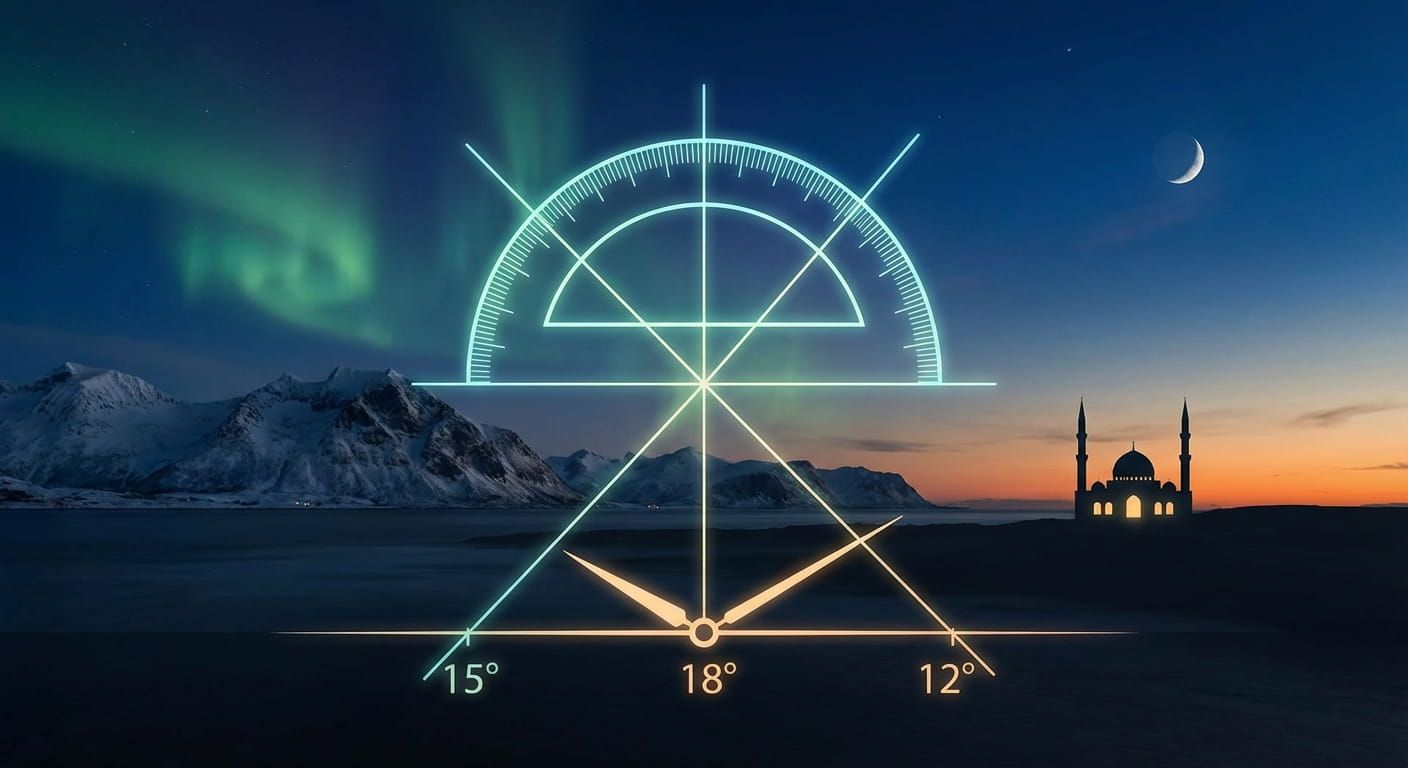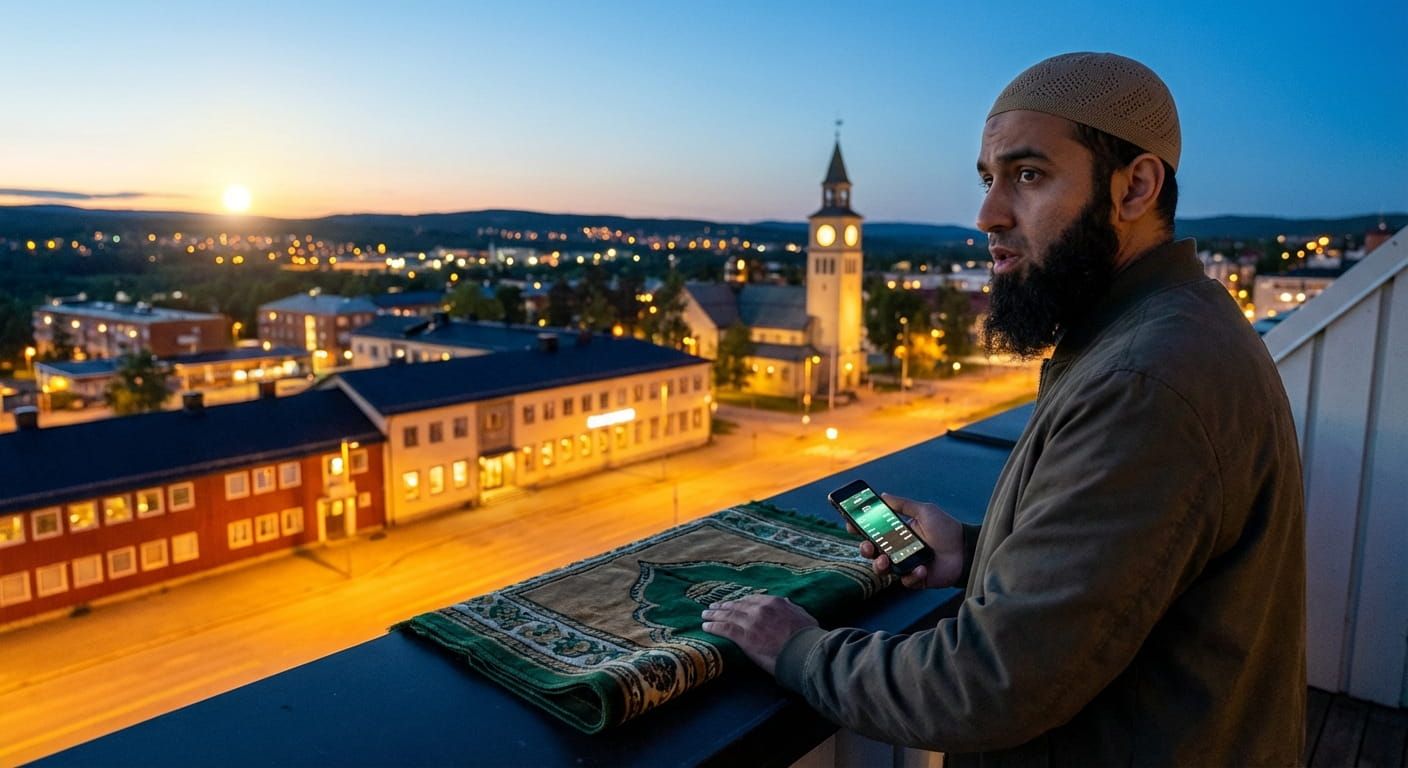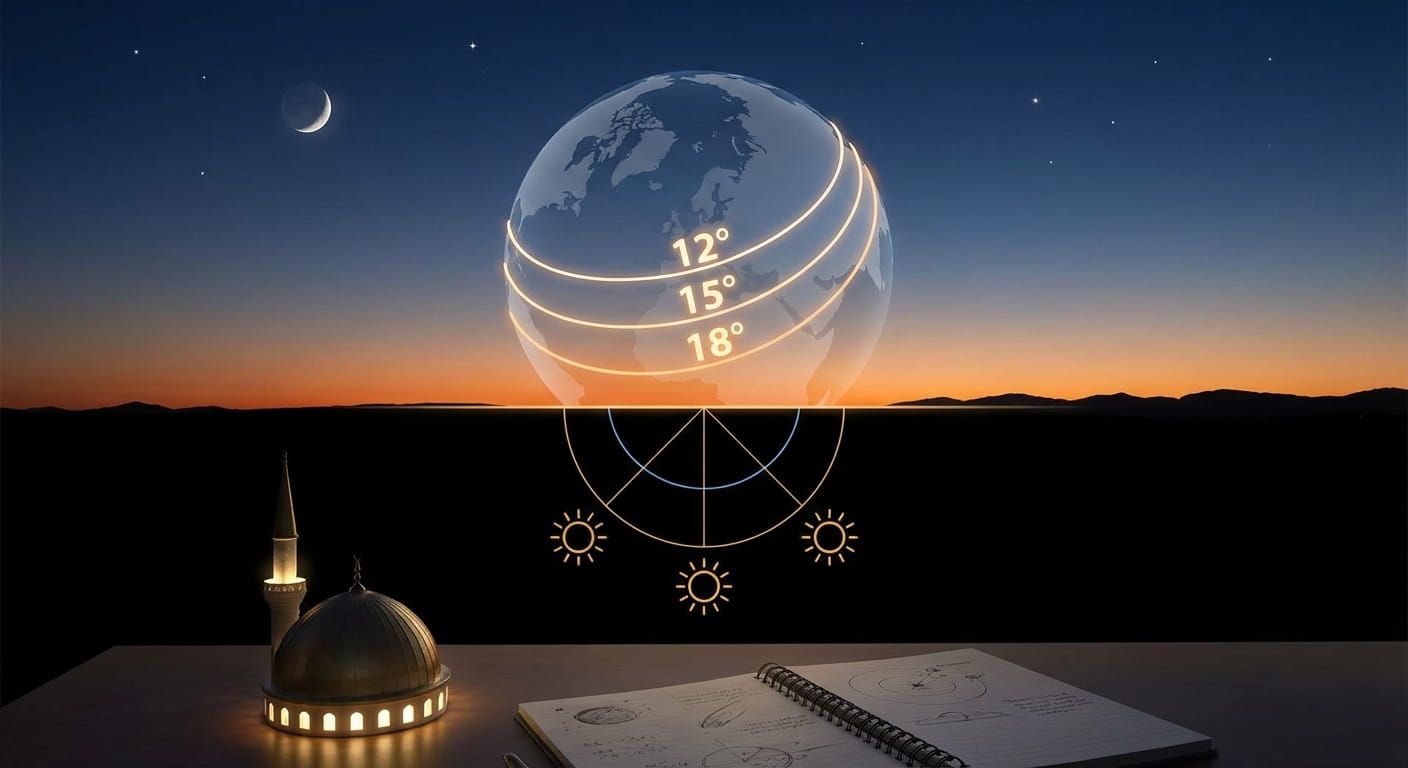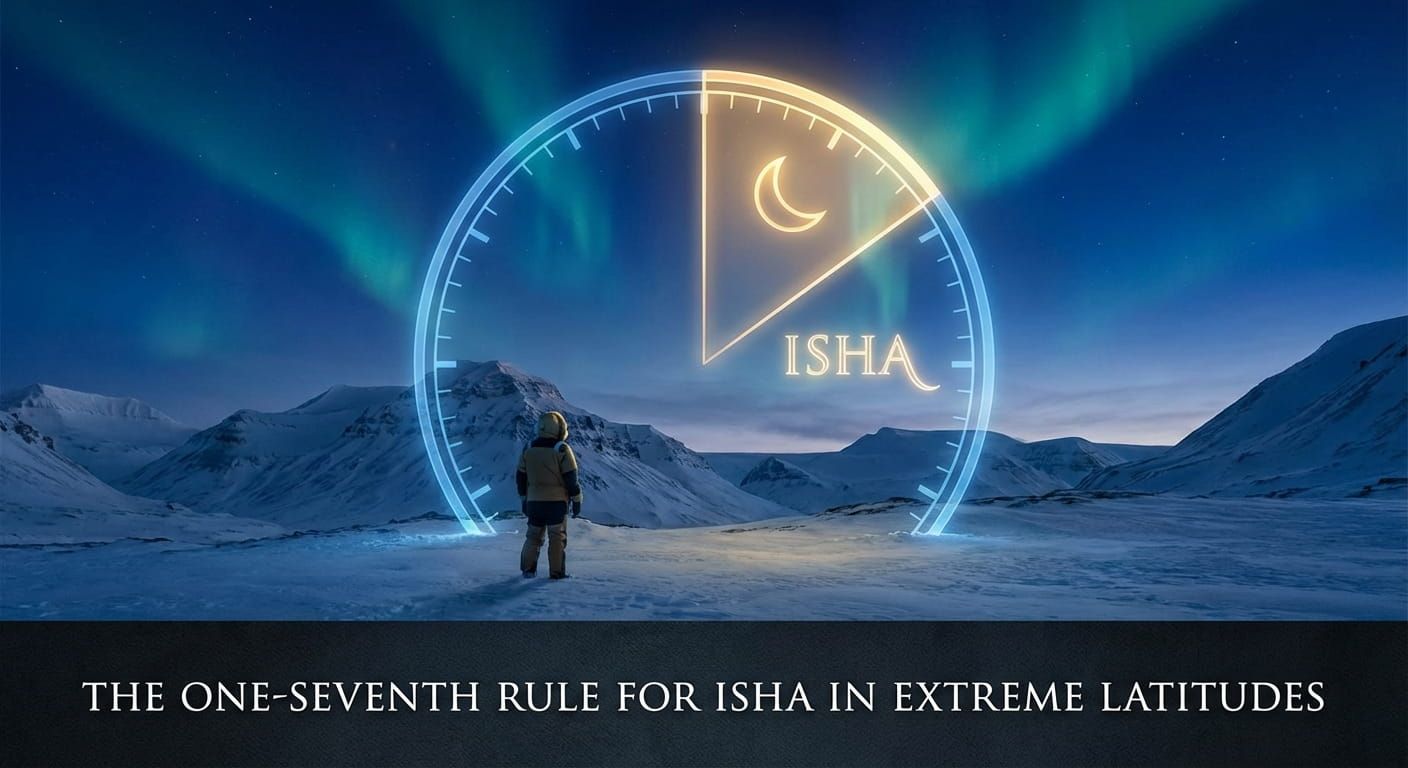
Summer nights in high latitudes can become so bright that the usual sign for Isha never fully appears. That leaves many Muslims asking a real and practical question, when does Isha begin if darkness does not settle in the normal way? One widely used answer is the one seventh rule. It takes the time from Maghrib to Fajr, divides that night into seven equal parts, then places Isha at the end of the first part after Maghrib. It is simple enough to calculate by hand, yet rich enough to show how jurists tried to preserve prayer with clarity and mercy.
The one seventh rule sets Isha at one seventh of the night after Maghrib when normal twilight signs are missing or too delayed, most often in places above about 48 degrees latitude during summer. You measure the night from Maghrib to Fajr, divide that span by seven, then add one share to Maghrib. Scholars differ on whether this is the best method, yet it remains a respected and easy approach in difficult latitudes.
Check Your Understanding
Try this short interaction. It helps fix the rule in your mind without breaking the flow of reading.
If Maghrib is at 9:30 PM and Fajr is at 2:18 AM, how much time after Maghrib marks Isha under the one seventh rule?
Where The One Seventh Rule Comes From
The normal entry of Isha is linked to the disappearance of twilight. In many places that sign is easy to observe or easy to calculate through standard solar angles. Yet in northern regions, summer can stretch twilight deep into the night, or prevent it from disappearing in the familiar way. That problem has been discussed for generations. Scholars looked for methods that would preserve the obligation of prayer without asking people to wait for a sign that may never arrive.
The one seventh rule is one of those methods. It treats the night as a measured span. Start at Maghrib. End at Fajr. Divide the whole period into seven equal parts. Isha begins after the first seventh has passed. This rule is practical because it uses two points that remain available even in difficult seasons, sunset and dawn.
The one seventh rule is not about changing the prayer itself. It is about preserving prayer time when the sky no longer gives the ordinary signal in a reliable way.
Many communities mention this rule in places where summer twilight is unusually persistent. A broad rule of thumb often points to latitudes above about 48 degrees north or south, though the real issue is not the number alone. The real issue is whether twilight behaves abnormally enough that the standard method becomes difficult, very late, or unusable. That is why two cities at similar latitudes may still handle the issue a little differently based on local policy, season, and scholarly guidance.
When This Rule Usually Becomes Relevant
People often hear that the one seventh rule applies above 48 degrees latitude in summer. That statement is helpful, but it needs care. It is not a hard legal border written into the sky. It is a practical marker. In places such as London, Amsterdam, Berlin, and parts of northern Europe, summer nights can become short enough that twilight lingers. In more northern settings, this challenge becomes even sharper. Moscow can face significant seasonal complications, and cities farther north may see much stronger disruption.
Lower latitude cities such as Cairo, Mecca, Medina, Riyadh, Karachi, Dhaka, Lagos, Kuala Lumpur, Singapore, Jakarta, Bangkok, and Nairobi usually do not rely on this rule in the same way because the normal twilight pattern is easier to observe or calculate. By contrast, cities such as London, Paris, Toronto, Chicago, New York City, Berlin, Amsterdam, and sometimes parts of Moscow are more likely to encounter discussions about alternative handling during parts of the year.
- The rule is most discussed during late spring and summer.
- It becomes relevant when twilight does not fully vanish in the usual way.
- It is more common in higher latitudes than in equatorial or desert regions.
- Local mosques often adopt one standard for community unity.
- Personal calculation should still stay connected to trusted local scholarship.
Anyone trying to compare methods across countries can gain useful context from Isha methods used around the world, where the broader picture becomes easier to see. A reader in London may not face the same summer timing issue as someone in Dubai or Manila, even though both are asking about the same prayer.
How To Calculate It Step By Step
The strength of the one seventh rule is its simplicity. You do not need advanced astronomy software to understand it. You only need Maghrib and Fajr times for that date and location.
- Write down Maghrib time.
- Write down Fajr time for the following morning.
- Measure the total number of minutes between them.
- Divide that total by seven.
- Add one seventh of the night to Maghrib.
- The result is the Isha time under this rule.
That is the whole method. The only place people slip up is crossing midnight. It helps to convert everything into minutes. That removes confusion and makes the answer easy to verify.
A Worked Example
Take a summer evening in a northern city where local guidance allows the one seventh rule. Suppose Maghrib is 9:30 PM and Fajr is 2:18 AM.
- From 9:30 PM to midnight is 2 hours and 30 minutes, which is 150 minutes.
- From midnight to 2:18 AM is 2 hours and 18 minutes, which is 138 minutes.
- Total night length is 288 minutes.
- Divide 288 by 7, which gives about 41.14 minutes.
- Add about 41 minutes to 9:30 PM.
- Isha begins at about 10:11 PM.
This is why the method appeals to many people. It is clear, repeatable, and manageable. For readers who want a deeper feel for the gap between sunset and night prayer in ordinary settings, the span from Maghrib to Isha adds useful background.
A Comparison Of Common Approaches
No single adjustment method owns the whole conversation. The one seventh rule sits among other scholarly views. Some councils prefer one seventh. Others prefer one half of the night. Others still use fixed angles, a nearest latitude method, a nearest day method, or local mosque standards created for community consistency. The right question is not only which method sounds easiest, but which one has been responsibly adopted by trusted scholars in a given setting.
Readers who want the twilight angle side of the issue can continue with twilight angles for Isha in northern countries. That helps explain why a method based purely on angles may become difficult exactly when people most need a fallback.
Why Scholars Differ
The difference comes from a basic legal and practical tension. One group gives heavy weight to preserving the nearest possible link to the sky itself, even if the calculation becomes harder. Another group gives heavy weight to preserving regularity and preventing hardship when astronomical signs no longer function in a normal way. Both are trying to honor prayer time, not escape it.
Some scholars argue that one seventh has a measured balance. It moves Isha into the night, yet does not push it too late for families, students, workers, and congregations. Others say one half of the night is stronger in certain hard cases. Some councils prefer using established angle methods until they genuinely break down, then switching to an adjustment rule only when needed.
A method can be valid and still not be universal. High latitude prayer timing is one of those areas where legal method and local trust matter deeply.
This is also why local mosque unity matters. If a mosque in Toronto adopts one rule after consulting scholars, praying with the community may be wiser than creating a personal schedule from a different framework. The same principle can apply in Paris, London, Amsterdam, Berlin, Chicago, or New York City during the difficult weeks of summer.
How Time.now Can Help You Use The Rule Sensibly
A site built around time tools, calendars, and prayer schedules can make this topic far less stressful. Time.now is well placed for this because the issue is not only religious theory. It is also a matter of accurate local timing, date handling, and clean presentation. A reader in London can compare Isha in London with what happens in lower latitude places such as Cairo, Dubai, or Kuala Lumpur and see at once why northern summers create special pressure.
That wider context matters. In Singapore, Jakarta, and Nairobi, the sky behaves in a more familiar rhythm. In Berlin and Amsterdam, certain dates raise sharper questions. In Toronto and Chicago, community schedules may also need careful treatment during the longest days. In Moscow, the issue can become more intense still. Good tools do not replace scholarship, but they let ordinary readers see the problem clearly enough to follow scholarly advice with confidence.
Mistakes People Make With The One Seventh Rule
The rule sounds easy, yet small mistakes can change the result.
- Using the wrong Fajr, by forgetting it belongs to the next morning.
- Dividing the gap from Maghrib to midnight instead of Maghrib to Fajr.
- Assuming the rule applies all year in every city.
- Ignoring local mosque policy and creating confusion within families.
- Treating 48 degrees latitude as a hard legal wall instead of a practical indicator.
Readers who want a grounded overview of the larger issue may appreciate the white nights challenge for Isha. It brings the seasonal problem into view without turning it into a technical maze.
Holding On To Prayer When The Sky Gets Complicated
The one seventh rule endures because it answers a human need with clarity. It gives people a way to pray on time even when the sky no longer behaves in the familiar pattern. That is why it still appears in discussions about summer prayer in higher latitudes. The method is easy to calculate, easy to teach, and rooted in an effort to preserve worship without denying the unusual conditions of northern nights.
For many readers, the wisest path is simple. Learn how the rule works. Understand why it appears above about 48 degrees latitude in summer. See the arithmetic for yourself. Then follow the reliable scholarly guidance used in your community. In that balance, between personal understanding and local trust, the rule becomes more than a formula. It becomes a steady way to keep Isha present even when twilight refuses to fade.