Clock time looks neat on a map, but the sun does not move in neat blocks. That gap explains why Dhuhr can begin at different moments inside the same time zone. A city farther east reaches local solar noon earlier, and Dhuhr follows that solar position, not the center line of the zone. Once you see how longitude shifts time by four minutes per degree, the pattern becomes clear and surprisingly easy to follow.
Summary
Longitude helps explain why Dhuhr does not start at one identical clock time across a full time zone. Earth turns 360 degrees in 24 hours, which means each degree of longitude changes solar time by about four minutes. Cities farther east reach solar noon earlier than cities farther west. Since Dhuhr begins after the sun passes its highest point, eastern cities in the same zone usually pray earlier.
A Check On Solar Time
Try this simple question before reading further. It turns the whole idea into something you can feel on the clock.
If City A is 3 degrees east of City B, about how much earlier would local solar noon reach City A?
The Earth Turns, The Clock Follows
The basic math starts with one full rotation of Earth. A full circle is 360 degrees. A day is 24 hours. Divide 360 by 24, and you get 15 degrees for each hour. Divide 60 minutes by 15 degrees, and one degree equals four minutes. That single fact does a lot of work in prayer time calculation.
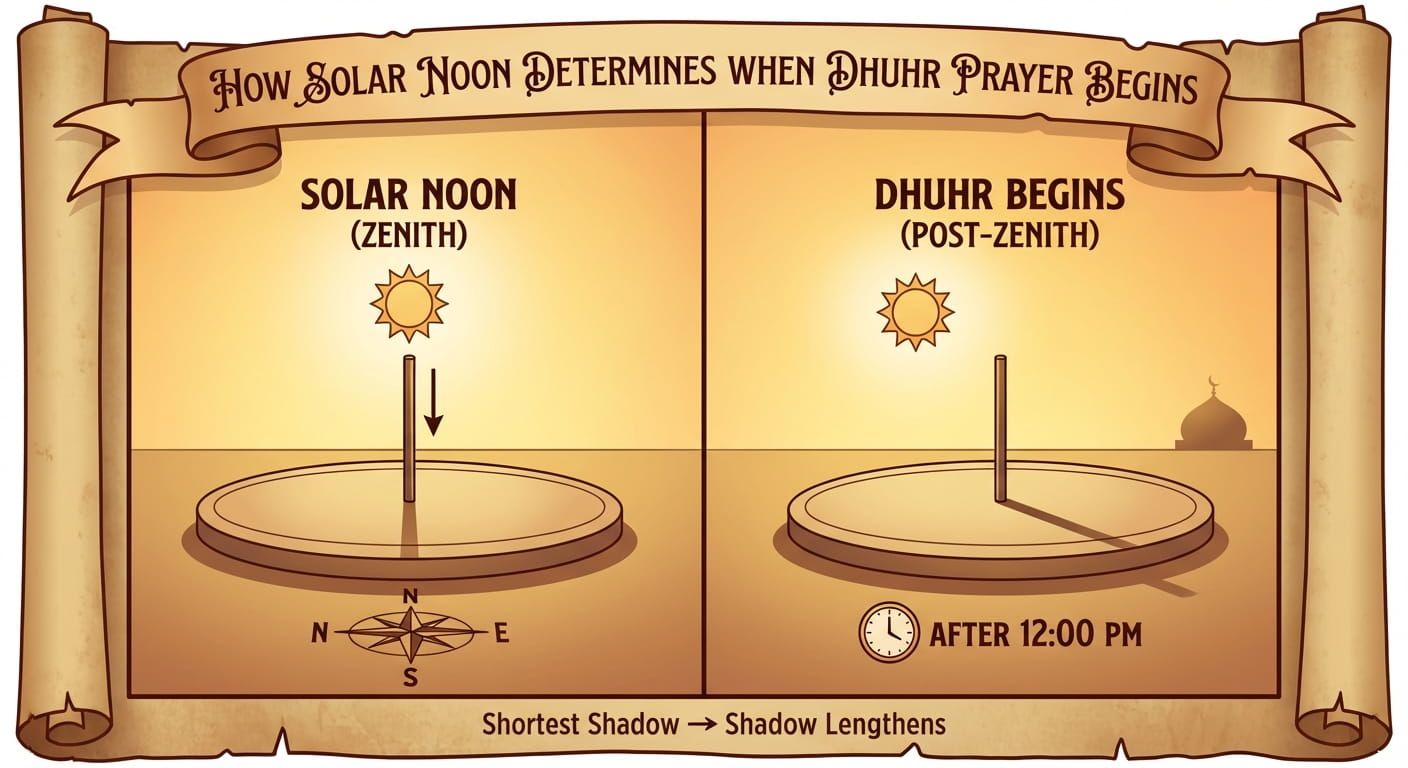
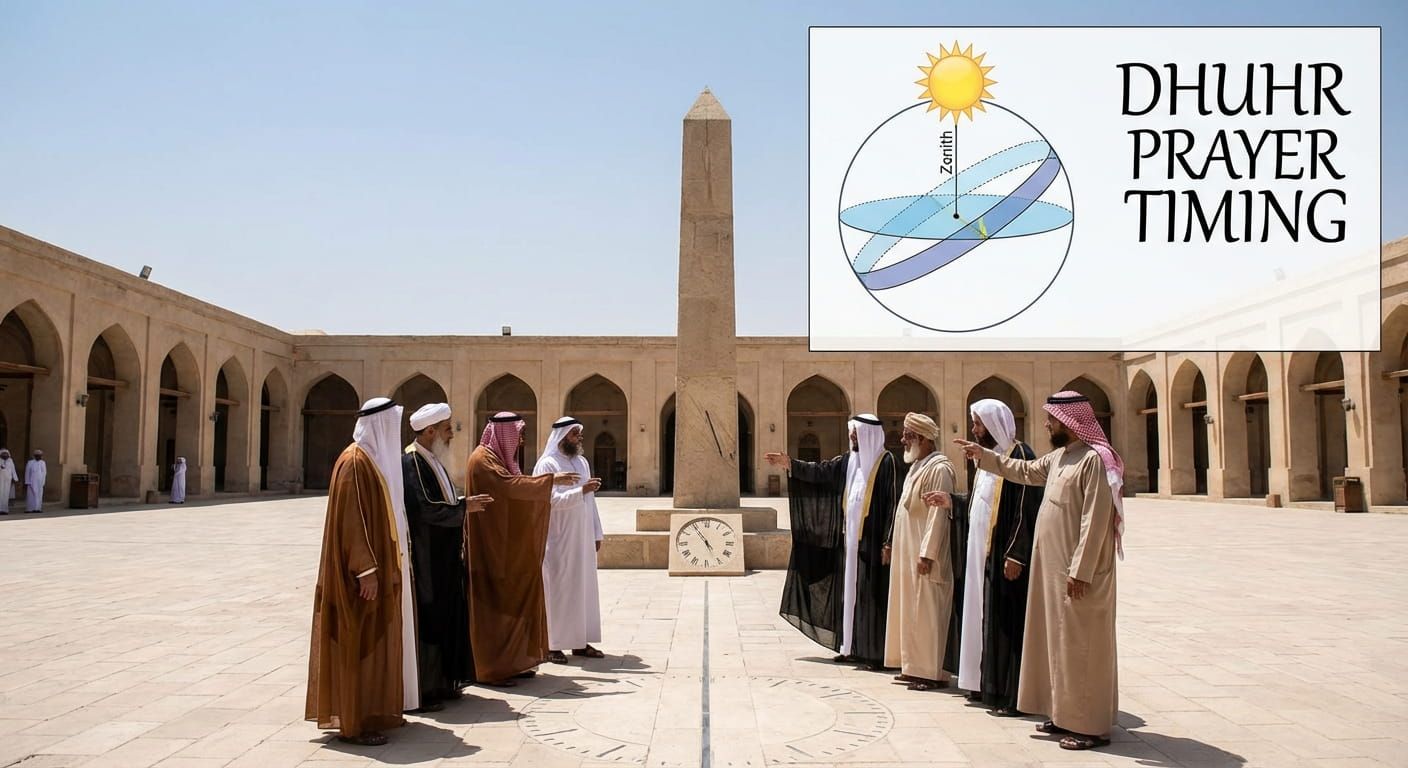
Dhuhr begins after the sun passes the local meridian, the point where it reaches its highest place in the sky for that day. Many people casually call that noon, but clock noon and solar noon are not always the same. Standard time zones flatten large east west distances into one shared clock. The sun does not flatten with them.
“Dhuhr is tied to the sun crossing its peak, not to a watch striking 12:00. Longitude explains why one city can begin earlier even while sharing the same zone name with another.”
Why Eastern Cities In One Zone Reach Dhuhr Earlier
Imagine two cities inside the same time zone. The eastern one faces the sun a little sooner as Earth rotates. That means its local solar noon arrives first. Since Dhuhr begins just after that point, the eastern city starts earlier. The western city has to wait a bit longer for the sun to cross its own local meridian.
This can feel strange because both places may show the same clock time on a phone. Yet the sky is not in the same stage. That difference is one reason prayer schedules can vary even between nearby cities. It is also why checking a city specific page matters more than relying on a general time zone label alone. You can see this city by city on pages for Dhuhr time in New York City and Dhuhr time in Chicago, where local solar timing shapes the schedule in a very practical way.
- Farther east usually means earlier solar noon.
- Earlier solar noon usually means earlier Dhuhr.
- Shared zone clocks do not erase longitude differences.
- Local calculation keeps the prayer time tied to the sun.
The Four Minute Rule In Real Numbers
The four minute rule is simple enough to remember without a calculator. Move one degree east, solar time shifts about four minutes earlier. Move one degree west, solar time shifts about four minutes later. A spread of five degrees creates roughly twenty minutes of solar difference. A spread of eight degrees creates roughly thirty two minutes.
This does not mean every Dhuhr schedule differs by exactly that amount every day, because latitude, the equation of time, and local calculation settings also play roles. Still, longitude gives the backbone. It explains the broad direction and a large portion of the gap you see between cities.
Boston And Detroit Show The Same Zone Problem Clearly
Boston and Detroit are both commonly treated as part of Eastern Time in the United States. Their clocks follow the same zone, yet their longitudes are not the same. Boston sits farther east. Detroit sits farther west. Using the four minute rule, that east west spread creates a meaningful solar difference, which is why Dhuhr in Boston can begin earlier than Dhuhr in Detroit.
The point here is not the exact daily number on one specific date. The point is the direction of the difference and the reason behind it. Boston reaches solar noon first because it lies farther east. Detroit reaches it later because it lies farther west. Shared civil time does not cancel local solar timing.
Why The 15 Degree Zone Standard Helps, And Why It Never Solves Everything
Standard time zones are built around a tidy idea. Since Earth turns 15 degrees each hour, one zone can roughly cover 15 degrees of longitude. In theory, that keeps solar time within about half an hour of the zone center on each side. It is an efficient civil system. People can work, travel, study, and coordinate with one shared clock.
Still, real world boundaries are shaped by countries, regions, transport links, and public life. Some zones are wider than the ideal model. Some borders bend around politics and geography. That means the sun can feel early in one part of a zone and late in another. Dhuhr calculation has to respect the sky, not just the legal clock.
- The 15 degree model gives one hour for roughly each zone.
- The center meridian acts like the reference line for standard time.
- Cities east of that line tend to reach solar noon before 12:00 zone time.
- Cities west of that line tend to reach solar noon after 12:00 zone time.
- Dhuhr follows the actual solar crossing, which is why city schedules differ.
City Examples Across The World Make The Pattern Easier To See
The pattern is not limited to one country. It appears across continents. In North America, Dhuhr time in Toronto and schedules farther west reveal how the same broad zone logic can still produce local variation. In Europe, Dhuhr time in London does not mirror cities farther east on the continent, even when people casually speak about noon as if it were one fixed moment.
Across the Middle East and South Asia, comparing Dhuhr time in Dubai, Dhuhr time in Karachi, and Dhuhr time in Cairo makes it easier to appreciate how longitude shapes the hour at which solar noon appears on the clock. The same idea extends eastward through Dhuhr time in Singapore and Dhuhr time in Tokyo, where the zone label alone never tells the full story.
Large countries make this especially visible. China, Australia, and the United States stretch far across longitude. Even where one official clock covers a broad area, local solar timing keeps moving from east to west. That is part of the reason dedicated city pages are useful. They do the local work that a zone label cannot do by itself.
Why Clock Noon And Dhuhr Noon Are Not Always The Same
Many people assume Dhuhr begins right at 12:00. Sometimes it lands near that mark. Often it does not. Longitude is one reason. The equation of time is another. Earth’s orbit is not a perfect circle, and its axis is tilted. Those facts shift apparent solar time through the year. Put those seasonal effects together with longitude, and the gap between watch noon and solar noon becomes easy to understand.
That is why a helpful explainer on why Dhuhr is not always noon connects so naturally with longitude. A related page on solar noon and Dhuhr prayer also fits this topic because both ideas point back to the same principle, Dhuhr is a solar event first, a clock reading second.
How Prayer Time Tools Turn Longitude Into A Usable Schedule
A good prayer time tool starts with location. Longitude and latitude define where you are on Earth. From there, the calculation estimates the sun’s position for the date and place. Once the sun passes the local meridian, Dhuhr begins. The result is more precise than a rough guess based on a time zone map.
That is one reason time.now works well as a practical resource. The site covers clocks, timers, calendars, time zones, and prayer times in one place. For someone checking local prayer schedules, city based pages reduce confusion and make the astronomy feel less abstract. A broad example appears in Dhuhr time in Los Angeles, where the local solar context matters far more than a one size fits all assumption.
A Simple Way To Think About Your Own City
You do not need advanced astronomy to keep the main idea straight. Think in three steps. Your time zone gives a shared civil clock. Your longitude shifts solar time inside that zone. Dhuhr begins after local solar noon. That is the chain.
For an easy memory aid, keep this short set in mind within one paragraph: east means earlier solar noon, west means later solar noon, each degree means about four minutes, and broader zones create wider differences. That one line explains a lot of what people notice when comparing cities from Boston to Detroit, from London to Cairo, and from Singapore to Tokyo.
A practical note
Two cities can share the same legal time, the same date, and even nearby weather, yet still begin Dhuhr at different clock moments. Longitude is often the clearest reason. Once that clicks, prayer timetables stop looking inconsistent and start looking precise.
Reading The Sun Through Longitude
The role of longitude in calculating Dhuhr prayer times is both elegant and grounded. Earth turns. The sun reaches each meridian in sequence. Every degree shifts solar time by about four minutes. Eastern cities in a time zone reach Dhuhr earlier because they meet local solar noon earlier. Western cities follow later. The 15 degree time zone standard helps organize daily life, yet Dhuhr still belongs to the sun’s actual position above each place. That is why local prayer pages matter, and why a city based reading of time gives a truer picture than a zone label alone.