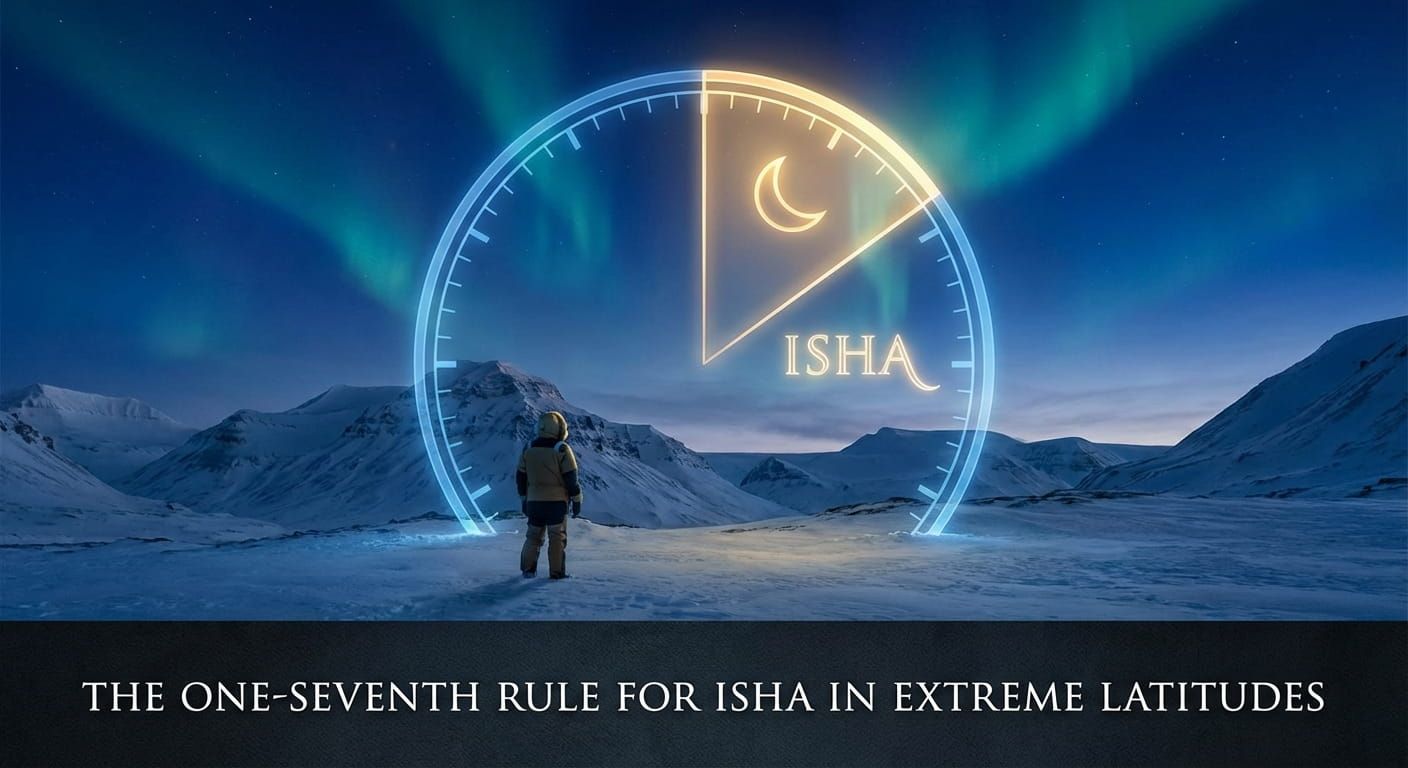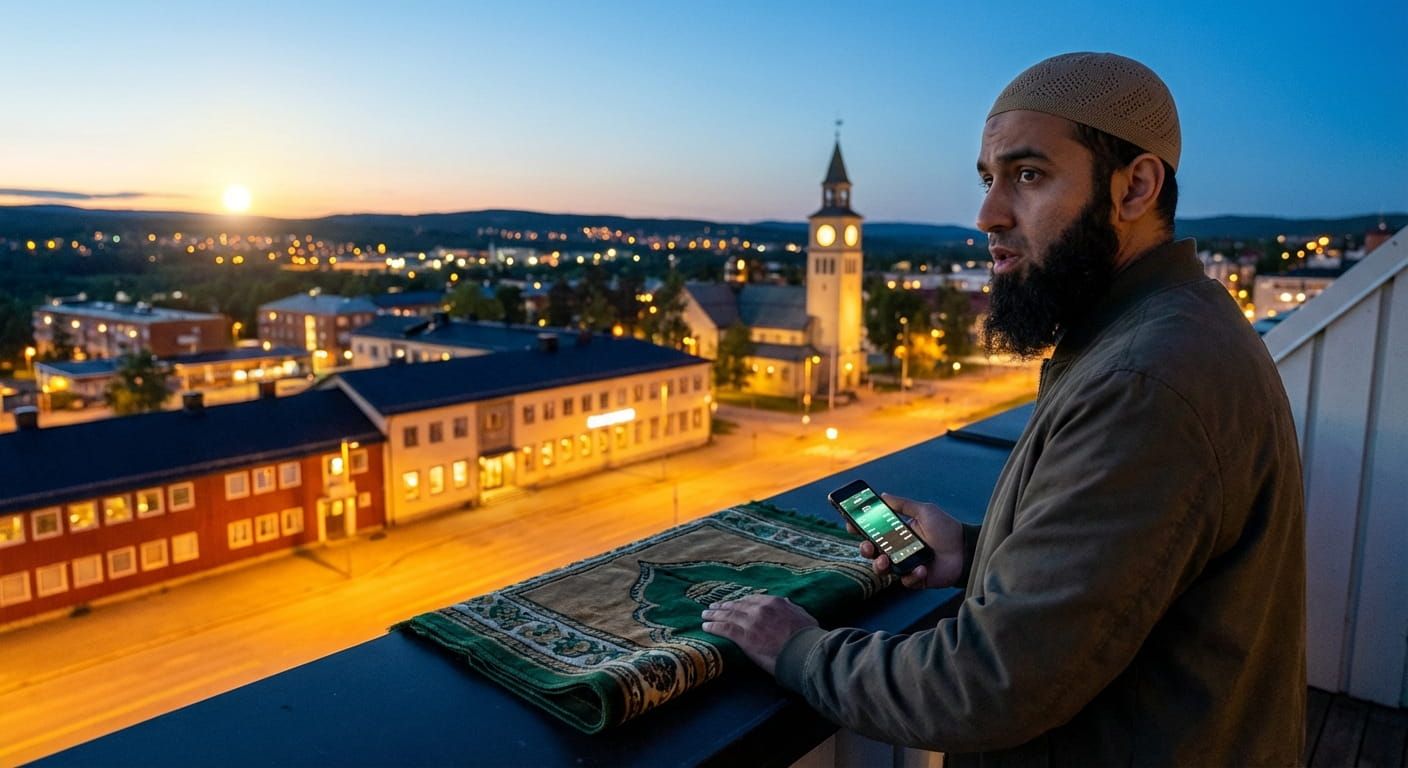
Summer can stretch the night until it almost disappears. In parts of Northern Europe, Alaska, and northern Canada, that creates one of the hardest prayer time questions a Muslim can face, when does Isha begin if the sky never gets dark enough? For many families, this is not a theory problem. It shapes sleep, work, school, fasting, and peace of mind across June and July.
Key takeaway
In white night regions, the usual twilight sign for Isha may not appear in June and July. Muslims often rely on scholarly methods that keep worship manageable and rooted in fiqh. Common approaches include the 90 minute rule after Maghrib, using the nearest valid country or city where twilight still occurs, and fixed interval methods set by local councils. The aim is faithful prayer with clarity, consistency, and mercy.
Test Your Understanding
Tap an answer and check your understanding of how Muslims handle Isha in places where darkness barely arrives.
Which method uses a nearby place where the twilight sign still appears?
Why White Nights Make Isha Hard To Identify
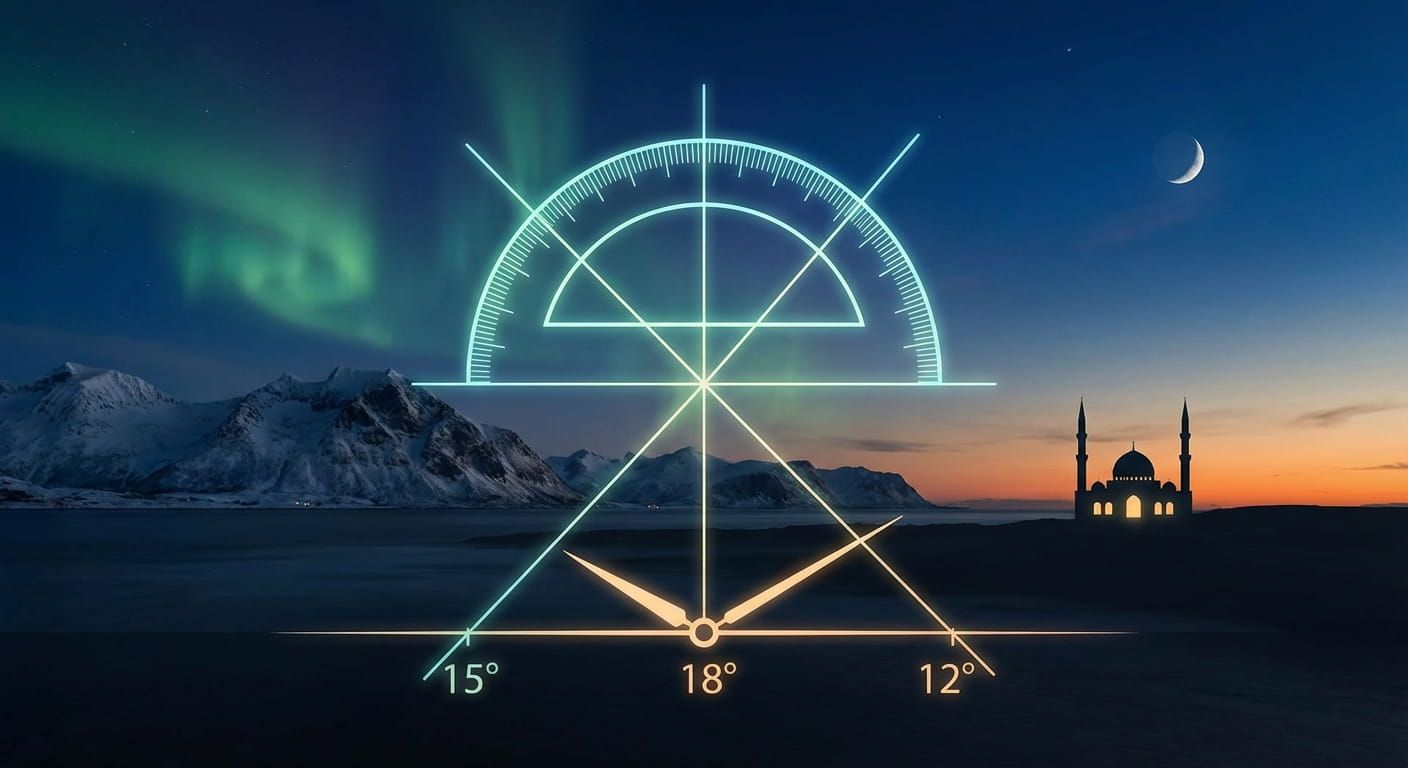
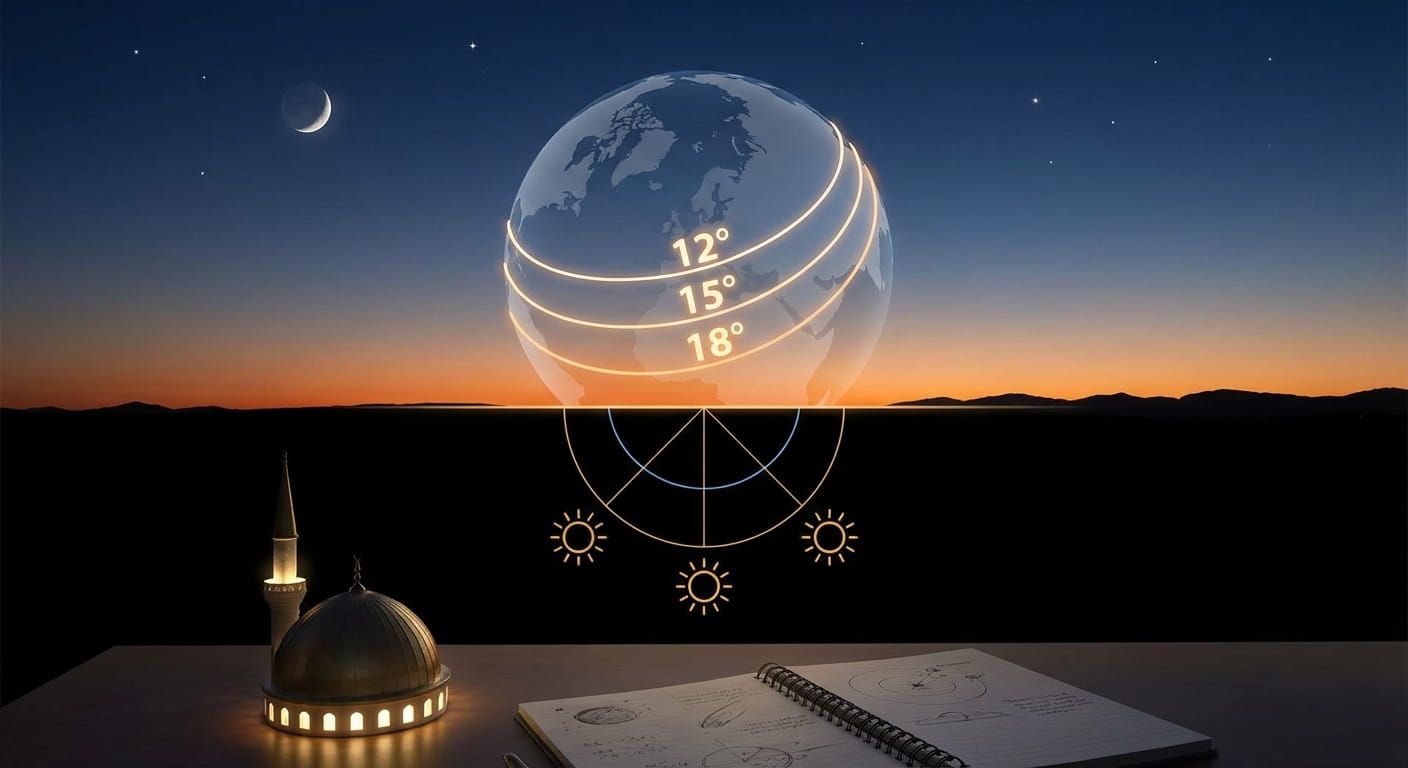
Under ordinary conditions, Isha begins after evening twilight disappears. In many prayer timetables, that is tied to a twilight angle below the horizon. In places farther north, that sign can fade very late, or not fully appear at all, during high summer. Cities in Norway, Sweden, Finland, Iceland, parts of Scotland, and parts of Russia can all face this issue. The same pressure shows up in Alaska and large parts of northern Canada.
Think about Tromsø, Bodø, Reykjavik, Rovaniemi, Kiruna, Fairbanks, Anchorage, Whitehorse, Yellowknife, Iqaluit, Edmonton, and parts of northern Ontario. June and July can bring nights that stay bright, or at least bright enough that classical twilight markers become difficult or impossible to observe. A timetable that waits for full astronomical darkness may push Isha to an hour that leaves people exhausted, or may fail to produce a meaningful time at all.
Voices from the far north: “You look outside at midnight and the sky still feels like late evening,” many Muslims in northern Sweden and Alaska explain. “The challenge is not laziness. The challenge is that the sign you are waiting for may not arrive in a normal way.”
This is why scholars did not leave these communities alone with confusion. They developed methods that preserve worship and remove hardship. The issue is not whether Isha matters. It matters deeply. The issue is how to mark its entrance when nature behaves differently near the poles.
How Scholars Frame The Problem
Islamic law has long dealt with unusual circumstances. The broad principle is that prayer remains due, but the method of timing may need adaptation when the normal sign is missing or severely distorted. This happens with fasting too, but prayer needs daily practical solutions.
Three ideas usually guide the discussion:
- The prayer itself does not drop away because the sky pattern is unusual.
- Hardship should be reduced through an accepted fiqh method, not personal guesswork every night.
- Consistency within a community matters, because families, mosques, and schools need a stable timetable.
Some councils preserve angle based calculations for as long as they still produce a sensible result. Others shift to estimated timings when the twilight sign no longer functions. Those estimated timings often take one of the forms below.
The 90 Minute Rule And Why Many Communities Use It
The 90 minute rule is one of the best known solutions. It simply places Isha 90 minutes after Maghrib. Many Muslims appreciate it because it is easy to follow, easy to explain to children, and manageable for workdays. It also reflects the fact that in many mid latitude cities, the gap between Maghrib and Isha often lands around that range outside extreme seasons.
This method is common in places where twilight based calculation becomes unstable in summer. A mosque in northern England may use it for a limited part of the year. Communities in Oslo, Stockholm, or parts of Canada may also use it when the usual angle produces very late times. The method can reduce confusion and help preserve congregational prayer.
Still, scholars note that it is an estimate, not a direct reading of the sky. That means it should be adopted with a clear fiqh basis, ideally through a local mosque board, national fatwa body, or a respected council that has looked at the region’s conditions carefully.
Readers who want a deeper look at the gap between the sunset prayer and the night prayer can continue with how long maghrib to Isha, which gives helpful context for why that interval can vary so much by season and latitude.
Using The Nearest Valid Country Or City
The nearest valid country method works by borrowing the timing from a nearby place where the twilight sign still occurs in a normal way. In practice, some communities use the nearest valid city rather than an entire country, since cities give a more precise timetable. The idea is simple. If your own location cannot produce a workable Isha sign, look to the nearest location that can.
For example, a Muslim community in far northern Norway may look south to a city where twilight still ends. A family in northern Canada may use a more southern Canadian city, or another nearby valid location, rather than a place on the other side of the world. This keeps the borrowed timing rooted in geography and season.
The strength of this method is that it stays connected to the natural twilight cycle, even if that cycle is borrowed from nearby. The challenge is deciding what counts as “nearest” and “valid.” That needs agreement. Without shared guidance, one family may follow one city and another family a different one, creating unnecessary strain.
From northern Canada: “We wanted something that still felt tied to the sky,” one worshipper in Yukon described. “Borrowing from a nearby valid place gave us that sense of continuity, while also letting us sleep.”
Fixed Interval Methods Bring Stability To Daily Life
Fixed interval methods set Isha at a chosen period after Maghrib, sometimes 90 minutes, sometimes 100, 110, or 120 minutes depending on the school or local policy. A fixed schedule is especially useful for mosques trying to keep jama'ah times predictable throughout June and July. Families with children also find it easier than checking changing astronomical data each evening.
In practice, these methods are often paired with seasonal limits. A mosque may use normal angle calculation until the time becomes excessively late. After that point, it shifts to a fixed interval. Once darkness patterns return to something more familiar, it shifts back.
That is one reason Isha calculated differently worldwide is worth reading. It shows that there is no single global timetable model for Isha. Different regions face different sky conditions, and their methods reflect those realities.
What June And July Feel Like In Northern Europe, Alaska, And Canada
Maps do not always show the human side of the issue. In June, Stockholm can have a very long bright evening. In places farther north, light clings to the horizon through the night. Helsinki and much of Finland experience shallow darkness in high summer. Reykjavik sits at a latitude where twilight can remain drawn out for hours. In Alaska, Fairbanks can stay bright so late that the body feels it is still evening. Parts of Nunavut and the Northwest Territories face even more severe patterns.
These conditions affect more than one prayer. They affect sleep cycles, commute times, school routines, early fajr preparation, and family energy. A person may finish Isha and then feel there is barely any time before sleep or before the next prayer timetable starts creeping in. During Ramadan, the pressure grows stronger.
Many Muslims describe the emotional side as just as real as the legal side:
- They want a method they can trust.
- They do not want to feel guilty for following a local scholarly adjustment.
- They want mosque unity, not argument after argument.
- They want their children to see prayer as steady and livable.
A Clear Way To Compare The Main Approaches
How Families And Mosques Usually Decide
- They ask which method their local mosque or council already follows.
- They check whether the policy changes only in June and July, or across a wider summer period.
- They look for a method that fits accepted scholarship, not just convenience.
- They keep the household on one clear timetable to avoid stress.
- They stay with that method unless trusted scholars advise a better local option.
This kind of order matters. A family in London may only need a small adjustment for part of summer. A family in Amsterdam or Berlin may face a bigger change. In Toronto or Edmonton, the issue can feel very different depending on the exact month and latitude. That is why local guidance matters more than copying a timetable from another continent.
What Muslims In These Regions Often Say
Personal testimonies give life to the legal discussion. Worshippers in northern Sweden often mention the mental strain of waiting for a darkness level that never feels complete. Muslims in Alaska talk about children asking why bedtime arrives before the sky looks like night. Canadian families describe trying to hold onto congregation while still protecting health and work schedules.
From Norway: “Once our mosque chose one method and explained it clearly, the tension dropped. People stopped feeling they had to solve the sky alone.”
From Alaska: “The fixed interval helped our family sleep without feeling that we were cutting corners.”
From Canada: “Using a nearby valid place made sense to us because it still felt connected to real twilight, just not our exact horizon.”
These testimonies point to one shared need, confidence. People can live with variation in method. What wears them down is uncertainty night after night.
Useful References For Comparing Summer Timings
Anyone tracking how twilight behaves at high latitudes will benefit from reading twilight angle isha northern countries. It explains why northern skies push standard angle based calculations to their limits. For city based examples, readers often compare regional pages such as London Isha prayer times, Berlin Isha prayer times, Toronto Isha prayer times, Amsterdam Isha prayer times, and Moscow Isha prayer times to see how location changes the result.
Those pages are not a substitute for local scholarly direction, though they can help readers understand why the same month feels very different in Cairo, Mecca, Karachi, Istanbul, Lagos, New York City, Paris, or Stockholm. Latitude changes the sky, and the sky changes the timetable.
A Steady Path Through The Brightest Nights
The challenge of Isha during white nights is real, but it is not without guidance. Muslims in Northern Europe, Alaska, and Canada have workable paths grounded in scholarship and lived experience. The 90 minute rule offers simplicity. The nearest valid country or city method keeps a link to twilight. Fixed interval methods give communities a stable summer rhythm. Each method tries to honor the prayer while protecting people from confusion and harm.
For the person standing by the window at 11:30 p.m., still seeing light on the horizon, that balance matters. Prayer should call the heart toward Allah, not trap a believer in panic. With sound local guidance, a clear method, and community unity, even the brightest nights can hold a calm and faithful place for Isha.