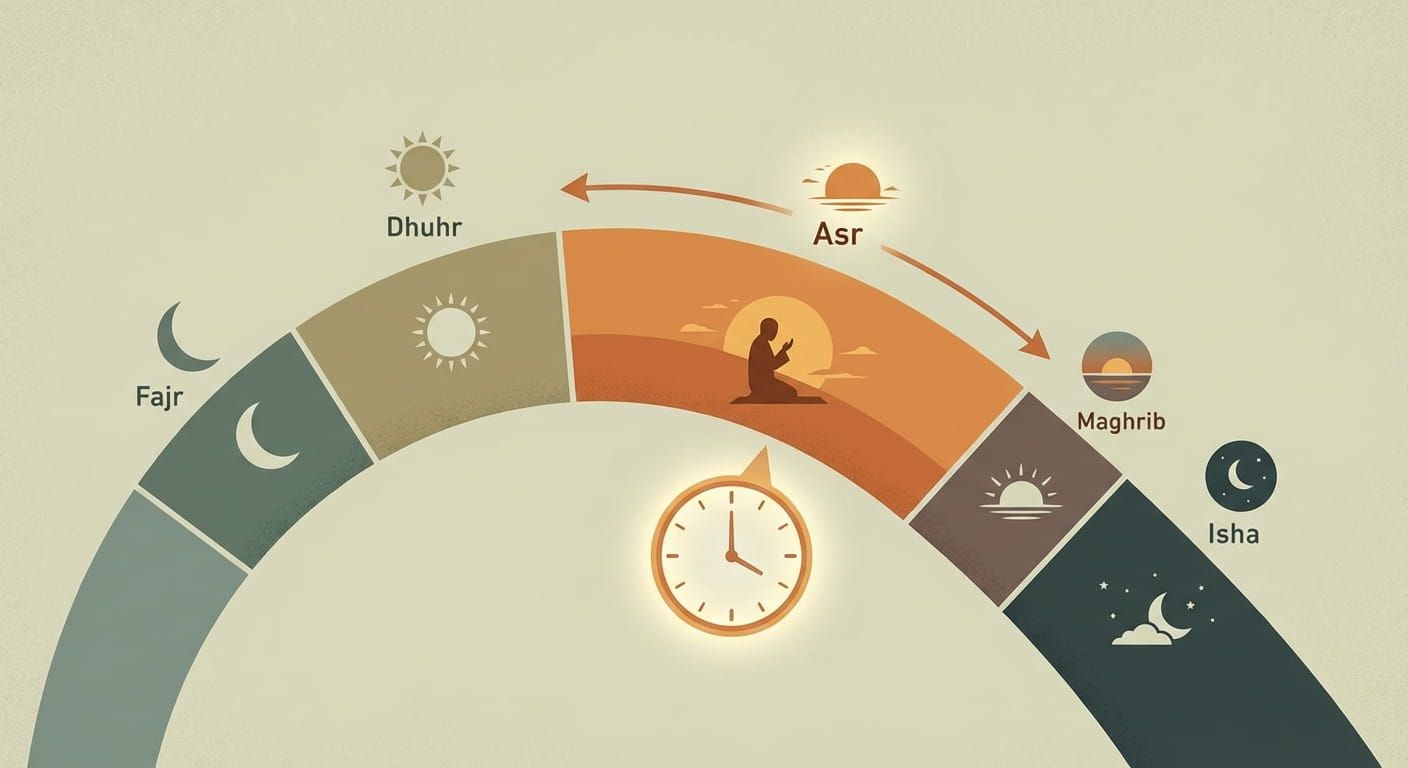
A few minutes can change the feel of your afternoon prayer, and Asr is the prayer where that difference often stands out the most. In one method, Asr begins when an object’s shadow matches its own height, after the midday shadow is set aside. In the Hanafi method, Asr begins later, when that shadow reaches twice the object’s height. That single juristic difference is why many people notice a gap of about 30 to 60 minutes between prayer calendars, mosque schedules, and mobile apps.
Standard Asr begins when an object’s shadow equals its height, beyond the midday baseline. Hanafi Asr begins when that shadow reaches twice the height. That makes Hanafi Asr later, often by 30 to 60 minutes, though the exact gap changes with season and latitude. Many apps let you choose a madhab setting, and many communities follow the method tied to their local school of fiqh.
Test your grasp of the Asr timing difference
Pick one answer, then tap the button.
What the two Asr methods actually measure
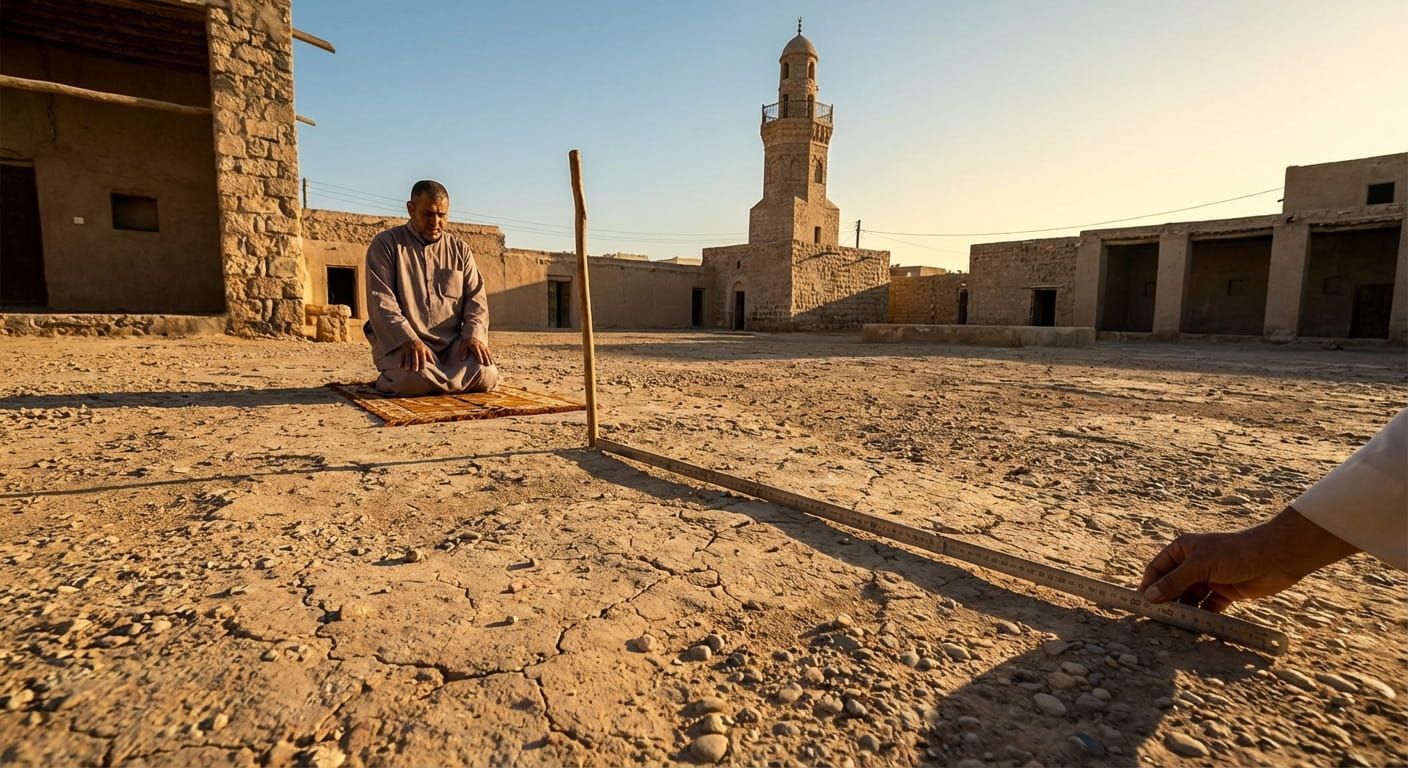
Both methods watch the sun and the length of shadows in the afternoon. The key point is not the total shadow seen on the ground at every moment. Scholars account for the shadow that exists around local noon, then measure the increase after that point.
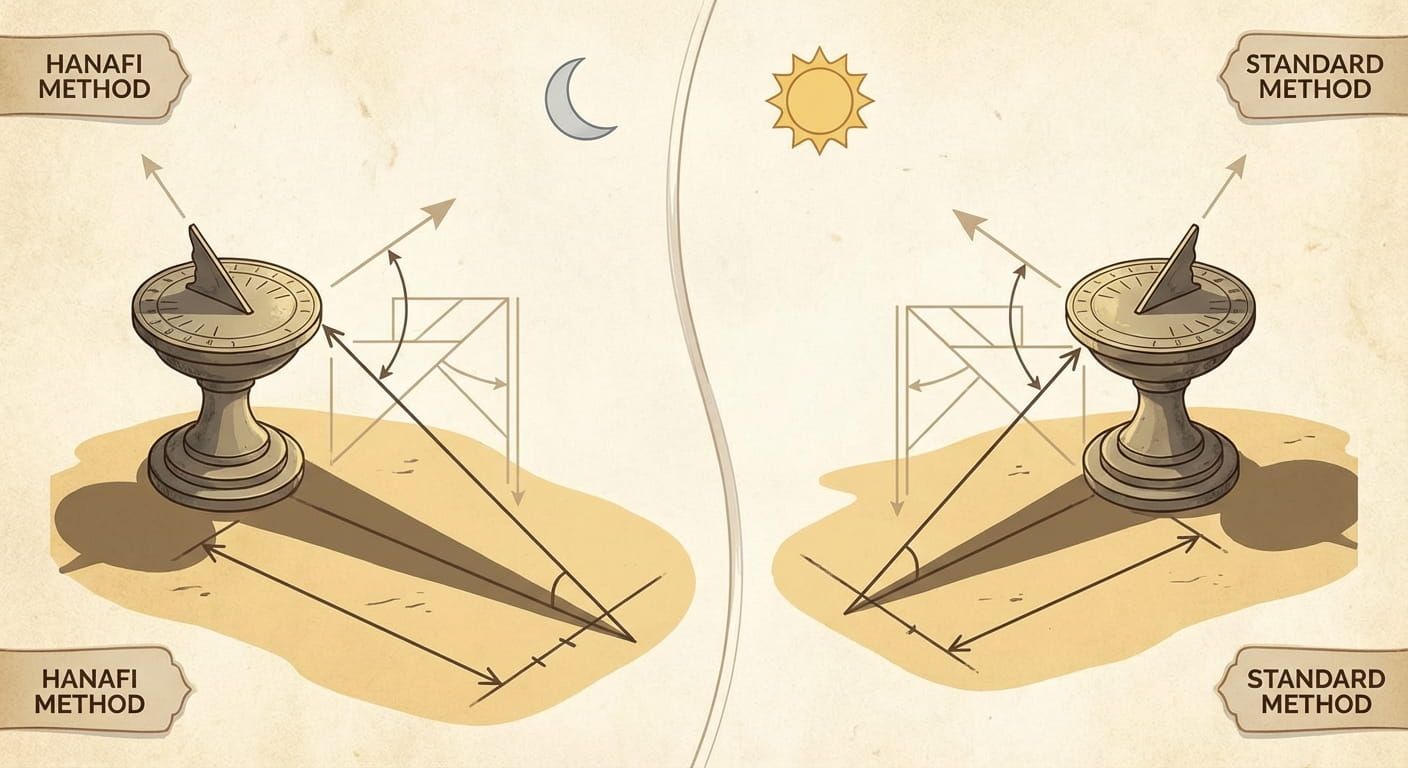
In the standard method, used by Shafiʿi, Maliki, and Hanbali schools, Asr starts when the added shadow equals the object’s height. If a stick is one meter tall, the added afternoon shadow reaches one meter, and Asr enters.
In the Hanafi method, Asr starts later. Using that same stick, the added afternoon shadow must reach two meters. This extra length takes more time, which is why the prayer entry is later on the clock.
Why Hanafi Asr appears later on prayer calendars
The later timing is not a calendar error. It is a fiqh choice. The sun keeps moving lower in the sky through the afternoon, and the shadow keeps growing. Reaching one times object height happens first. Reaching two times object height happens after that.
In many cities, the gap lands between 30 and 60 minutes. In some seasons it may be a little smaller. In other places, especially at higher latitudes, it can feel more noticeable. London, Berlin, Toronto, and Moscow may show a wider seasonal swing than Mecca, Medina, Dubai, or Karachi.
That is why a person checking Asr in London during summer may notice a different pattern from someone viewing prayer times in Cairo or Riyadh. Geography shapes the exact clock time. The juristic method shapes the rule being applied.
“Later” in Hanafi scheduling does not mean “better” or “more accurate” in a universal sense. It means the timing follows the Hanafi juristic threshold for the start of Asr.
A side by side view of the two approaches
How apps, mosques, and countries usually handle the difference
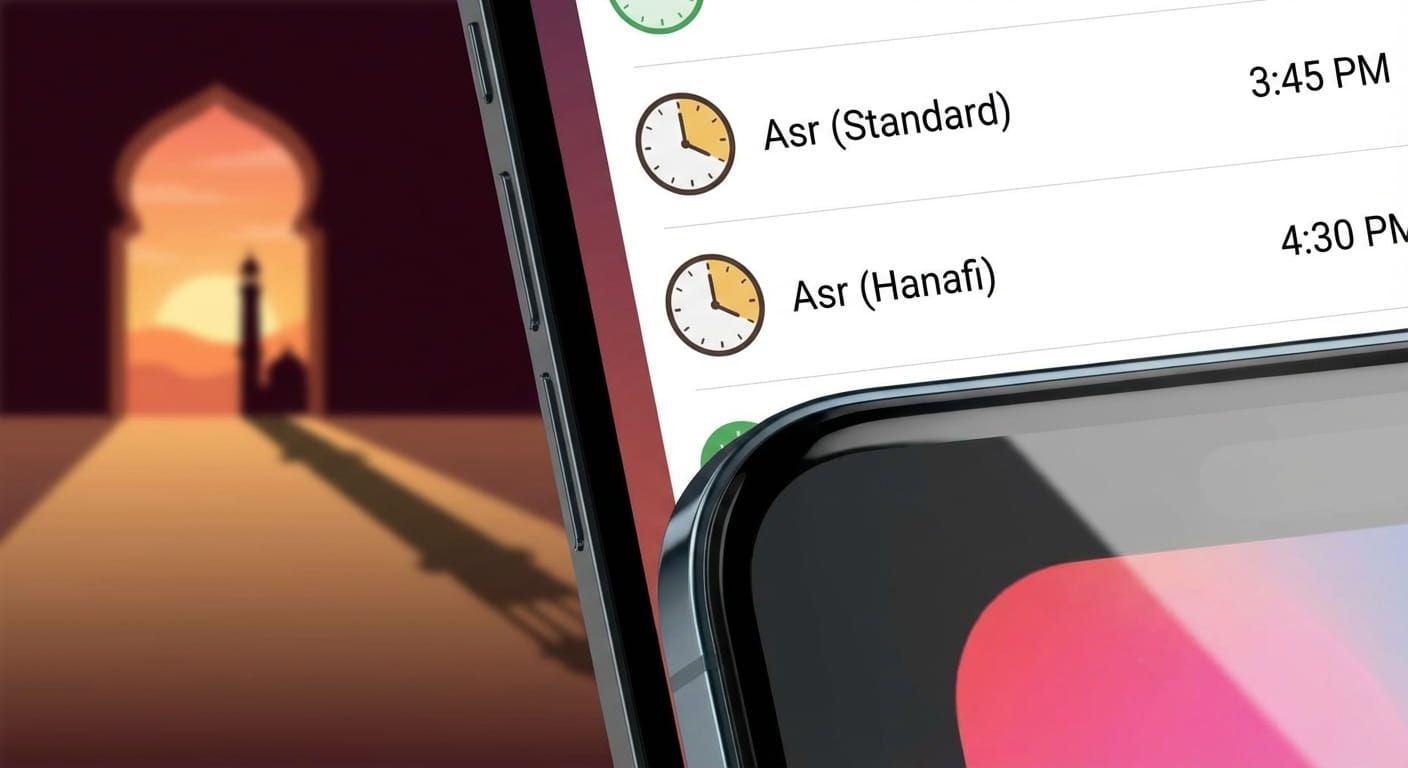
Many prayer apps include a madhab setting. You choose standard or Hanafi, and the Asr time updates. This is common because users may live in the same city yet follow different schools. A family in Chicago may use the standard setting while a nearby mosque follows Hanafi. Both are reading the same sky, though they are applying different fiqh rules.
Across the Muslim world, practice often follows local scholarly tradition, mosque leadership, or the prayer authority whose timetable is being used. In South Asia, Hanafi settings are often widespread. That means Karachi, Delhi, Dhaka, and parts of Mumbai may commonly display a later Asr. In other regions, including much of Egypt, East Africa, the Gulf, and parts of Southeast Asia, standard scheduling is often more visible in public timetables.
This is why a person checking Asr in Karachi may expect a Hanafi aligned community norm, while someone looking up Asr in Cairo may see schedules shaped by a different local pattern. In Indonesia, a reader reviewing Asr in Jakarta may find the timing closer to the standard approach used by many public tables.
- South Asian communities often prefer Hanafi Asr in mosque timetables and personal apps.
- Many global apps let you toggle the madhab setting inside prayer time preferences.
- Public schedules may follow the dominant local fiqh tradition, not every household’s preference.
- Travelers should check the app setting before assuming a timetable is wrong.
What this looks like in real cities
Seeing local pages helps make the point clearer. In Saudi Arabia, readers comparing daily changes in Asr in Mecca and Asr in Medina can see how close geography keeps the daily rhythm, even while fiqh choice still shapes the exact entry time.
In the Gulf, Asr in Dubai often feels familiar to travelers from Riyadh and other nearby cities. In Africa, Asr in Lagos gives another useful point of comparison because the afternoon shift through the year differs from what people see in Europe.
Asia adds even more variety. A reader checking Asr in Singapore may notice a steadier year round pattern than someone following Asr in Tokyo, where seasonal daylight swings feel stronger. Nairobi, Bangkok, Manila, Seoul, and Beijing each bring their own daylight rhythm too.
A simple rule to keep in mind
Same city does not always mean same Asr start. The method setting matters. The season matters too. That is why two reliable schedules can differ without either one being mistaken.
Which method should you follow
The cleanest answer is to follow the method tied to your madhab, your local imam, or the mosque where you pray regularly. That keeps worship steady and removes daily uncertainty. A person trained in Hanafi fiqh will usually choose the Hanafi setting. A person following Shafiʿi, Maliki, or Hanbali fiqh will usually choose the standard setting.
For many people, the practical issue is not theory but app setup. If your app is showing a later Asr than your local mosque, open the prayer calculation settings and check whether the madhab is set to Hanafi or standard. That single tap often explains the gap.
- Check which madhab your mosque timetable follows.
- Open your app settings and look for the Asr or madhab option.
- Match the setting to your school of fiqh or your local congregation.
- Recheck while traveling, since local norms can differ from home.
- Use one reliable source consistently, instead of jumping between mixed schedules.
Common points of confusion around Asr timing
One common mix up is treating the standard method as the default for every Muslim community. Another is assuming Hanafi timing is a later safety buffer added by apps. It is not a simple buffer. It is a defined juristic threshold with a clear shadow rule behind it.
Another point of confusion appears during travel. Someone moving from Delhi to Istanbul, or from Nairobi to New York City, may notice that public schedules feel different even before changing app settings. Latitude, season, and local fiqh custom all shape what appears on the timetable.
This is also why Time.now can be useful as a reference site. A person checking city specific pages for Asr can compare daily timings with their own settings and understand whether the change comes from place, season, or madhab preference.
Finding calm in the later or earlier start
The title question has a simple answer with a meaningful layer behind it. Standard Asr starts earlier because the shadow condition is one times the object’s height. Hanafi Asr starts later because the condition is two times the object’s height. That later start is often about 30 to 60 minutes after the standard one, though the exact gap shifts across the year and across the map.
Once you know which rule your mosque, madhab, or app follows, the timetable stops feeling confusing. It starts feeling consistent. And that is exactly what most people want from Asr, clarity, steadiness, and confidence that the prayer has entered according to the method they trust.