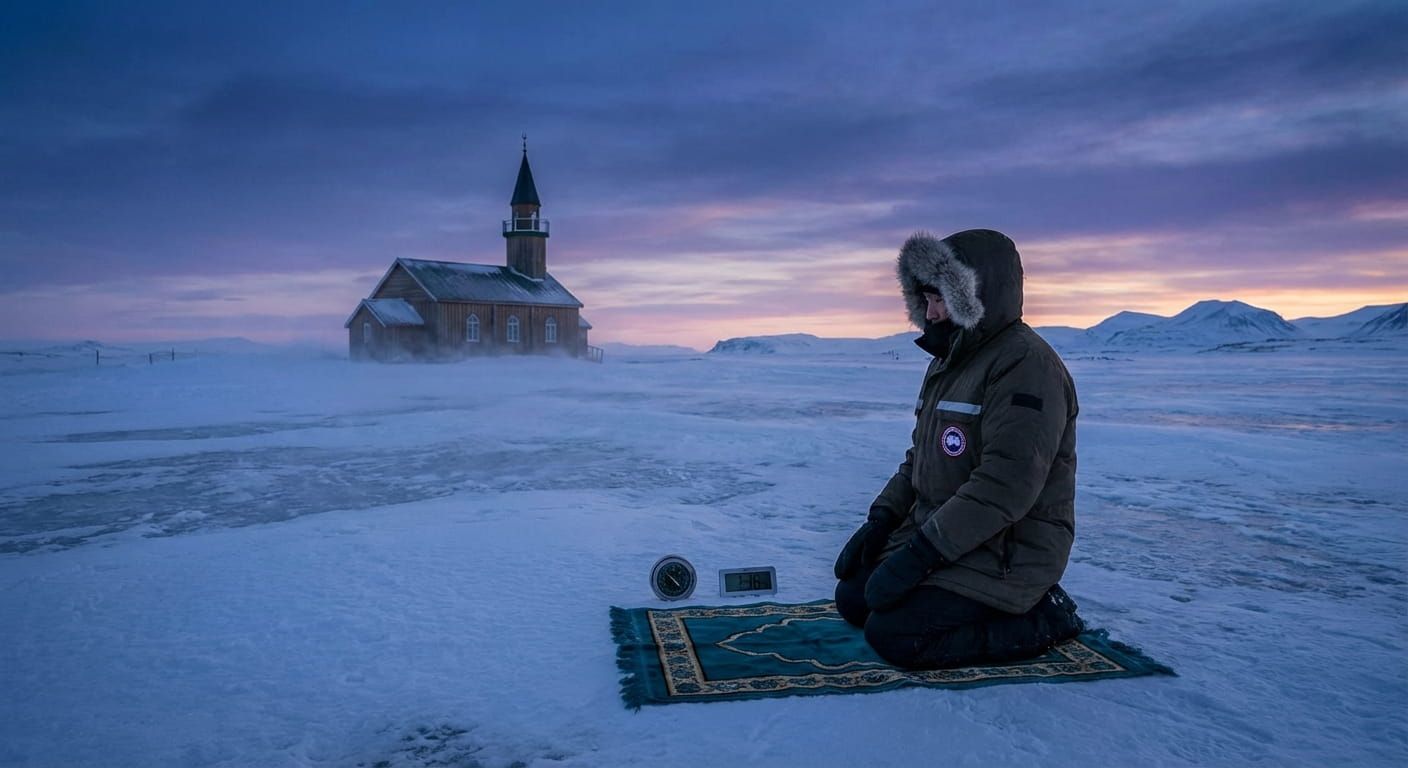
Summer near the Arctic Circle can turn one of the clearest signs of dawn into a real question mark. The sky never gets fully dark, twilight can linger for hours, and in some places the sun does not set at all. That creates a serious issue for Muslims trying to pray Fajr on time. If dawn never appears in the usual way, when does the prayer begin? Scholars have worked on this problem for generations, and their answers aim to protect both the prayer and the people trying to live by it in places like northern Norway, Iceland, and Alaska.
In countries near the Arctic Circle, Fajr can become difficult to identify in summer because true dawn may not appear during nights with continuous daylight or bright twilight. Scholars respond with three main methods: using the nearest place with a valid dawn, applying a fraction of the night such as one seventh, or adopting a fixed interval before sunrise. Communities in Norway, Iceland, and Alaska often rely on one of these methods to keep worship workable and consistent.
A simple check before reading further
Pick the answer you think is right, then tap the button.
1. What creates the hardest summer problem for Fajr near the Arctic Circle?
2. Which method uses a fraction of the night?
3. Why do local mosques prefer one agreed method for the whole community?
Why summer breaks the usual signs of dawn
In many parts of the world, Fajr begins when the horizontal light of true dawn spreads across the horizon before sunrise. The pattern is familiar. Night deepens, then dawn arrives, then sunrise follows. Near the Arctic Circle, that pattern can weaken or disappear in summer. The sun dips only a little below the horizon. In some places it does not dip below it at all. That means the sky may stay bright through the night or move through a soft twilight without reaching the darkness that normally comes before true dawn.
The technical side matters here. Many prayer timetables calculate Fajr by the sun reaching a certain angle below the horizon. If the sun never reaches that angle, the calculation stops producing a normal result. This is one reason readings from Why Fajr time changes daily and Calculate Fajr twilight angles become especially helpful. They show that Fajr is tied to real solar motion, not just a fixed clock time.
Key idea: the problem is not that Fajr disappears as a prayer. The problem is that the sky stops displaying the normal sign used to identify its start.
What scholars do when true dawn does not appear
Islamic scholarship does not leave people trapped by impossible conditions. Where the usual sign cannot be observed, scholars turn to estimation. The goal is to preserve prayer times with fairness and clarity. Three methods are discussed most often.
- Nearest country or nearest city method. A community uses the prayer time of the closest location where dawn still appears in a valid and observable way. Some scholars define this as the nearest place to the south where the normal twilight pattern still exists. Others frame it as the nearest place with a reliable timetable.
- One seventh rule. The period between sunset and sunrise is divided into seven parts. Fajr is placed at a point linked to one seventh of that night. This is one of the best known fractional night methods because it gives a practical estimate when twilight based angles fail.
- Fixed interval before sunrise. Some councils or local mosques choose a stable interval before sunrise, often based on established juristic guidance or local practice. This can reduce confusion for worshippers who need a workable routine.
None of these methods claims that the sky suddenly behaves normally. They are legal responses to unusual conditions. Communities adopt the method they trust, then apply it with consistency. That consistency matters. A family trying to wake children, a worker starting an early shift, and a mosque setting iqamah times all need a schedule that can actually be followed.
Norway, Iceland, and Alaska in real life
Northern Norway is often the clearest example. In places above the Arctic Circle, the midnight sun can last for weeks. During that period, the sun remains visible at local midnight, which means there is no normal night in the ordinary sense. Muslim communities there often consult trusted mosque councils and adopt an estimated Fajr time rather than waiting for a dawn that does not appear in the usual way.
Iceland presents a related challenge. Reykjavik is below the Arctic Circle, yet summer nights can remain extremely bright, and deeper northern areas experience even more prolonged twilight. The problem may not always be full twenty four hour daylight, but the effect on prayer calculations can still be serious. At certain points in summer, the standard twilight angles used in many prayer apps may no longer produce a meaningful Fajr entry.
Alaska shows how wide this issue is. Anchorage has very long summer days, and communities farther north face conditions much closer to continuous daylight. In practice, mosques and local scholars may publish special summer schedules. Those schedules often reflect one agreed method so worshippers are not forced to guess on their own.
What local communities often prioritize
Consistency for congregational life • Respect for trusted juristic guidance • A method people can understand • A timetable that does not change wildly from one app to another
How the main methods compare in practice
Why one city can still help another
A person living in Tromsø may not have a usable twilight based Fajr in part of the summer. A city farther south may still have one. That is why comparison matters. Looking at Fajr time in Moscow, Fajr time in London, or Fajr time in Istanbul shows how much more stable dawn remains at lower latitudes. Those cities are not substitutes for northern locations in every legal opinion, but they help people grasp what a normal twilight pattern looks like.
The contrast becomes sharper when you compare far northern difficulty with places closer to the tropics or sacred centers. Fajr time in Mecca and Fajr time in Medina follow a much more predictable pattern through the year. That predictability is exactly what disappears as you move toward the far north in summer.
If your app shows no Fajr, an unusually late Fajr, or dramatic shifts that make little sense during peak summer, that is often a sign that standard twilight angles are colliding with extreme latitude conditions.
What worshippers should look for in a timetable
A reliable summer timetable near the Arctic Circle should tell you more than a single clock time. It should make clear which method is being used. Is it based on the nearest valid place? Is it using one seventh of the night? Is it based on a fixed interval adopted by a local council? Without that explanation, people can end up comparing several apps and assuming one of them must be wrong, even though they are based on different legal approaches.
- Check whether your local mosque has issued a summer specific schedule.
- Look for notes that explain the calculation method.
- Stay with one trusted method for the season instead of shifting daily between apps.
- Ask local scholars how they handle the period when normal twilight disappears.
For people living outside the far north, the difference between summer and winter can still be educational. Fajr summer winter differences explains why changing daylight affects prayer times everywhere, even if the change is not as extreme as Norway or Alaska. A reader in Fajr time in Toronto or Fajr time in New York City can see long summer shifts too, though not usually to the point where true dawn disappears completely.
A human side to the issue
This subject is not only about astronomy or legal theory. It affects sleep, work, family routines, and mosque attendance. In places with very bright summer nights, a person may already feel disoriented because the body expects darkness that never really arrives. Add uncertainty over Fajr, and the strain becomes heavier. That is one reason scholars often stress ease within the bounds of worship. A method that preserves prayer while avoiding confusion is not a compromise with faith. It is part of caring for the community.
Quoted idea from the lived reality: in high latitude summers, certainty often comes from shared guidance, not from standing outside and waiting for a horizon sign that never arrives in the expected form.
What makes the best choice for a community
No single sentence can settle every case across every northern region. A coastal town in Norway, a city in Iceland, and a community in Alaska may not face identical sky conditions on the same date. Still, the pattern is clear. Once normal twilight signs fail, communities need a principled estimate. The strongest approach is usually the one backed by trusted scholarship, clearly explained to worshippers, and applied consistently by the local mosque.
That is why the question is not only, “Which method exists?” The deeper question is, “Which method has your community agreed to follow with knowledge and trust?” A stable answer helps people pray on time, sleep with less anxiety, and avoid constant second guessing during the most difficult part of the year.
Under the midnight sun, clarity still matters
Countries near the Arctic Circle bring the Fajr question into sharp focus. In summer, twenty four hour daylight or near continuous twilight can make the normal sign of dawn disappear. Scholars answer that challenge through estimation, usually by using the nearest valid place, one seventh of the night, or a fixed interval before sunrise. Real communities in Norway, Iceland, and Alaska rely on these solutions because daily worship still needs a clear start time, even when the sky stops behaving in the usual way.