Stand in New York City at midday in January, then check Dhuhr in Singapore on the same date, and the contrast tells a bigger story than a simple clock reading. Dhuhr follows the sun, not a fixed civil time, which is why major world cities can feel close on a map of schedules yet very different in practice. Latitude, longitude, daylight saving rules, and the shape of the seasons all leave a clear mark on when this prayer begins.
Key takeaway
Dhuhr varies between major world cities because solar noon shifts with geography and season. New York City and London show wider annual movement, while Dubai changes less, and Singapore stays notably steady across the year. Tokyo sits between these patterns. Equatorial cities stay more consistent because day length barely changes, while temperate zones swing more as summer and winter alter the sun’s path and, in some places, daylight saving time moves the clock itself.
Reader check
Which city usually shows the smallest annual change in Dhuhr time, New York City, London, Dubai, or Singapore?
Why Dhuhr Does Not Land At The Same Clock Time Everywhere
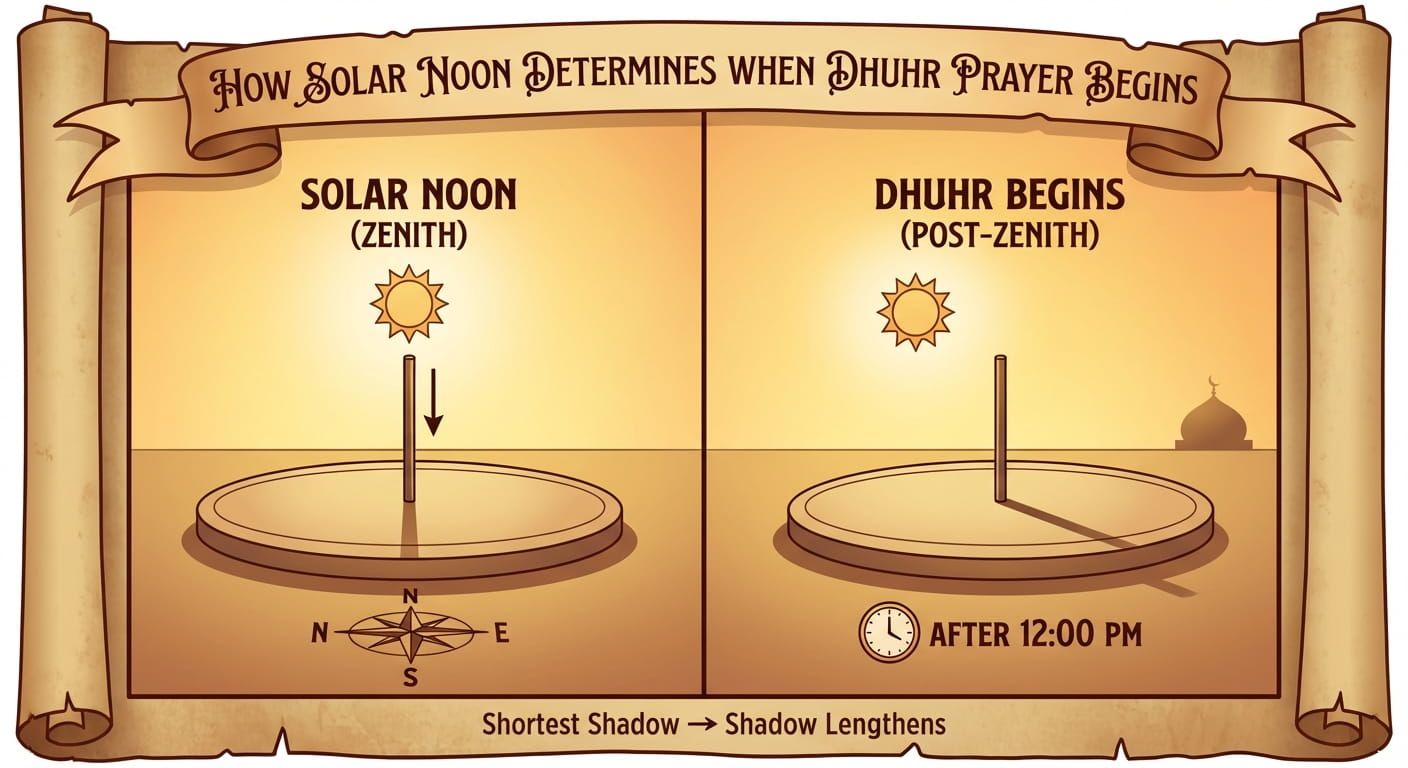
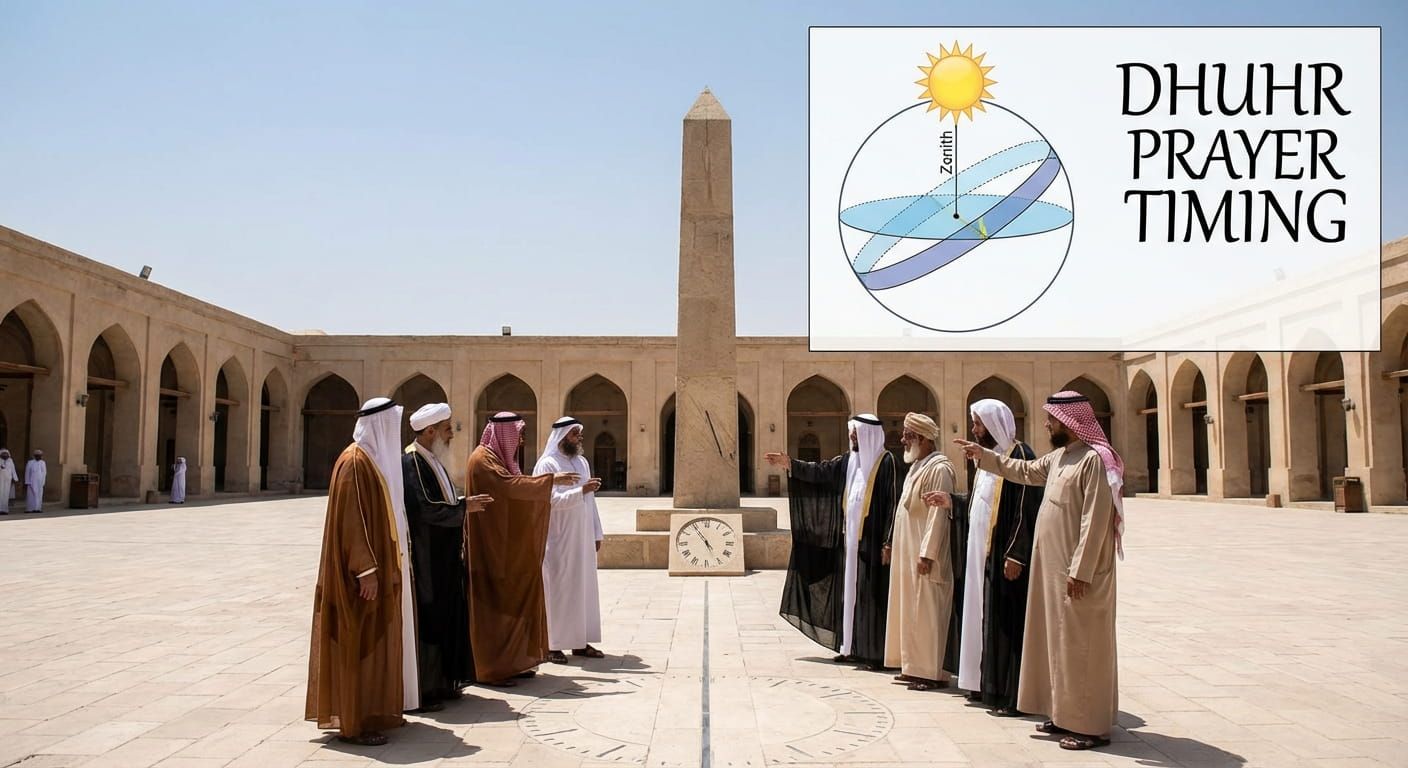
Dhuhr begins after the sun passes its highest point in the sky. That moment is tied to local solar noon, not to the neat center of a printed calendar day. Civil noon is a clock convention. Solar noon is an astronomical event. The two often sit close to each other, though they are not identical.
That difference matters across world cities. New York City and London both sit in temperate zones, yet they are shaped by different longitudes within their time zones and by daylight saving policies. Dubai sits closer to the tropics and avoids daylight saving changes, which makes its annual pattern calmer. Singapore, near the equator, stays steady for much of the year. Tokyo has clearer seasonal movement than Singapore, though less dramatic than cities farther from the equator.
Time.now helps make this easier to follow because readers can move from the broad idea into local pages that show the daily prayer moment in context. A reader comparing Dhuhr and solar noon can then jump to city pages and see how the concept plays out on the ground.
A Real Time Look At New York City, London, Dubai, Singapore, And Tokyo
These five cities make a strong comparison set because each one highlights a different piece of the Dhuhr puzzle.
New York City often feels more changeable because the city experiences both seasonal solar movement and the civil clock jump of daylight saving time. London can feel even more stretched through the year because of its latitude. Summer daylight expands dramatically there, and winter contracts it just as sharply. Dubai stays more restrained, while Singapore is the calmest of the group. Tokyo reminds readers that even without daylight saving, a city can still show meaningful seasonal movement simply because the sun’s path changes through the year.
“A city’s Dhuhr time is a meeting point between the sky above it and the clock culture around it. That is why two places can share a similar date and still feel different at midday.”
Why Equatorial Cities Stay More Consistent
Singapore is the clearest example in this comparison. Near the equator, the length of the day changes only a little across the year. The sun rises and sets within a narrower seasonal range than it does in London or New York City. Since Dhuhr is tied to the sun’s highest daily position, the prayer time remains comparatively stable from one month to another.
This consistency becomes even easier to notice when you place Singapore beside other low latitude cities such as Jakarta, Lagos, Nairobi, or Kuala Lumpur. Their local details differ, though the overall rhythm is calmer than what many people know from Europe or North America. A reader checking Dhuhr time in Singapore through different months will usually see smaller shifts than a reader watching London over the same span.
Three features usually explain the steadiness:
- Day length changes less near the equator.
- The noon sun stays on a more even annual rhythm.
- Many equatorial cities do not apply daylight saving time.
This does not mean equatorial cities are frozen in place. Solar time still moves through the year. The movement is simply gentler, which is why residents often feel that midday prayer arrives at nearly the same point on the clock week after week.
Why Temperate Cities Shift More Through The Seasons
Temperate cities live with wider swings in daylight. In summer, the sun takes a longer, higher path. In winter, it takes a shorter, lower one. This changes the timing of solar noon in practical terms and reshapes the clock time for Dhuhr.
London is a striking case. Long summer days and short winter days create a strong annual contrast. New York City shows the same kind of pattern, though its details differ because of longitude inside its time zone and local daylight saving rules. Tokyo also moves with the seasons, though the absence of daylight saving makes its pattern feel a bit cleaner to track. A reader watching Dhuhr time in London over the year will usually notice a broader spread than in Singapore.
The main reasons are easy to follow in order:
- Higher latitude changes the sun’s seasonal path more strongly.
- Long summer days and short winter days shift solar timing.
- Daylight saving can move the displayed clock time by a full hour.
- Longitude inside a time zone can make local solar noon earlier or later than the city next door.
This is why a person moving from Dubai to London may feel that Dhuhr is not just a different number on the clock, but part of a different seasonal rhythm altogether.
How Daylight Saving Time Changes What People See On The Clock
Daylight saving does not move the sun. It moves the clock. That sounds obvious, yet it is the source of much confusion. Dhuhr remains tied to solar reality, but the civil time shown on phones, wall clocks, office systems, and public transport timetables jumps ahead by an hour when daylight saving begins.
For readers in the United States or the United Kingdom, this can make Dhuhr feel as if it suddenly changed in a dramatic way, even though the solar pattern itself did not lurch by the same amount. Time.now covers this clearly in its discussion of daylight saving and Dhuhr, which helps explain why spring and autumn can feel especially confusing.
Dubai, Singapore, and Tokyo avoid this particular issue because they do not use daylight saving in the usual modern pattern. That makes city to city comparison easier. It also helps explain why a page such as Dhuhr time in Dubai often feels more stable to follow over the year than a page for New York City or London.
Longitude, Time Zones, And The Midday Surprise
People often expect Dhuhr to land near 12:00 because noon feels universal. It is not. Time zones are wide political and practical blocks. Cities inside the same zone can sit far east or west of each other. That means local solar noon can arrive earlier in one place and later in another, even before seasonal effects enter the picture.
This is part of the reason a city page can show a noon prayer time that feels slightly “off” from what instinct suggests. Time.now explains this nicely in its article on longitude and Dhuhr calculation. Once longitude enters the picture, the gap between clock noon and solar noon makes more sense.
It also explains why broad city comparisons are useful. New York City, Toronto, Chicago, and Houston all sit within North American patterns, yet their midday prayer times are not interchangeable. Across Europe, London, Paris, Berlin, Rome, Madrid, and Amsterdam each carry their own local solar identity. Across Asia, Tokyo, Seoul, Beijing, Bangkok, Manila, Delhi, Mumbai, Karachi, and Singapore show a different range again.
Comparing More Cities Gives The Pattern More Shape
The five headline cities do most of the teaching, though the wider list fills in the map. Cairo and Riyadh often feel closer to Dubai in their annual rhythm than to London. Jakarta and Kuala Lumpur sit near Singapore in overall steadiness. Sydney and Melbourne remind readers that the Southern Hemisphere flips the seasonal script, which can be eye opening for anyone used to northern calendars. Cape Town, Rio de Janeiro, Bogota, Mexico City, and Lagos each add another variation tied to latitude, longitude, and local clock policy.
For readers who want to move from the big picture into daily city detail, Dhuhr time in New York City pairs naturally with Dhuhr time in Tokyo. The contrast makes seasonal and geographic effects visible without needing technical language.
A practical way to compare cities is to watch one week in winter and one week in summer. Check the daily Dhuhr time in New York City, London, Dubai, Singapore, and Tokyo. Then place Cairo, Jakarta, Sydney, and Lagos beside them. The pattern becomes easy to see: equatorial and near equatorial cities tend to cluster more tightly, while temperate cities spread out more widely through the year.
What Readers Should Notice When They Compare City Pages
Reading city pages becomes far more useful when you know what to look for. A casual glance may only show today’s number. A better reading shows the local solar story behind it.
Keep an eye on these signals in a city page:
- Whether the city is near the equator or far from it.
- Whether daylight saving applies.
- How much the prayer time moves from month to month.
- Whether the city sits far east or west within its time zone.
- How the local pattern compares with nearby cities in the same region.
Readers who want a tighter conceptual frame can also read why Dhuhr is not always noon. That one idea clears up many of the small surprises people notice when comparing world cities.
From Skyline To Sun Angle, The Global Midday Story
Dhuhr does not behave like a single global appointment that lands everywhere with equal symmetry. It follows the sun with local honesty. New York City and London show how strongly seasons can bend the clock view of midday. Dubai shows a steadier pattern shaped by its latitude and the absence of daylight saving. Singapore shows why equatorial cities stay remarkably consistent across the year. Tokyo sits in between, seasonal yet easier to track without a clock jump.
That is what makes world city comparison worthwhile. It turns a prayer time into a readable map of latitude, longitude, season, and civil time. For anyone using Time.now, the lesson is simple: the more cities you compare, the clearer Dhuhr becomes.