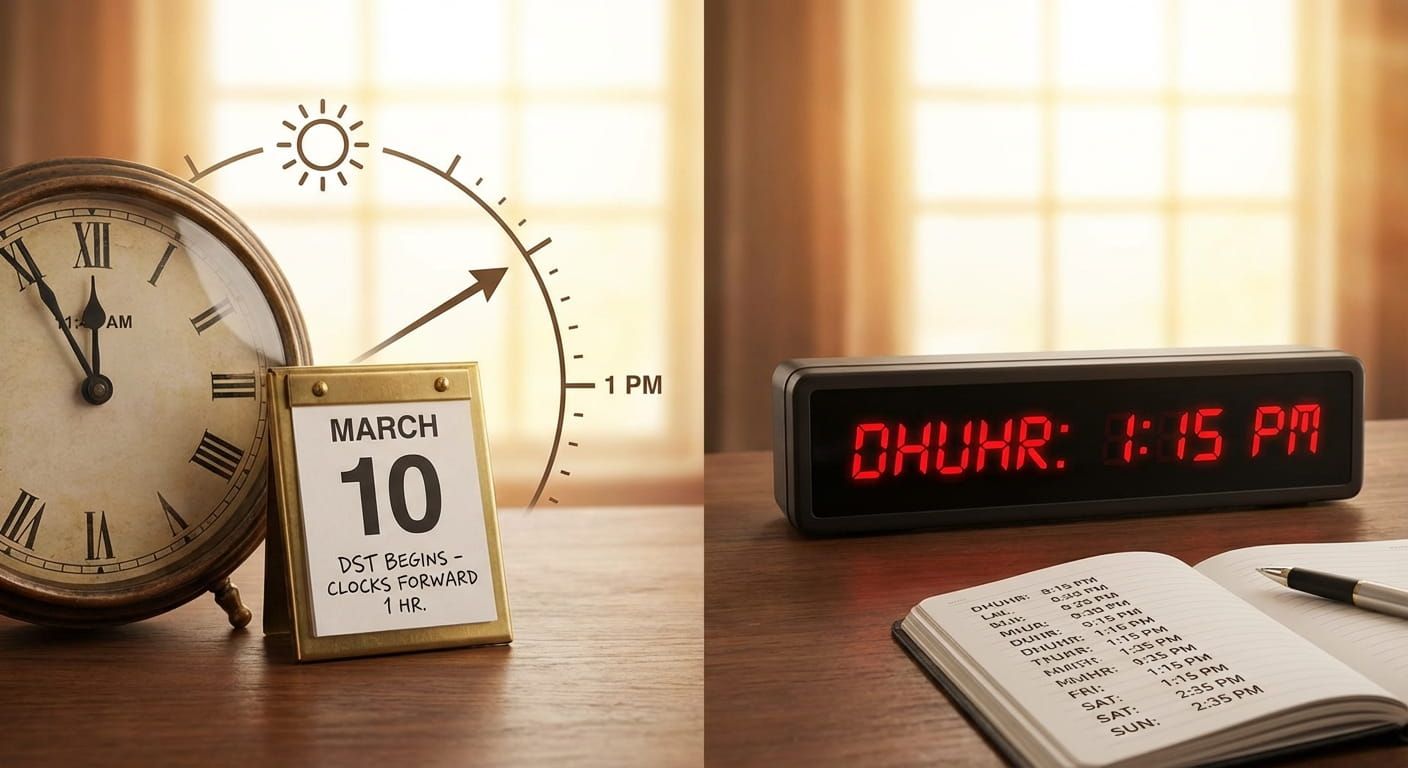
Twice a year, many people glance at the clock and feel a small jolt. Dhuhr looked settled, then daylight saving time arrived and the prayer seemed to jump by a full hour. That shift can feel strange at first, especially if your daily rhythm depends on a familiar midday routine. The key point is simple, the sun did not suddenly change its path in one night. The clock changed. Dhuhr still follows the sun, while your watch follows a legal time setting chosen by the country.
Summary
Daylight saving time does not move the sun or change solar noon itself. It changes the clock reading used in daily life. Since Dhuhr begins after the sun passes its highest point, the prayer appears about one hour later by the clock when DST starts, and about one hour earlier when DST ends. Places without DST usually show a steadier clock pattern, which makes planning Dhuhr easier.
Check Your Understanding
Pick the best answer and see the result instantly.
Solar Time Stays Put, Your Clock Does Not
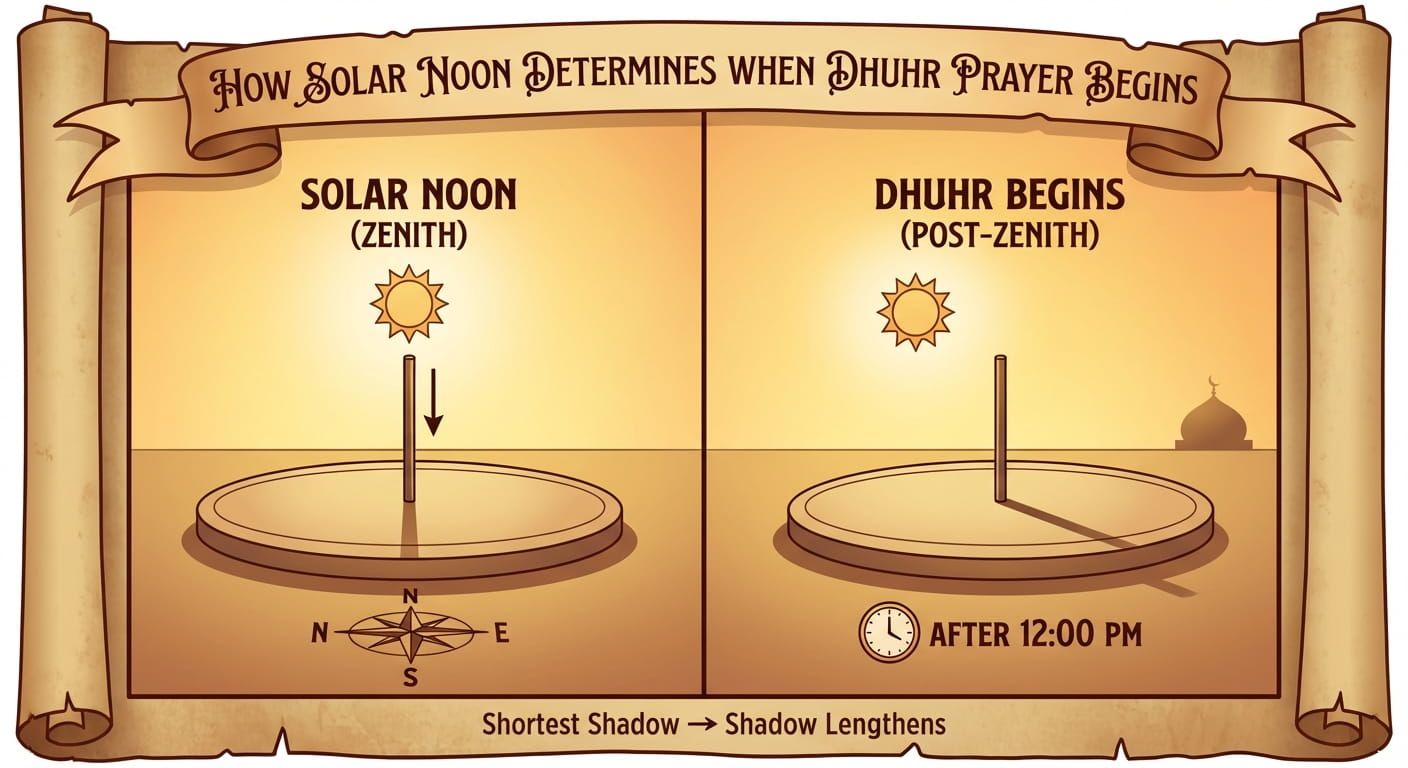
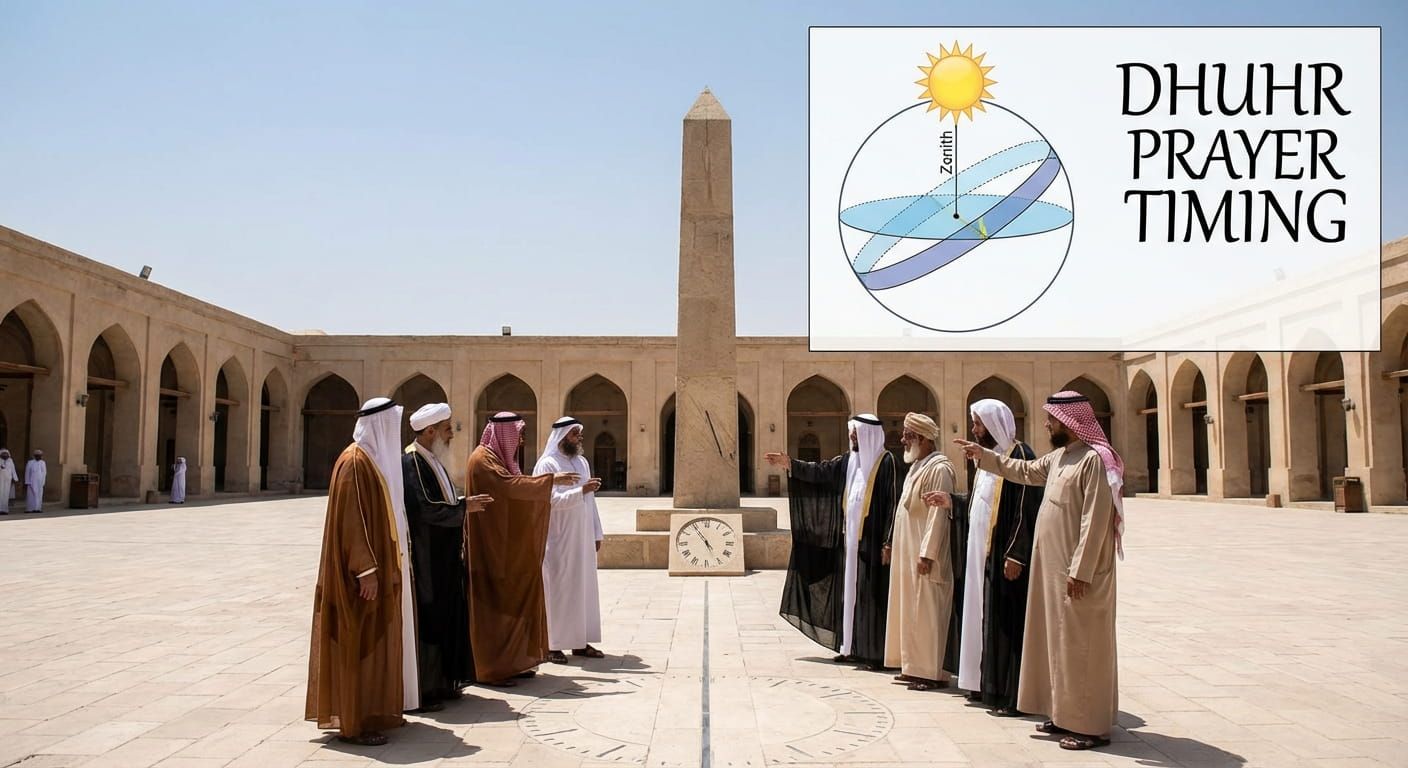
Dhuhr begins after the sun passes its highest point in the sky for that location. Many people call that moment solar noon, though actual Dhuhr can begin a little after it depending on the method used. The important part is that the trigger is astronomical, not administrative. A government can change official clock time. It cannot shift the sun.
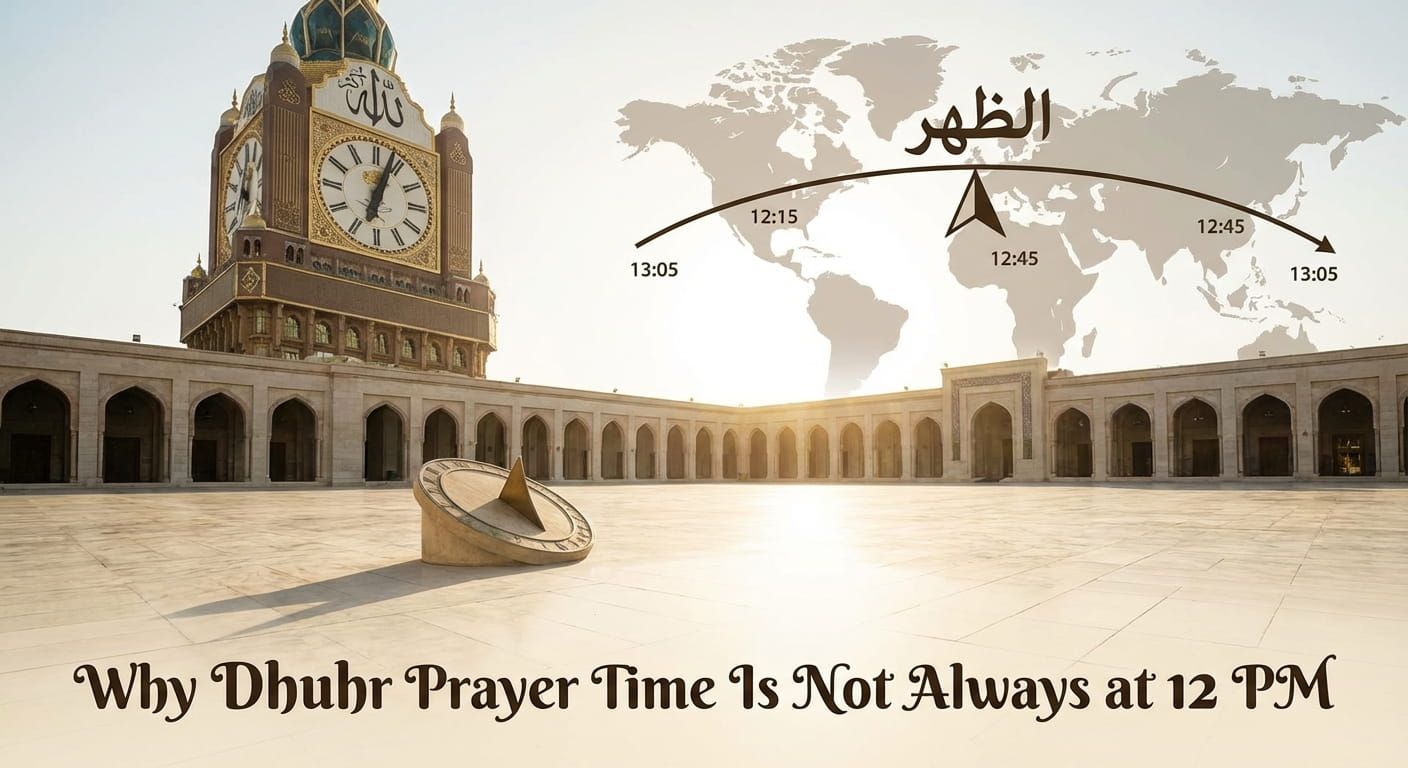
This is why a place can feel stable in the sky and unstable on the wrist. At 12:00 on a clock, the sun is not always at its highest point. In many cities, it never is. Longitude, time zone borders, and seasonal changes all shape the gap between solar time and clock time. That is why reading Dhuhr is not always noon helps clear up a very common misunderstanding. Noon on the clock and the sun at its peak are related, but they are not twins.
“Dhuhr follows the sun. Daylight saving time follows policy. The one hour jump is a clock story, not a sky story.”
That single idea makes the whole topic easier to grasp. If solar noon arrives at roughly the same true solar point from one day to the next, then a one hour shift in your schedule after DST starts is really a shift in labeling. The moment is similar in solar terms. The printed time around it changes.
Why The Prayer Seems To Jump By One Hour
When daylight saving time starts, clocks usually move forward by one hour. A Dhuhr that appeared at 12:18 the previous day may now appear around 1:18, assuming the same calculation method and similar solar conditions. Nothing dramatic happened to the prayer itself. The civil time attached to that moment moved ahead.
Here is the easiest way to picture it. Imagine a city where Dhuhr often falls shortly after the sun reaches its daily high point. On Saturday, the watch reads 12:20. Overnight, the legal time is advanced by one hour. On Sunday, the same solar relationship now appears at 1:20. That is the shift people notice.
This becomes even clearer if you read more about solar noon and Dhuhr prayer. The prayer starts after a solar event. DST does not cancel or rewrite that event. It only changes the number shown on the clock face used by schools, offices, transport, and daily appointments.
- The sun rises and reaches its highest point according to astronomy.
- Dhuhr begins after that solar point passes.
- DST changes official clock time by one hour.
- Your prayer timetable reflects the new civil clock, which is why Dhuhr looks later or earlier.
That same pattern happens in reverse when DST ends. The clock moves back by one hour. Dhuhr then appears one hour earlier by the clock. People sometimes feel relief in autumn because the prayer time looks closer to midday again, yet the underlying solar logic never changed.
Why Some Countries See Much Steadier Dhuhr Times
Countries that do not observe daylight saving time usually have a calmer clock pattern for Dhuhr across the year. The prayer still shifts gradually because the equation of time, seasonal solar changes, and local longitude all matter. Still, there is no sudden one hour jump caused by policy.
This is easy to notice when comparing different cities. Dhuhr time in Singapore tends to feel consistent in clock behavior because Singapore does not switch in and out of DST. The same goes for Dhuhr time in Jakarta, Dhuhr time in Riyadh, Dhuhr time in Karachi, and Dhuhr time in Dhaka. The listed times still move through the year, but they do not suddenly leap because the legal clock stayed put.
By contrast, cities in countries that observe DST often show a visible spring jump and autumn return. You can see that pattern in places where seasonal clock changes are part of civic life. Looking at Dhuhr time in London, Dhuhr time in Paris, Dhuhr time in Berlin, Dhuhr time in Toronto, and Dhuhr time in New York City, the one hour shift stands out the moment DST begins or ends.
That difference matters for planning. In non DST countries, habits around lunch, work breaks, school runs, and prayer often remain easier to predict. In DST countries, a familiar Dhuhr routine may need a small reset twice each year.
How Longitude, Time Zones, And DST Mix Together
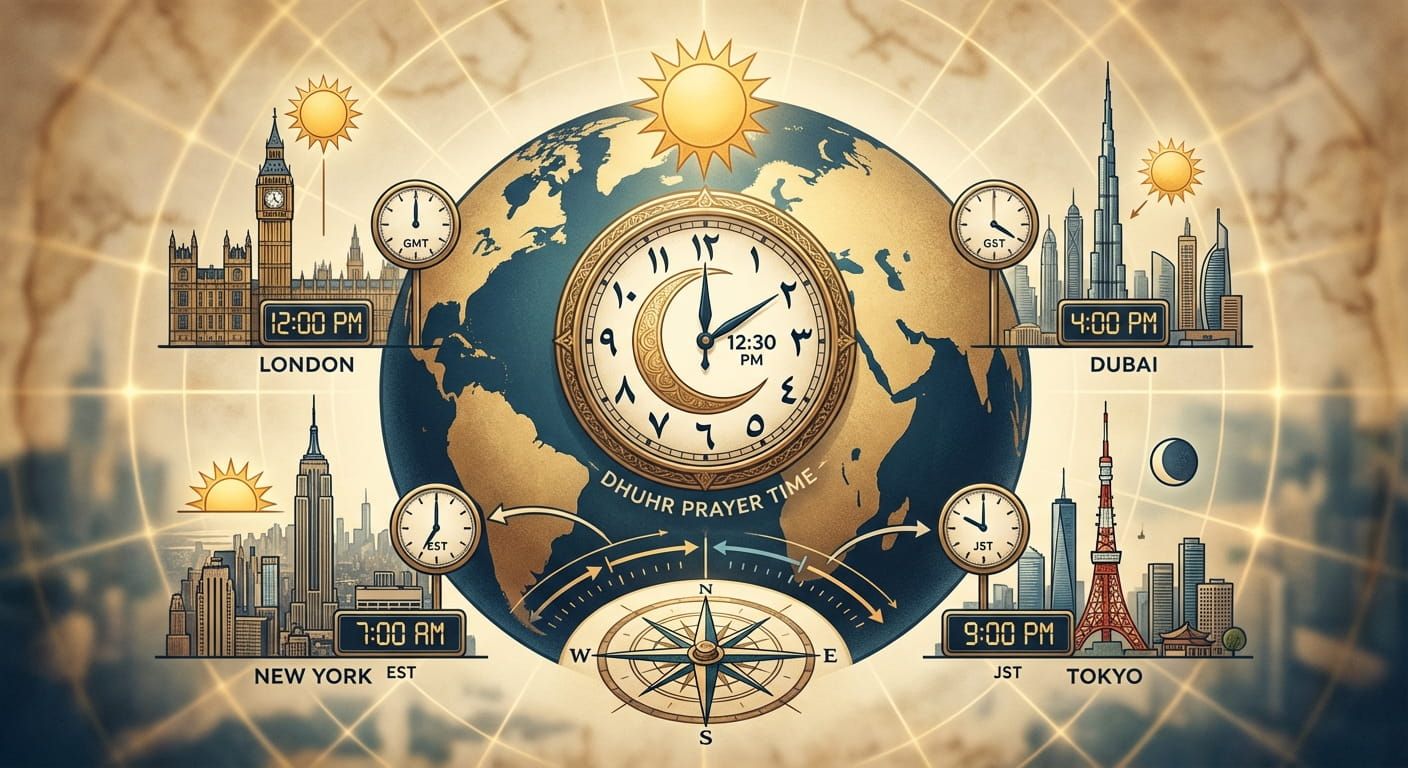
Daylight saving time is only one layer. Time zones are another. Longitude is another. The result is that two cities sharing the same legal time can have different solar realities. That is one reason Dhuhr can feel later in one part of a country than another. A closer look at longitude and Dhuhr calculation helps make sense of those differences, especially in wide countries or cities near the edge of a time zone.
Take London and Berlin. Both may use seasonal clock changes, but their local solar conditions and time zone positions are not identical. The same is true for Toronto and New York City. Even if the DST rule is similar, the exact Dhuhr reading still depends on the location. DST adds a one hour legal shift, while longitude and solar geometry shape the baseline time that gets shifted.
Making The Transition Easier In Daily Life
Many people do not struggle with the concept. They struggle with the routine. Dhuhr may now arrive during a meeting, a lunch break, a school pickup, or a commute. A little planning goes a long way.
- Check the prayer time source you actually use. App settings, mosque calendars, and local websites should reflect the new civil time.
- Review the week of the DST change, not only the first day. That gives you time to adjust work breaks and travel habits.
- Move reminders on your phone by one hour if you entered them manually.
- Talk with family members about shared midday routines, especially if children, older relatives, or office schedules are involved.
- Keep the solar principle in mind. Once you understand that the clock changed, the one hour shift feels much less confusing.
- Use a location specific page for your city rather than guessing from another place, since longitude and time zone details matter.
That final point deserves extra attention. A friend in one city may have a Dhuhr time that looks close to yours, yet a small local difference can still matter. People who travel often can get tripped up by assuming one timetable fits all. A dedicated city page reduces that risk.
A helpful habit is to think in two layers. Layer one is the sky, which sets the prayer basis. Layer two is the civil clock, which labels that basis for daily planning. Once those layers are separated in your mind, the DST change feels less like a disruption and more like a scheduling update.
Common Questions People Ask After The Clock Changes
Does DST make Dhuhr religiously later? No. It makes Dhuhr later by the clock. The prayer remains tied to the same solar condition.
Why does the shift feel bigger than regular seasonal movement? Seasonal movement is gradual. DST is abrupt. One day can look close to normal, the next day can look one hour apart.
Do all countries handle this the same way? No. Some never observe DST. Others observe it nationally. Some have changed policy over time. That is why local prayer pages matter.
Should I trust memory or the updated timetable? Trust the updated timetable. Human memory is strong with habits and weak with sudden clock changes.
What if my city has no DST but nearby places do? Your own local timetable still rules. Cross border work, travel, and online meetings can create confusion, though, especially if others shifted and you did not.
Keeping Midday Worship Grounded Through Clock Changes
Dhuhr does not lose its meaning because the clock moves. The prayer still arrives with the sun passing its peak for your location. What changes is the civil label attached to that moment. In cities without DST, that label often feels steadier. In cities with DST, the label jumps, then settles into a new pattern for the season.
That is why the best response is not frustration. It is clarity. Know that solar time and official time are related but separate. Check your local timetable after each clock change. Adjust reminders, lunch plans, and work breaks with intention. Once that rhythm is in place, the one hour shift stops feeling mysterious and starts feeling manageable.
For anyone tracking Dhuhr regularly, that understanding brings calm. The clock may move. The sun still marks the prayer in the same timeless way.