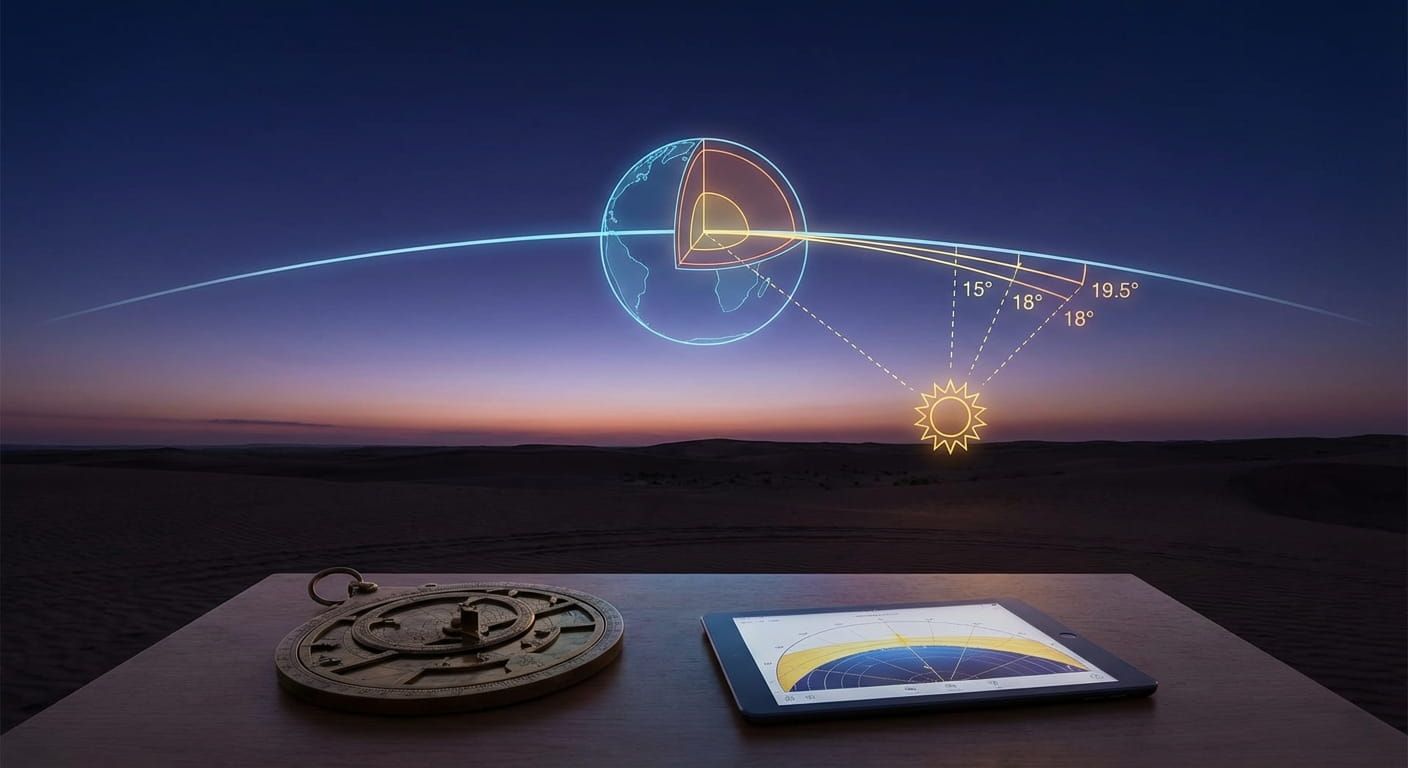
Fajr begins before sunrise, in that quiet stretch when the first true light spreads across the horizon. Getting that time right is not guesswork. It comes from astronomy, geometry, and a chosen twilight angle. Once you understand what an angle like 15°, 17°, or 18° actually means, the whole method becomes far easier to follow, whether you are checking prayer times in Mecca, Karachi, London, or Singapore.
Key takeaway
Fajr time is calculated by finding the moment when the sun reaches a chosen angle below the horizon, usually between 15° and 18°. A larger angle places Fajr earlier, a smaller angle places it later. The process uses date, latitude, longitude, solar declination, and local time correction. Different prayer authorities choose different angles because of regional practice, observation methods, and policy decisions.
Test your understanding before we get into the math
Knowledge check
If the chosen twilight angle changes from 15° to 18°, what usually happens to Fajr time?
What twilight angles mean in plain language
Twilight angle is the number of degrees the sun sits below the horizon before sunrise. During Fajr, scholars and prayer time institutions look for the start of true dawn, not just any faint glow. In astronomical terms, that means measuring the sun’s center while it is still below the horizon line.
If the angle is 18°, the sun is deeper below the horizon than it is at 15°. Because the sun moves upward as sunrise approaches, it reaches 18° first, then 17°, then 15°. That is why an 18° method gives an earlier Fajr than a 15° method.
Think of it this way: the horizon is your zero line. Every degree below that line marks a darker stage before sunrise. The farther below zero the sun is, the earlier that moment occurs.
This is the core idea behind prayer time calculations everywhere. It applies whether you are checking Fajr time in Mecca, comparing Fajr time in London, or reviewing Fajr time in Singapore. The city changes. The geometry stays the same. Latitude, season, and the chosen angle shape the final result.
Degrees below the horizon, without the jargon
The horizon is the apparent line where the sky meets the earth. Astronomers treat that line as 0°. Once the sun drops beneath it, the sun’s altitude becomes negative.
- 0° means the sun is right on the horizon
- 6° below the horizon is linked with a brighter stage of twilight
- 12° below the horizon is darker
- 15° to 18° below the horizon is the range many Fajr calculations focus on
For prayer timing, the target is not sunrise itself. It is the moment before sunrise when dawn has begun in a way recognized by the chosen standard. That is why you will see Fajr times change if a calculation method switches from 18° to 15°, even on the same date and in the same city.
You can spot the seasonal effect more clearly by reading why Fajr time changes daily. Winter, summer, and latitude all affect how fast the sun moves through twilight and how long dawn lasts.
The step by step process used to calculate Fajr
The full math can look intimidating at first glance, but the logic is orderly. Here is the process most calculators follow.
- Choose the date and location. You need latitude, longitude, and local time zone. Karachi and Tokyo will not produce the same Fajr on the same date because the sun’s path appears different from each place.
- Find the sun’s declination for that date. Solar declination tells you where the sun is relative to the equator. It changes throughout the year.
- Choose the Fajr angle. Common values include 15°, 17.5°, and 18°.
- Set the target solar altitude. Because sunrise is also influenced by refraction and the apparent solar radius, the formula for sunrise differs from the formula for Fajr. Fajr uses the chosen negative angle directly.
- Calculate the hour angle. This gives the time distance between solar noon and the desired twilight point.
- Convert solar time to local clock time. Apply longitude correction, time zone offset, and daylight saving time if relevant.
- Round according to the system being used. Many prayer schedules round to the nearest minute.
The key trigonometric relation often appears in a form based on solar altitude. In simplified language, the formula solves for the time when the sun reaches a specific negative altitude. Once that angle is known, the rest is a clock conversion problem.
A clean mental model
Start from solar noon. Move backward by the amount needed for the sun to reach the selected angle below the horizon. Convert that astronomical time into the civil time shown on your clock.
A worked example with simple numbers
Take a city at mid latitude with a chosen Fajr angle of 18°. Assume solar noon lands at 12:10 p.m. local time on a given date. After plugging declination and latitude into the hour angle formula, imagine the result says the target twilight point occurs 6 hours and 3 minutes before solar noon.
That puts Fajr at 6:07 a.m.? Not quite, because 12:10 p.m. minus 6 hours and 3 minutes equals 6:07 a.m., and that would be close to sunrise in many places. A true 18° dawn point is usually much earlier. In a real case, the hour angle from solar noon to 18° twilight may be closer to 7 hours or more, depending on season and latitude. If the offset is 7 hours and 18 minutes, Fajr becomes 4:52 a.m.
The exact numbers shift with the calendar and the city. That is why time for Fajr in Karachi can differ sharply from Fajr time in Tokyo even if both use the same angle.
Why 15° to 18° is the range people talk about most
The 15° to 18° range covers many widely used prayer calculation standards. It is popular because it captures the part of twilight most often linked to true dawn in modern schedules. The range is not random. It reflects a mix of scholarly interpretation, observational history, and practical scheduling.
A small angle shift may look minor on paper, yet it can move the prayer time by several minutes, sometimes more. In high latitude locations, that difference can become especially noticeable.
Why different organizations use different angles
This is where readers often get confused. If Fajr is tied to dawn, why do organizations disagree at all?
There are three main reasons.
- Observation history. Some methods lean more heavily on visual dawn observations collected in certain regions.
- Juristic preference. Scholars may differ in how they interpret the start of true dawn and how that should map onto astronomical twilight.
- Administrative consistency. National and international bodies often choose one standard and keep it stable for mosques, calendars, and prayer apps.
Muslim World League, MWL is often associated with an 18° Fajr angle. That creates an earlier dawn time than a 15° method. It is widely recognized and appears in many global prayer tools.
ISNA has long been associated with a smaller Fajr angle than 18°, often cited around 15° in many contemporary implementations. This produces a later Fajr compared with MWL. In North American settings, that later timing has often been seen as more practical and more aligned with adopted community standards.
Umm al Qura has used a distinct policy approach in Saudi Arabia. In many references, Fajr is tied to a set angle standard that differs from some other organizations, while Maghrib and Isha rules may involve additional conventions. Readers checking Fajr time in Cairo versus Fajr time in New York City may notice not only latitude differences, but also method differences depending on the source.
Important note: different does not always mean wrong. It often means a different adopted standard for mapping true dawn to a practical timetable.
How city and latitude change the result
Latitude affects the angle of the sun’s path through the sky. Near the equator, twilight transitions can be brisk. Farther north or south, twilight may stretch out. That is why cities behave differently through the year.
For example, Fajr time in Jakarta tends to show steadier seasonal change than Fajr time in Istanbul. A city like London can experience very early summer dawns, while Cairo follows a different seasonal pattern. Fajr time in Dhaka and Fajr time in Moscow offer another striking contrast for the same reason.
This also explains why Fajr should not be copied blindly from one place to another. Accurate timing needs local coordinates, date, and the chosen method.
How Fajr relates to sunrise and Dhuhr
Fajr sits at the start of the daily prayer cycle, long before sunrise. Sunrise ends the Fajr prayer window. Later in the day, Dhuhr arrives after the sun passes its highest point. Looking at the whole day this way helps readers see that Fajr is anchored to a precise astronomical phase, not just a general sense that the sky looks lighter.
The gap between Fajr and sunrise is not fixed. It grows or shrinks with the angle standard, the season, and the city. A method using 18° usually creates a larger gap than one using 15°.
What to check before trusting a prayer time source
Readers often assume every prayer timetable uses the same standard. That is rarely true. Before relying on any source, check these points in one glance: the calculation method, the Fajr angle, the city coordinates, daylight saving adjustments where relevant, rounding rules, and whether the source updates daily. One missing detail can shift the answer enough to matter in daily practice.
Time.now works well for readers who want a broader time based toolkit, since it covers clocks, timers, calendars, time zones, and prayer times in one place. That broader context helps because prayer schedules always sit inside the larger structure of local civil time.
Reading dawn with confidence
Calculating Fajr is really about answering one precise question: when does the sun reach a chosen angle below the horizon for this place and this date? Once that is clear, the rest follows naturally. A 15° standard gives one answer. An 18° standard gives an earlier one. MWL, ISNA, and Umm al Qura differ because they adopt different ways of translating dawn into a timetable people can follow every day.
That knowledge makes the schedules easier to read and compare. It also makes it easier to understand why prayer times are not identical from city to city, or from method to method. Dawn is one event in the sky, yet the path from observation to published time passes through calculation choices. Knowing those choices gives you a far better handle on the numbers you see each morning.