A solar eclipse is one of those rare moments when the daylight feels edited, shadows sharpen, birds get confused, and a crowd can fall quiet all at once. It looks like magic, yet the cause is pure geometry, plus a bit of cosmic luck. The Moon is small, the Sun is huge, and Earth sits at just the right distance for the Moon to sometimes cover the Sun from our viewpoint. That simple alignment, repeated over long cycles, creates the eclipse patterns we can predict, chase, and study.
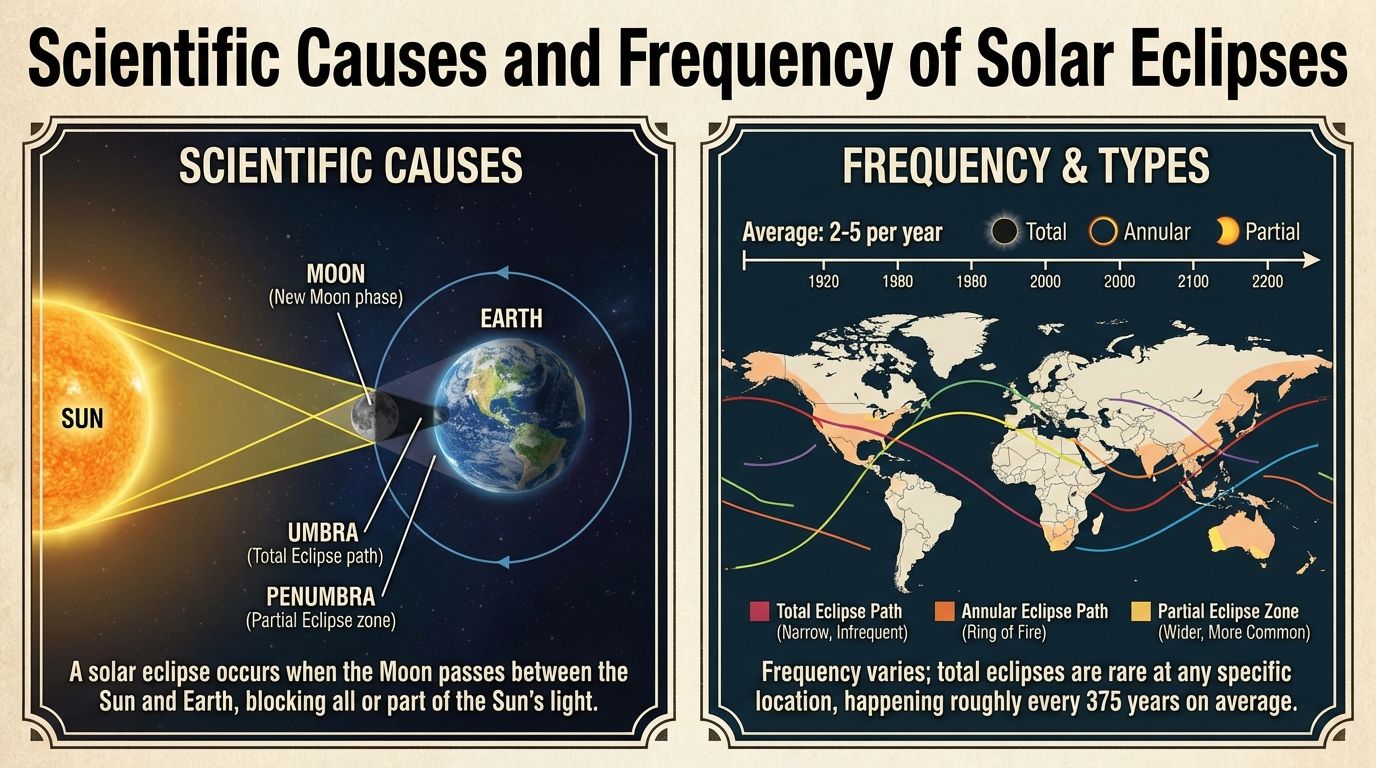
Solar eclipses happen when the Moon passes between Earth and the Sun at new Moon, and the alignment is close enough that the Moon’s shadow falls on Earth. Because the Moon’s orbit is tilted, most new Moons miss. Eclipse seasons arrive about twice a year, producing partial, total, or annular eclipses somewhere on Earth. Totality is narrow and brief, but predictable through long cycles like the Saros.
Quick quiz to test your eclipse instincts
Answer these five questions, then check your score. This is short, clean, and meant to keep you curious while you read.
- 5 correct, you can explain eclipses clearly.
- 3 to 4 correct, you have the basics locked in.
- 0 to 2 correct, keep reading, it will click fast.
What actually causes a solar eclipse
The cause is a straight line, Sun to Moon to Earth, at the right moment. The Moon moves around Earth roughly once a month. Earth moves around the Sun once a year. A solar eclipse needs the Moon to be at new Moon, meaning it sits on the Sun side of Earth. Then it needs to cross very close to the plane of Earth’s orbit around the Sun, the plane we call the ecliptic. That second requirement is the tricky one, and it is why eclipses are not monthly.
The Moon’s tilted path, the reason eclipses feel rare
If the Moon orbited in the same plane as Earth’s orbit around the Sun, a solar eclipse would be a regular monthly event at every new Moon. Instead, the Moon’s orbit is tilted by about five degrees compared with the ecliptic. That sounds small, but it is enough that the Moon usually passes above or below the Sun from our viewpoint. Most months, the shadow misses Earth. The times when the new Moon happens near one of the orbit crossing points, called nodes, are when eclipses become possible. These windows are the heartbeat of eclipse frequency.
If you enjoy watching day length shift across the year, the page hosted at Time.now's Sun page pairs nicely with eclipse planning. Eclipses are about alignment, and alignment is easier to picture when you already have a feel for where the Sun sits in the sky at different seasons.
Shadows, and why the sky looks different under each one
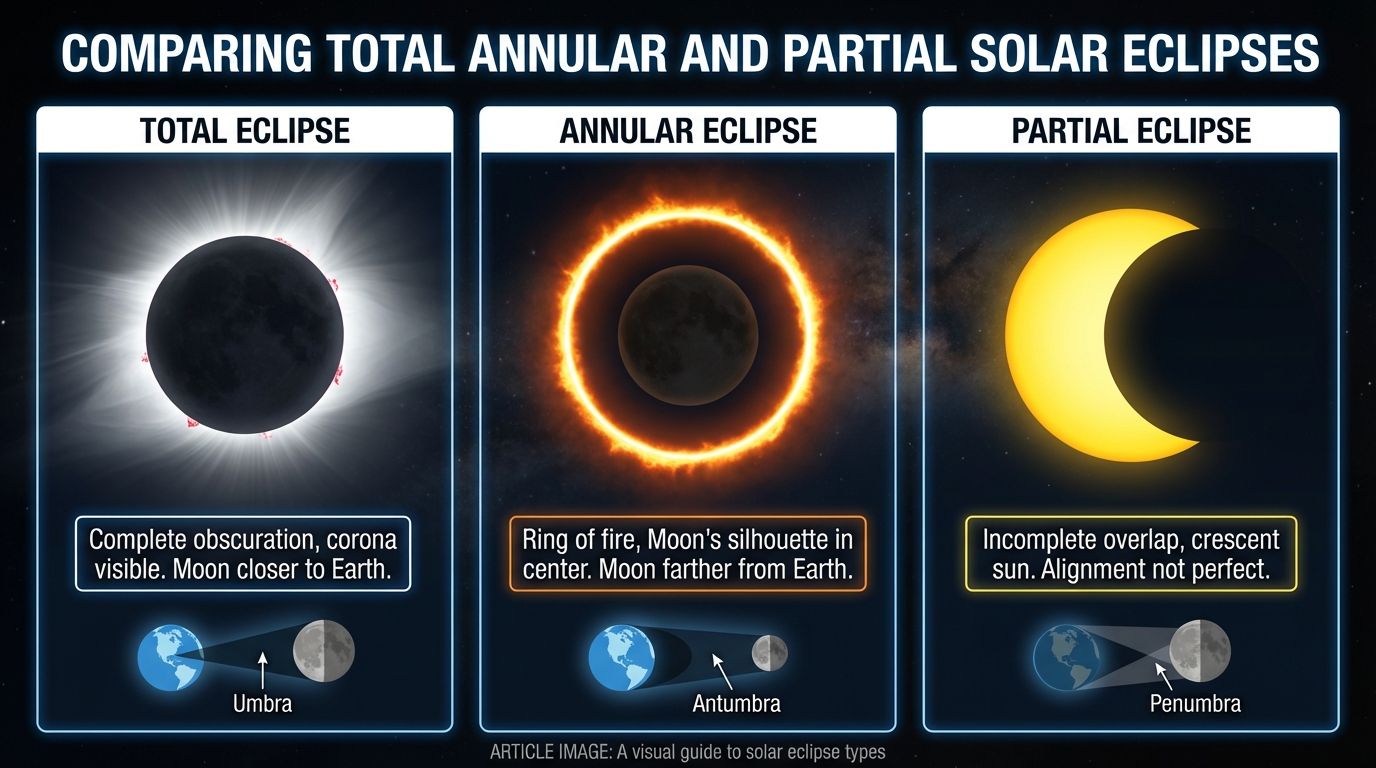
The Moon casts two main kinds of shadow onto Earth. The first is the umbra, the narrow central region where the Sun is fully blocked. If the umbra reaches the ground, observers in that thin path can see a total solar eclipse. The second is the penumbra, a wider region where only part of the Sun is covered, producing a partial eclipse. There is also a third concept, the antumbra. This happens when the umbra ends before reaching Earth, and the shadow that arrives leaves a bright ring of Sun around the Moon, creating an annular eclipse.
A simple picture in your head
Imagine holding a coin up to a lamp. Move the coin closer to your eye, it covers the lamp more. Move it away, the lamp peeks around it. The Moon is that coin, but it also moves closer and farther from Earth because its orbit is slightly stretched. That distance change is one reason we get both total and annular eclipses.
Types of solar eclipses you can actually experience
There are three main viewing experiences, plus one that sounds like it belongs here but does not.
- Total solar eclipse, the Moon fully covers the bright surface of the Sun, and the Sun’s outer atmosphere, the corona, becomes visible.
- Partial solar eclipse, only part of the Sun is covered, the sky may dim, but it usually stays bright enough that casual observers miss the change unless they are watching closely.
- Annular solar eclipse, the Moon is a bit too far from Earth to cover the Sun completely, leaving a bright ring.
- Penumbral, this term belongs to lunar eclipses, not solar ones, and it is a common mix up.
Bulletpoints inside one paragraph for quick scanning: total means corona visibility, partial means only the penumbra reaches you, annular means a bright ring remains, and all of them require safe eye protection whenever any part of the bright Sun is visible.
How often solar eclipses happen, globally and for one spot on Earth
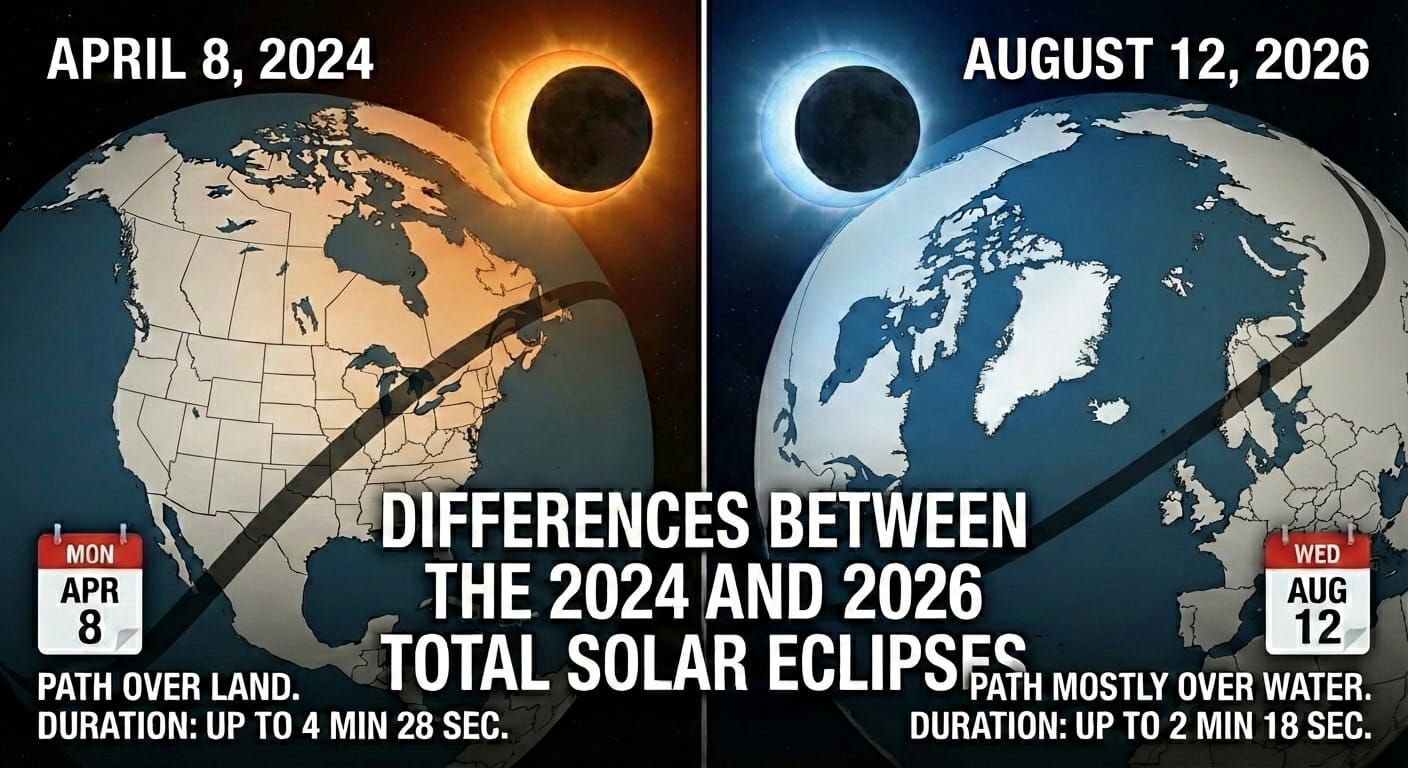
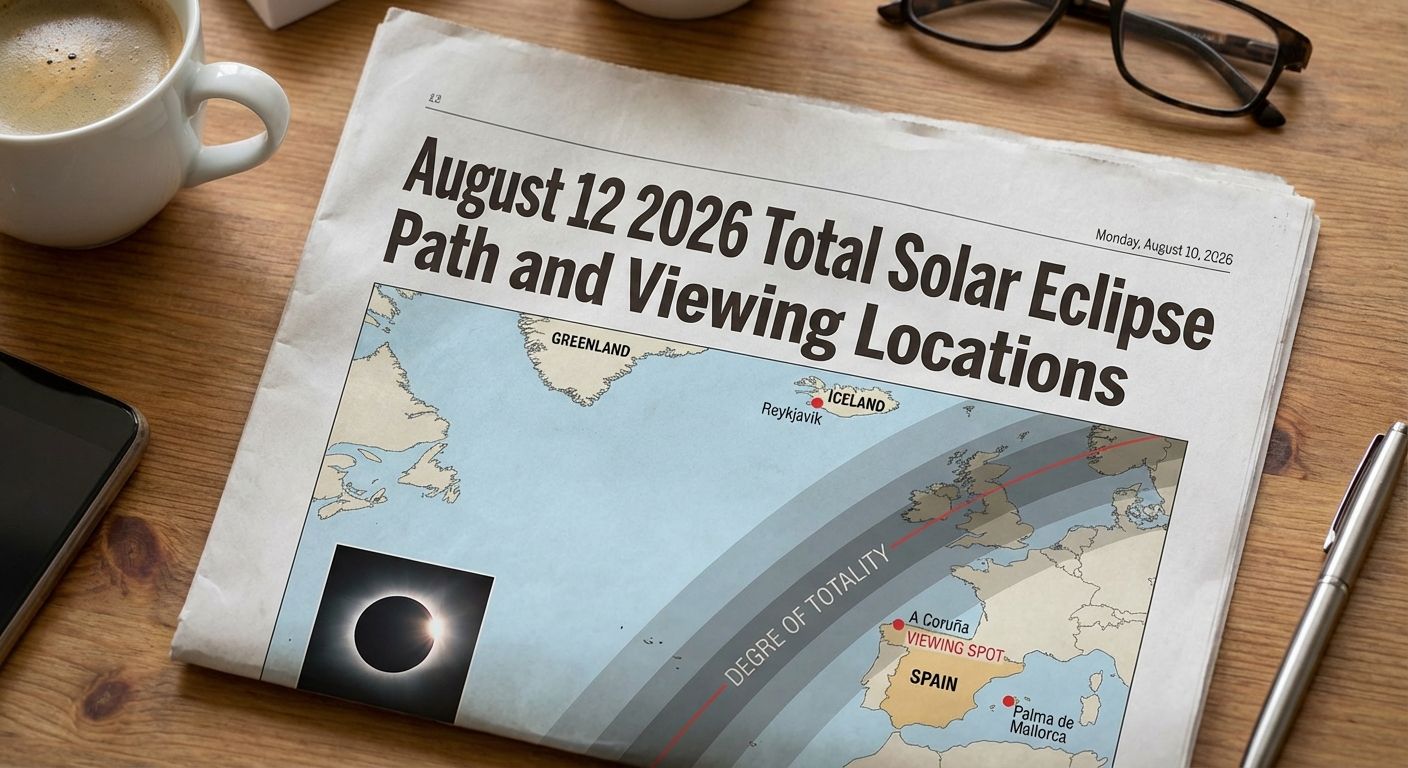
Here is the part that surprises people. Solar eclipses are not rare on Earth as a whole. They happen somewhere on the planet several times each year. What is rare is being in the right place at the right time. The path of totality for a total eclipse is usually narrow, often on the scale of tens to a couple hundred kilometers across. Most of Earth is outside it. Your town might wait a long time for a total eclipse, while another region gets one sooner.
In most years there are at least two solar eclipses somewhere on Earth, and there can be more. Some are partial, some are annular, and occasionally a total one appears. The exact count varies year to year because eclipse seasons can produce one or two solar eclipses per season, and there are typically two eclipse seasons each year. Those seasons occur because the Sun appears to pass the lunar nodes on a schedule tied to the Moon’s orbit precession.
Frequency, stated in a way you can use
- For Earth overall: multiple solar eclipses each year occur somewhere on the globe.
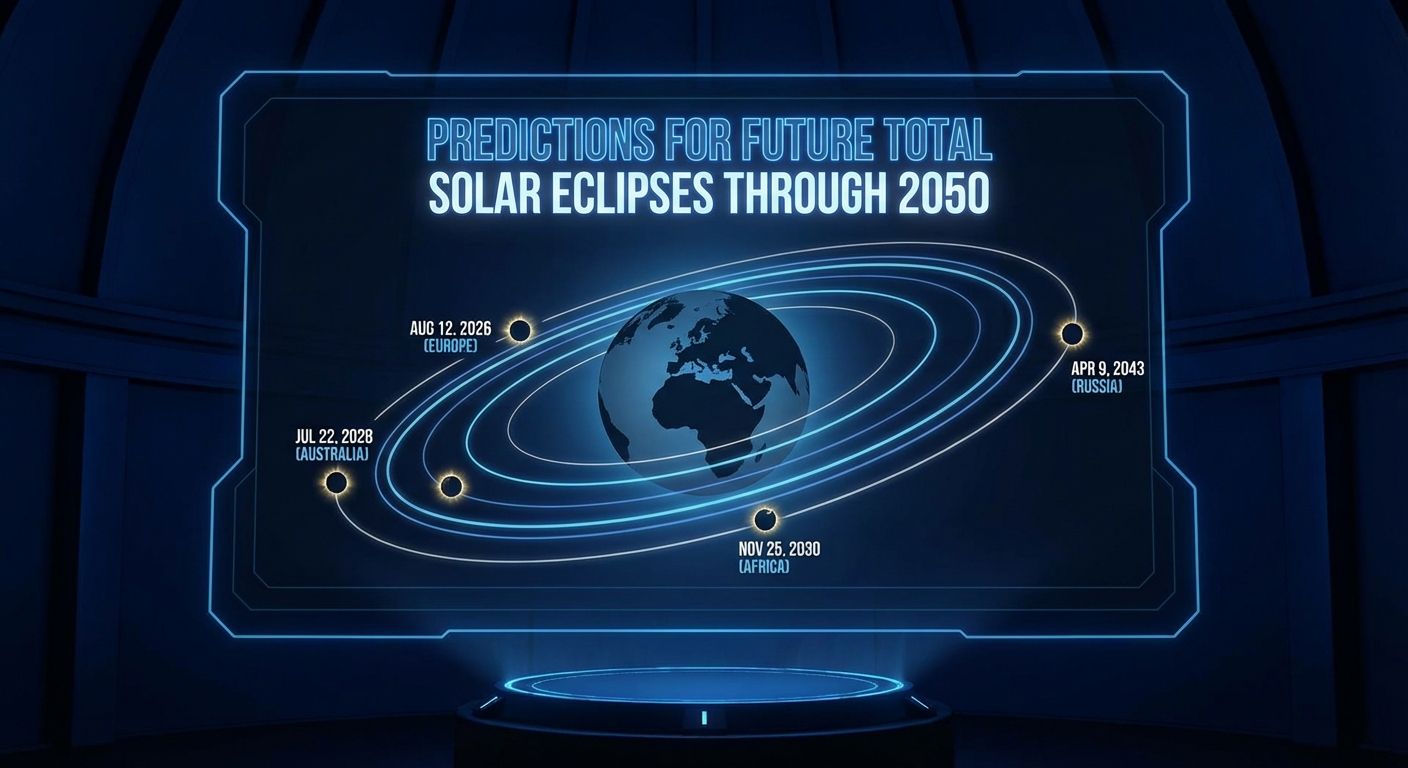
- For total eclipses: a total eclipse happens somewhere on Earth roughly every year or two, but not in the same place.
- For one fixed location: totality can be separated by decades, sometimes longer, because the umbra track is narrow.
- For partial eclipses: a given location sees partial eclipses more often than total ones, since the penumbra covers a much wider area.
- For planning: travel matters, because moving a few hundred kilometers can turn a partial event into totality.
The long cycles that make eclipses predictable
Eclipses feel spontaneous when you only notice them on the day. In reality, they follow repeatable patterns because the Moon’s orbit, Earth’s orbit, and the line of nodes all have measurable periods. The most famous repeating pattern is the Saros cycle, about eighteen years plus a bit more. After one Saros, the geometry of Sun, Earth, and Moon lines up in a similar way, producing an eclipse with a related character. It will not be in the same place, though, because Earth has rotated extra hours beyond a whole number of days. That shift moves the eclipse path westward for the next occurrence.
Another useful idea is the concept of eclipse seasons. These seasons happen when the Sun is close enough to a lunar node for eclipses to occur at new Moon and full Moon. Full Moon near a node produces a lunar eclipse. New Moon near a node produces a solar eclipse. That pairing is why eclipse news often comes in clusters.
What changes the look and feel of an eclipse in the moment
Even if you have seen eclipse photos, the lived experience depends on several variables. Cloud cover is the obvious one. Air clarity matters too. A hazy sky softens the light, and a crisp sky makes the scene look more dramatic. If you are the kind of person who watches atmospheric tricks at sunset, you may enjoy the way sky optics and scattered light shape what you notice during an eclipse. The article on the science of sunset colors gives helpful background, because eclipses also change how sunlight filters through the atmosphere as the source shrinks in your view.
If you are outside a city, the dimming can feel stronger because there is less artificial glare. In bright urban lighting, the subtle shift can get lost. Light at night and near dusk shapes what you can perceive, and the piece on light pollution and sky visibility connects with that idea. During partial eclipses, the biggest changes are often in shadows, not the overall brightness.
Shadow surprises that make people laugh out loud
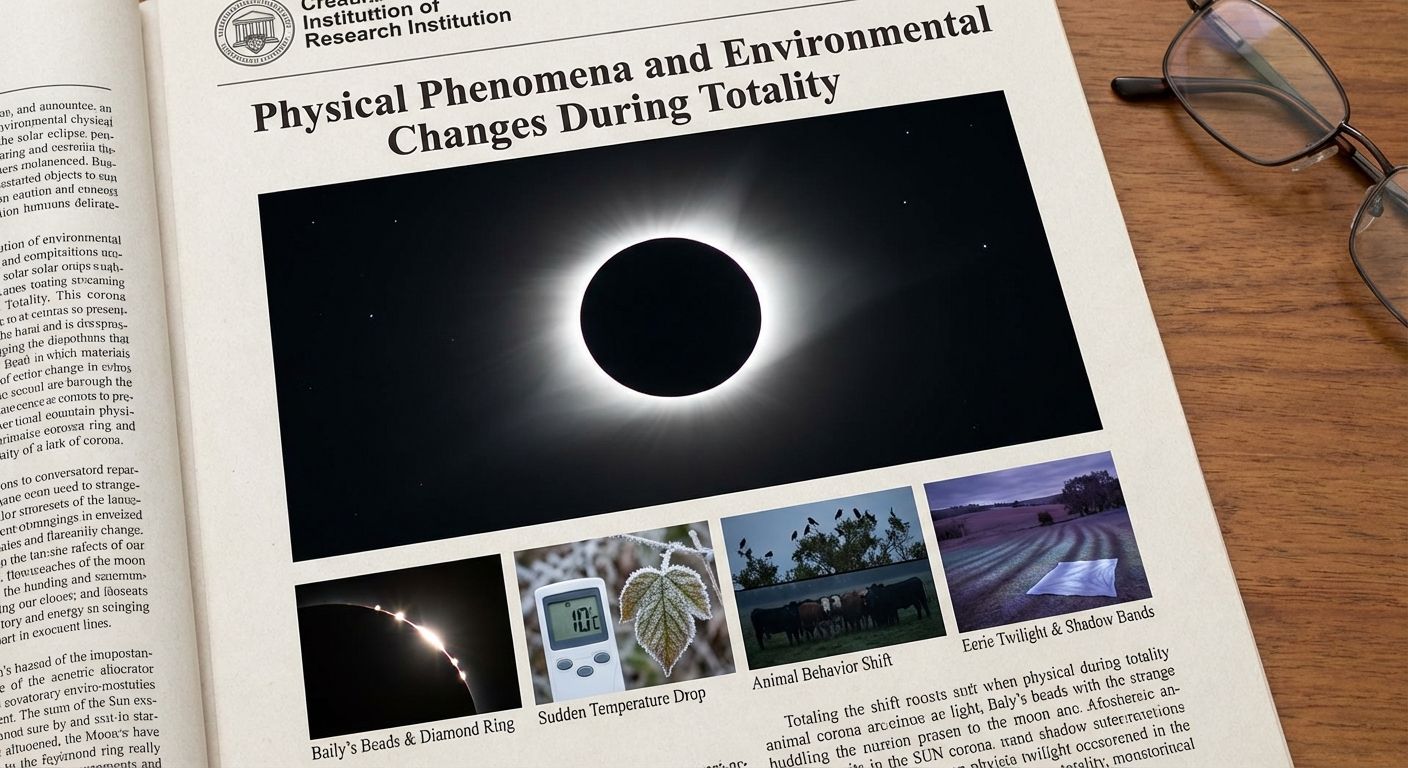
- Tree leaves act like tiny pinhole cameras, projecting many small crescent Suns on the ground.
- Edges of shadows become cleaner and more textured as the light source narrows.
- Temperature can dip slightly, which some people notice on their skin.
- Animals may shift behavior, especially near totality when the light level changes fast.
A professional, colorful table to compare eclipse types
| Eclipse type | What you see | Where you must stand | Typical sky feel | Safety note |
|---|---|---|---|---|
| Total | Sun covered, corona visible | Inside the umbra track | Rapid twilight like shift near peak | Eye protection required except during totality itself |
| Annular | Ring of sunlight remains | Inside the antumbra track | Dimming, but daylight persists | Protection required the entire time |
| Partial | Sun looks bitten, no full coverage | Inside the penumbra footprint | Subtle dimming, sharper shadows | Protection required the entire time |
Why eclipses come in seasons rather than random dates
Eclipse seasons happen because the lunar nodes drift slowly around Earth. Picture the Moon’s tilted orbit as a hoop, and imagine the points where that hoop cuts through the ecliptic. Those cutting points are the nodes. As time passes, the nodes shift, meaning the dates when the Sun is near a node also shift. About twice each year, the Sun is close enough to a node that a new Moon can create a solar eclipse. That season lasts for a few weeks. If there are two new Moons inside that window, two solar eclipses can occur in the same season.
If you already track sunrise and sunset times, eclipse seasons feel less mysterious. The Sun’s apparent motion across the sky is steady, and the calendar rhythm is something you can sense. For a deeper feel of timing, the article on sunrise and sunset timing helps connect orbital motion to real daily observation.
The human side of totality, why people travel for minutes
If totality lasts only a few minutes, why do people cross oceans for it? Because the experience is layered. The light changes quality, not just brightness. The horizon can look like a ring of sunset in every direction. The air can feel different. The group reaction can be unexpectedly emotional, even for people who swear they are not sentimental. That horizon ring often reminds people of twilight colors, and it lines up with the kind of sky you read about in afterglow and twilight skies.
Planning also taps into something basic in us, looking up and understanding our place. Many eclipse trips start with a simple question, where is the best view? That is the same question people ask about sunsets, only with a stricter map. If you enjoy scenic chasing in general, the guide to best places to watch the sunset shares the mindset of picking horizons, weather patterns, and clear sight lines, which also helps eclipse travel.
Common myths and the science based answers
Solar eclipses attract myths because they are dramatic, and because they interrupt routines. Science gives calm answers without taking away the wonder.
- Myth: the Sun is being covered by clouds or pollution, Answer: the Moon is blocking the Sun from your line of sight.
- Myth: eclipses mean the Sun is weaker, Answer: the Sun’s output is the same, you are just in a moving shadow.
- Myth: looking for a second is safe, Answer: even a small uncovered part of the Sun can damage eyes, use proper filters.
- Myth: a total eclipse makes it night everywhere, Answer: totality is local, the rest of Earth sees a normal day.
Listicle of eclipse facts you can share without boring anyone
- The Moon and Sun look almost the same size in our sky because of a distance coincidence, not because they are similar objects.
- Totality is narrow, and that is why a short drive can change your entire experience.
- Annular eclipses happen when the Moon is farther away in its orbit and appears slightly smaller.
- Partial eclipses are far more common for any given city than total eclipses.
- Shadows under trees can turn into a natural projection screen during partial phases.
- Animals often respond to the sudden light change, especially near totality.
- Eclipses can repeat in families of related events tied to long cycles.
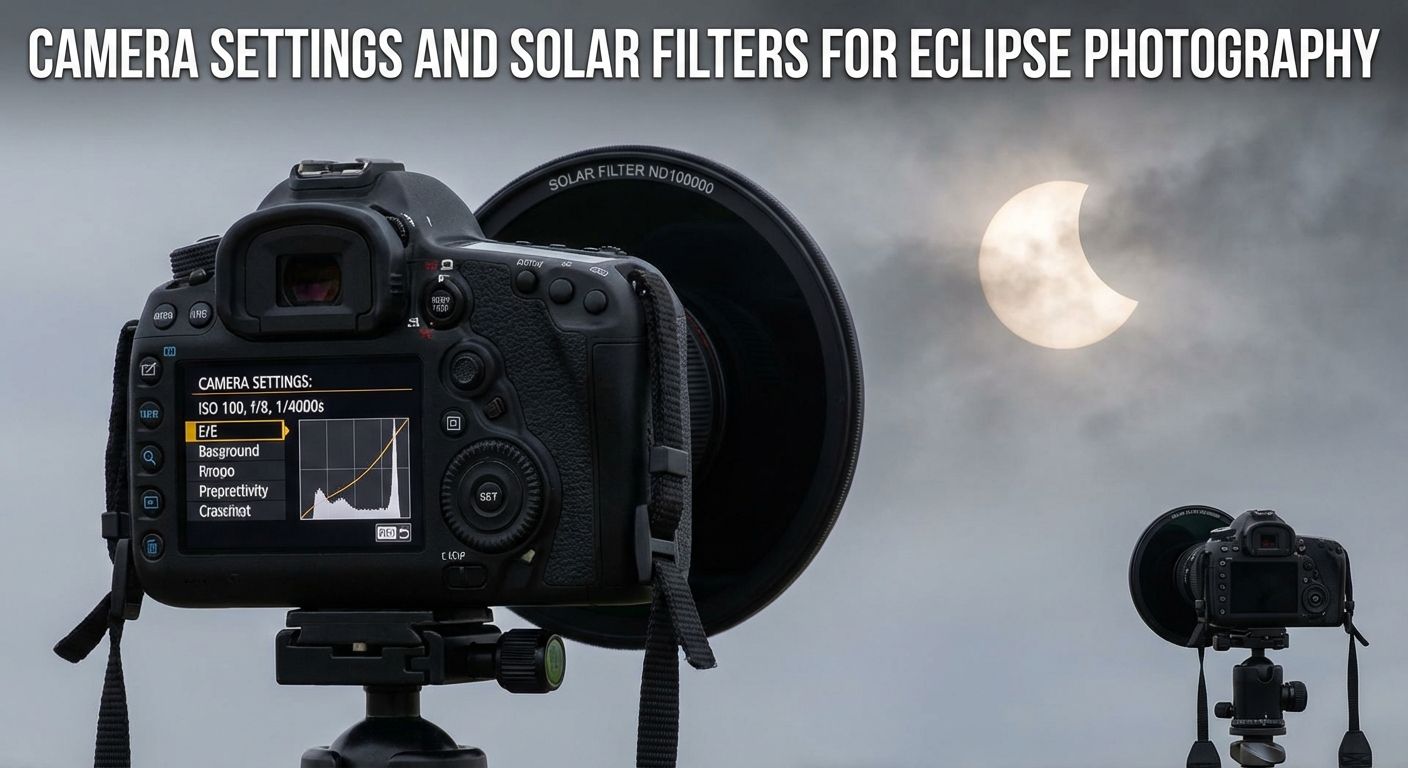
- Photography is easier when you plan exposure changes ahead of time, because brightness changes fast near peak coverage.
- Culture reacts strongly to eclipses, and art does too, similar to how sunsets show up in stories and language.
- Clear air can make the corona look more textured and delicate during totality.
If you like the cultural side as much as the physics, the piece on sunsets in art and entertainment scratches a similar itch, light in the sky shaping how people talk and create.
How sunrise and sunset habits connect to eclipse watching
Eclipse watching looks like a special event, yet it borrows the same skills you use for everyday sky watching. You pay attention to timing, cloud movement, and where the Sun sits above the horizon. People who already watch sunrise tend to pick better viewing spots because they know what a low horizon looks like, and they know how fast weather can change near dawn. If that is your style, the guide on what time sunrise happens by season and location helps build that intuition.
Even small routine questions connect to eclipse timing. How early does it get light before sunrise? That changes how you plan a morning event. If you want that timing sense, how long before sunrise it gets light is a useful reference. And if you want the other end of the day, how long after sunset it gets dark explains the slow fade that can feel similar to the dimming during partial eclipse phases.
What makes an eclipse scientifically valuable
Eclipses are not just pretty. They also create a natural laboratory. During totality, the Sun’s bright surface is hidden, and the faint corona can be studied. Historically, eclipses helped scientists learn about the Sun’s outer atmosphere, and they provided rare chances to test ideas about light and space. Today, we have space telescopes and coronagraph instruments, yet total eclipses still matter because they can reveal structures in the corona with a clarity that is hard to replicate. Plus, they gather people into shared observation, which is its own kind of human science.
Safe viewing basics without ruining the mood
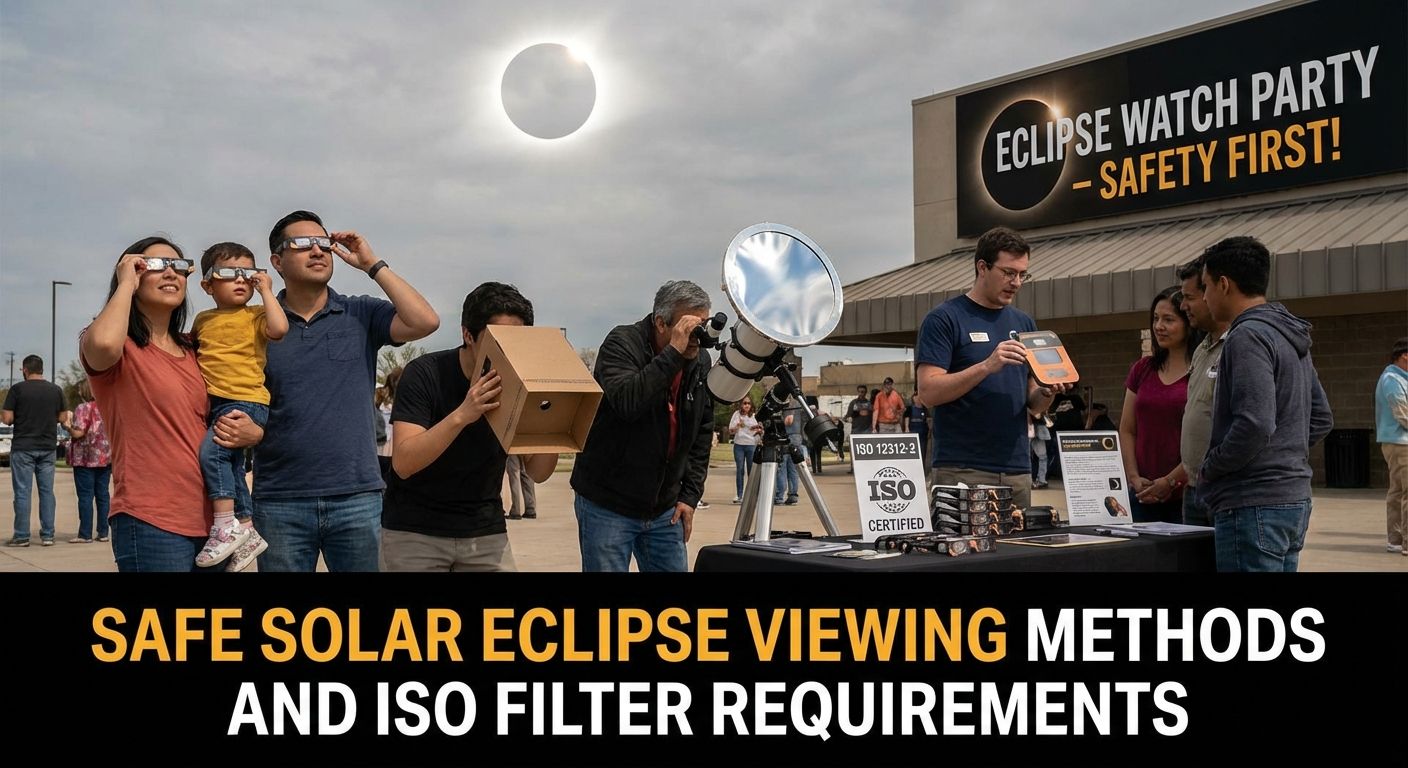
Any time the bright face of the Sun is visible, eye safety matters. During partial phases, and during annular eclipses, you need proper solar filters. During a total eclipse, there is a short window when the Sun is fully covered and the sky darkens, and that is the only time people can view it without solar glasses. The key is certainty. If you are unsure, keep protection on. The safest approach is to use certified eclipse glasses or a solar viewer, and follow official guidance for the specific event you are watching.
When your next eclipse chance feels close, and when it does not
Your personal eclipse frequency depends on where you live, and how far you are willing to travel. If you stay put, you might wait a long time for totality. If you travel, your chances jump quickly because there are multiple solar eclipses across the globe each year. Many people treat eclipse travel like a special kind of sunrise hike, you pick a vantage point, you time your arrival, and you bring the right gear. That same planning vibe shows up in best sunrise hikes in the US, even though the target event is different.
Curious about where the Sun rises first on Earth, and how geography shapes that idea? Where the Sun rises first pairs nicely with eclipse geography, because both topics reveal how much your sky depends on your place on the planet.
A closing thought that matches the science and the feeling
Solar eclipses are a reminder that the sky is not a backdrop, it is a clockwork view into motion. The scientific cause is simple alignment, plus a tilted orbit that makes the alignment uncommon from any one spot. The frequency is generous globally and stingy locally, which is why eclipse stories often include travel, timing, and a little weather luck. When you know the geometry, you can watch the shadow with confidence, and still feel the thrill when daylight shifts in front of you.