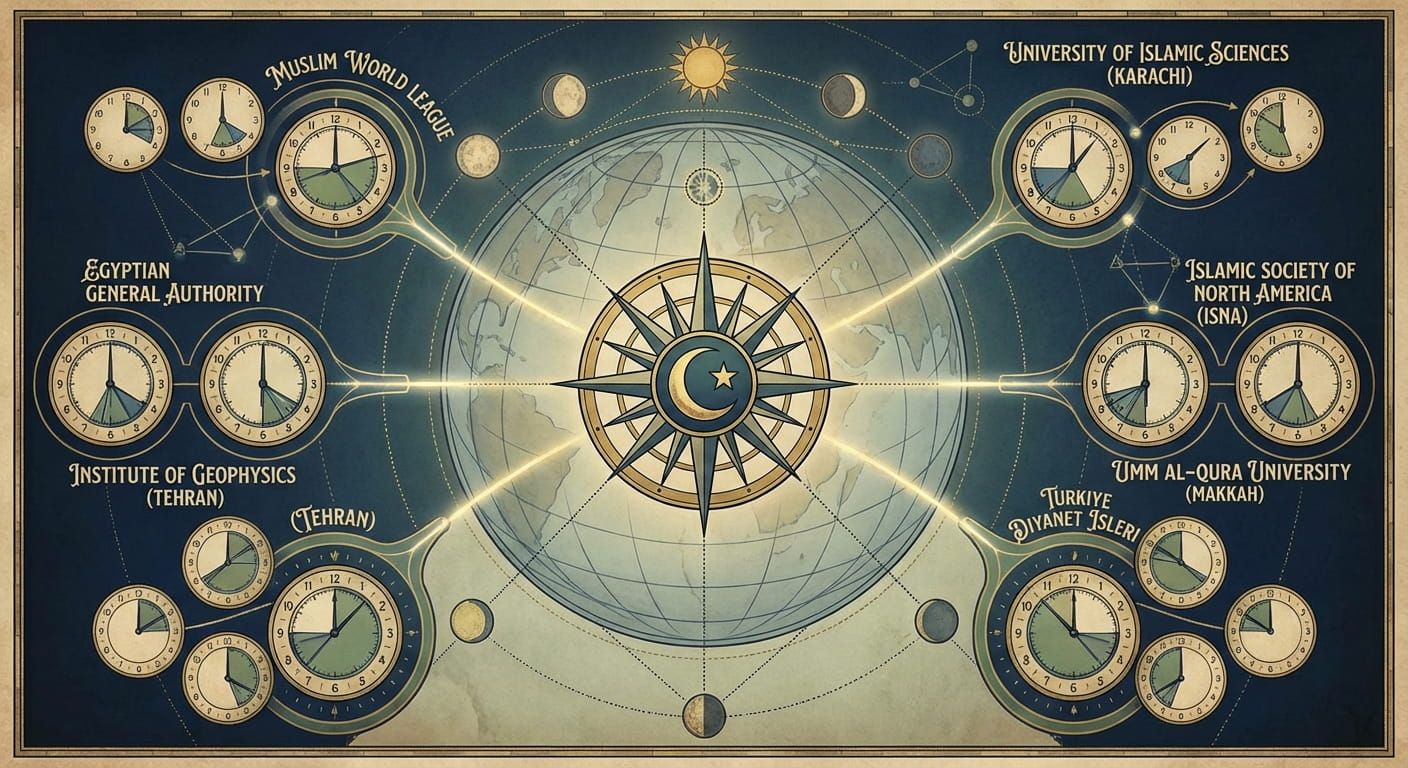
Prayer time tables look simple, yet behind every minute sits a careful set of astronomical choices. A small change in one setting can shift Fajr and Isha by several minutes, and in some places, much more. That is why you will see “calculation methods” inside many apps and mosque timetables. This guide explains the major methods in plain language, how they differ, and how to pick the one that fits your local practice.
Islamic prayer calculation methods are sets of agreed settings that turn the sun’s position into prayer times. The biggest differences come from how Fajr and Isha are defined, often by solar depression angles or fixed minute offsets. Some methods also set Maghrib or Isha by minutes after sunset. Local geography, high latitude rules, and mosque tradition matter. Choose the method used by your city or mosque first, then fine tune only if needed.
Test Your Timing Knowledge
This short quiz checks the ideas in this article. Pick an answer, then tap the button to see feedback.
What A “Calculation Method” Really Means
A calculation method is not a new religion rule. It is a bundle of settings that scholars and astronomers agreed to use when turning the sun’s movement into a timetable. You can think of it as a recipe. The ingredients are the same everywhere, sunrise and sunset times for your location, plus the way twilight is handled. The recipe changes the exact timing of some prayers, mainly the ones tied to twilight.
Time.now focuses on practical, location based schedules, so the goal is simple: give times that match what people in that city actually use. Your location sets the sun angles and the length of day. The method sets how to translate those angles into Fajr and Isha, and sometimes Maghrib. If you are learning the basics of the five daily prayers, the overview at five daily Islamic prayers pairs well with this guide.
A common surprise: the same city can have more than one valid timetable, because different communities follow different councils. Matching your local mosque is usually the calmest choice.
The Astronomy Behind The Prayers
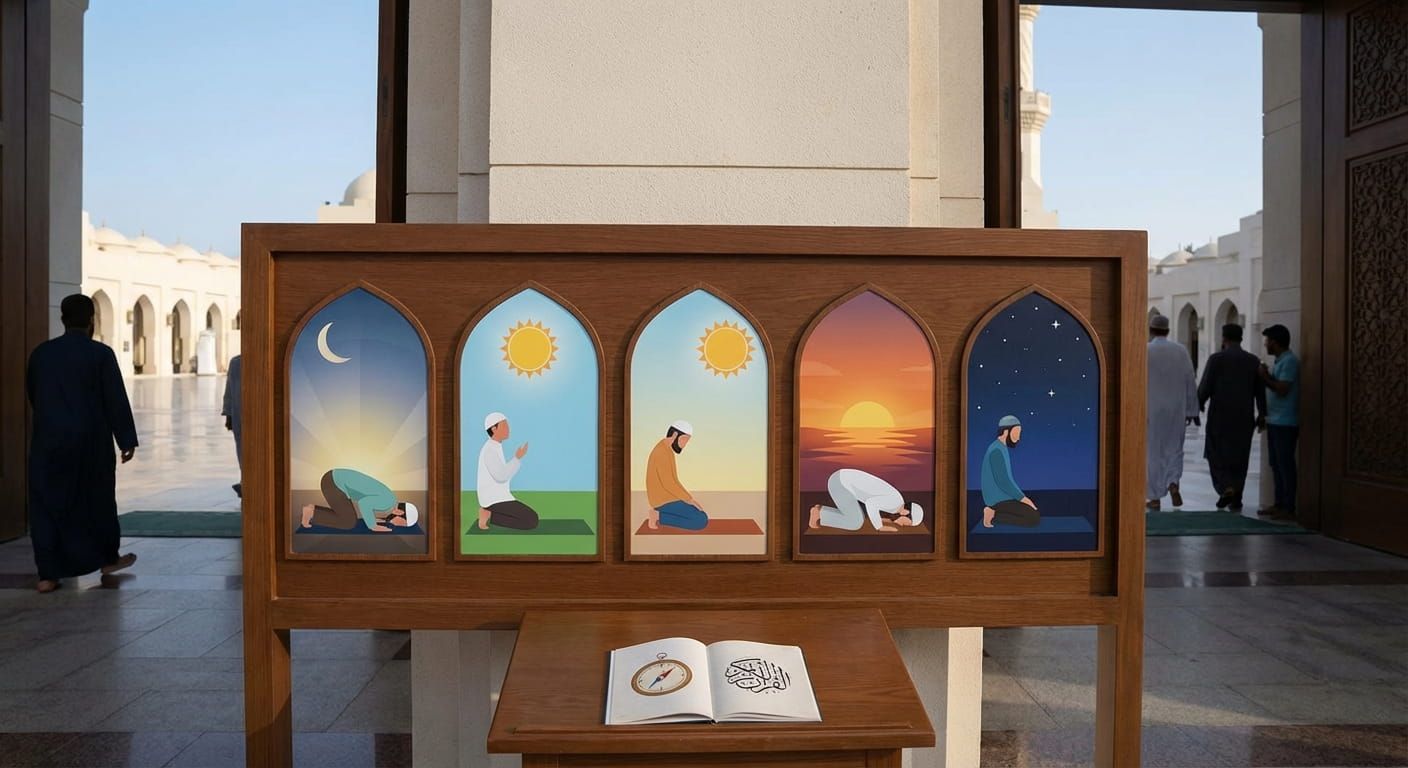
The sun is the main clock for Salah. Dhuhr begins after the sun passes its highest point. Asr begins when the length of an object’s shadow reaches a defined ratio. Maghrib begins at sunset. Isha begins after twilight fades. Fajr begins at the start of true dawn. Most apps do not guess these times, they compute the sun’s position for your latitude, longitude, and date.
The technical heart of it is the sun’s angle below the horizon. Twilight is not a switch, it is a slow change. Councils pick specific angles or offsets that correspond to observed dawn and night in many places, then publish a method. If you want the full walk through of the math in friendly terms, how Islamic prayer times are calculated breaks it down step by step without drowning you in formulas.
The settings that matter most
The key settings are simple to list:
- Fajr angle, how far the sun is below the horizon at dawn.
- Isha angle or an Isha offset, how night is defined after sunset.
- Maghrib rule, usually sunset, sometimes a small offset.
- Asr juristic choice, shadow ratio for standard or Hanafi.
- High latitude adjustment, how to handle long twilight seasons.
Major Methods You Will See In Apps And Timetables
The names below show up in many prayer time tools, including city pages on Time.now. Each method is a published bundle of settings, often maintained by a council. A method can be globally popular and still be a poor fit for a specific city if the local tradition uses a different council. Use the list as a map, then match it to your community.
Muslim World League
Muslim World League is widely used across many regions and often appears as a default option in apps. It typically uses angle based twilight for Fajr and Isha. Many people choose it because it feels balanced across climates, and because it is common in international tools used by travelers.
ISNA
The Islamic Society of North America method is common in North America and in some international apps. It uses angle based definitions for Fajr and Isha as well, with angles chosen to match the council’s research and practice. If you live in the United States or Canada, it is worth checking whether your local mosque also follows it before switching anything.
Egyptian General Authority of Survey
Often labeled as “Egyptian,” this method is common in parts of Africa and the Middle East. It uses angle based settings for twilight. People pick it because it aligns with official timetables in places influenced by Egyptian scheduling.
Umm al Qura University
This method is well known in Saudi Arabia. One feature that stands out is that Isha is often set by a fixed number of minutes after Maghrib, rather than by an angle, at least in many common implementations. That can make Isha less sensitive to seasonal twilight, which is helpful in certain climates, but it also means it may not match other councils in higher latitudes.
University of Islamic Sciences, Karachi
Often shown as “Karachi,” this method is popular in South Asia and beyond. It uses angle based twilight definitions, and it is commonly paired with the Hanafi Asr option in communities where that juristic view is standard.
Tehran and Jafari settings
Some timetables include settings used in Iran or in Jafari practice. You may see differences not only in Fajr and Isha, but also in how Maghrib is treated. In some interpretations, Maghrib begins after a short delay that reflects a specific definition of sunset completion. If you follow a local Shia community timetable, matching that official setting matters more than matching an international default.
Comparison Table
This table gives a high level view of what usually differs. Exact angles and offsets can vary by implementation, and local authorities may publish regional variants. Use this as a way to understand the shape of the differences, not as a legal ruling.
How Asr Changes With Juristic Choice
Most method lists focus on Fajr and Isha, yet Asr can shift too. The reason is fiqh, not astronomy. Asr begins when an object’s shadow reaches a certain length compared to its height. In many Sunni timetables, “standard” Asr starts when the shadow equals the object’s height plus the noon shadow. In Hanafi practice, Asr starts later, when the shadow reaches twice the object’s height plus the noon shadow.
Many apps label this as “Asr calculation” with two options. If your family and mosque follow Hanafi timings, choose that and keep the rest of the method aligned with your local council.
High Latitude Challenges And The Rules That Help
In places far from the equator, twilight can last a long time in summer, sometimes all night. That breaks the simple idea of “sun is a certain angle below the horizon” because the angle may never be reached. Without an adjustment, an app might show no Isha time, or show it extremely late.
High latitude rules exist to keep prayer times workable. You might see options like “middle of the night” or “one seventh of the night,” or “nearest latitude.” Each option tries to set a reasonable boundary based on night length. This is where two apps can differ even if they share the same named method, because one app might apply a different high latitude rule by default.
If you live in a high latitude city, match your local mosque first. Tweaking angles without a community reference can lead to confusing results.
Choosing The Right Method For Your Location
Picking a method is less about personal preference and more about community alignment. Prayer is shared life. People meet at the masjid, break fast together, and plan schedules around a common clock. A method that matches your local practice reduces friction and doubt.
- Start with your city’s standard timetable. Many places have an official or commonly accepted schedule.
- Match your mosque. If your masjid posts times, treat that as your anchor.
- Check the method label in your app. Select the one that matches the mosque’s method if it is known.
- Confirm Asr juristic choice. Standard or Hanafi should follow your community.
- Review high latitude settings if relevant. This matters in summer seasons far from the equator.
- Do a week of comparison. Check a few days against the mosque schedule before trusting it fully.
If you want a simple way to confirm what your area uses, the location pages on prayer times help you check schedules by city and country, then compare them with your local masjid posting.
Common Questions People Ask
- “Why does my friend’s app show a different Fajr?” Often a different Fajr angle or a different high latitude rule.
- “Why is Isha much later in summer?” Twilight lasts longer, angle based Isha can drift late without a special rule.
- “Why does one timetable use minutes after Maghrib for Isha?” Some councils prefer a fixed offset in their region.
- “Can I just pick the earliest times to be safe?” People usually follow local scholarship and community practice instead of chasing extremes.
- “Does travel change the method?” Travel changes your location, which changes the sun’s path, and sometimes your community guidance too.
Prayer Timing, Daily Habits, And Peace Of Mind
The point of a method is not to create arguments, it is to create consistency. A stable timetable helps you plan school, work, and family life. It also helps you focus in prayer instead of second guessing the clock. If staying punctual is a goal, the reminders in importance of salah on time can support the habit side, not just the math side.
For many people, the most sensitive time is Fajr. In some regions, the difference between two common methods can be enough to affect suhoor planning in Ramadan. That is another reason local practice matters. Communities choose a method after years of use, not after a single comparison screenshot.
Special Cases: Travelers And Unusual Daylight
Travel adds two layers. One is geography, your sunrise and sunset shift as soon as you land. The other is routine, airports, road trips, and packed schedules. A location based tool helps, yet you still need a practical plan for prayer on the move. The tips in islamic prayer travelers are useful for planning, combining prayers where valid, and staying steady without stress.
Another special case is the times when prayer is disliked or not permitted, like the moments around sunrise and sunset in many fiqh discussions. These do not change the calculated start times, but they do matter for planning when you can pray. A careful summary is available at forbidden prayer times.
Tips For Reading A Prayer Time Page Without Confusion
A prayer times page is more than a list of clocks. Small labels explain what settings were applied. To make reading easier, scan in this order: Bullet guide:
- Check the city and the date, then confirm the time zone.
- Look for the method name and any high latitude option.
- Check whether Isha is angle based or minutes after Maghrib.
- Confirm the Asr juristic choice if your community follows Hanafi timings.
- Note rounding, some tables round to the nearest minute, others to the nearest five minutes.
If you ever see a big jump in Fajr or Isha after changing a method, do a sanity check with a trusted local timetable. A setting that is correct in one region can feel off in another.
Common Mistakes People Make When Switching Methods
Method menus invite curiosity, yet switching without a plan can create doubts. These are the patterns that cause the most confusion:
- Changing the method but forgetting the Asr juristic setting.
- Comparing two apps that apply different high latitude rules by default.
- Assuming a method name means identical settings across every app.
- Relying on a screenshot instead of checking a full week.
- Ignoring local authority guidance in favor of a global default.
What Time.now Tries To Do For You
A practical prayer time tool should help you pray with confidence, not push you into settings you do not recognize. Time.now aims to present location based Salah schedules with clear context, so you can match local practice and keep your routine steady. If you want to compare timings across places, country pages are also handy for a broader view, for example Malaysia shows how one country’s cities can share a common approach while still differing by geography.
The Moment Your Method Choice Feels Settled
A good choice feels calm. The times line up with the masjid, your family, and the rhythm of your day. After that, the method becomes background, and the focus returns to prayer itself. Keep the settings stable, check them when you travel or move, and treat small minute differences with patience. A timetable is a tool, and the goal is worship with clarity and ease.