The moment a city grows quiet before dawn, there is a special kind of focus in the air. For many Muslims, that focus begins with knowing exactly when each prayer starts and ends. Prayer times are not guesswork. They are built from the sun’s path, your location on Earth, and a set of scholarly rules that turn astronomy into a daily schedule you can trust.
Key takeaway
Islamic prayer times come from the sun’s position relative to your horizon. Dhuhr begins after the sun passes its highest point. Maghrib starts at sunset. Fajr and Isha use twilight, based on a chosen sun angle below the horizon. Asr depends on shadow length, with two common juristic options. Modern tools combine latitude, longitude, elevation, time zone, and a calculation method to produce local Salah schedules that update day by day.
Test your understanding with a short quiz
Answer the questions, then tap the button to see your score.
1) Which solar event defines the start of Maghrib?
2) Fajr is commonly tied to which concept?
3) What usually causes two nearby cities to have different prayer times?
4) Asr differs by juristic opinion because it depends on:
From the sky to your schedule
Every prayer time is anchored in something you can see in the real world: the sun rising, the sun setting, shadows stretching, and twilight fading. Scholars and astronomers translated those visible signs into clear definitions. Then modern computation made the process fast, repeatable, and location specific.
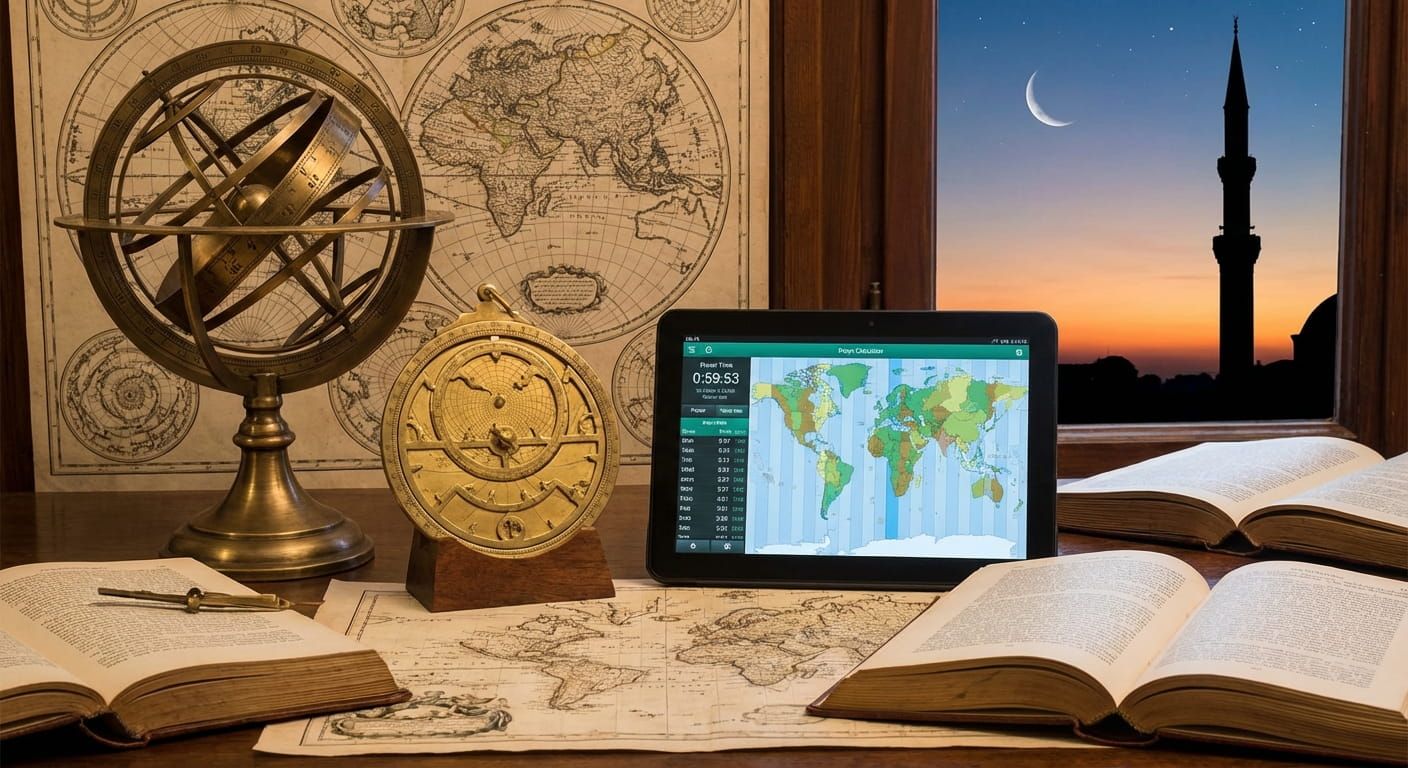
A location based service needs your latitude and longitude, your time zone, and the date. With those, it can compute the sun’s path for your horizon. A tool like prayer times takes that astronomy and presents it as a daily Salah schedule for the city you choose.
The core idea: the sun’s position
Astronomy describes the sun’s position using angles. Two are especially useful for prayer times.
- Altitude, how high the sun is above or below your horizon.
- Azimuth, the compass direction of the sun.
At sunrise and sunset, the sun is right at the horizon line, which is close to an altitude of zero from an ideal geometry view. Twilight happens while the sun is below the horizon, but its light still scatters through the atmosphere. That is where the well known Fajr and Isha angle settings come in.
Quote to keep in mind
Prayer time calculation is not about forcing one city into another city’s schedule. It is about reading the same sky from where you stand.
How each of the five times is defined
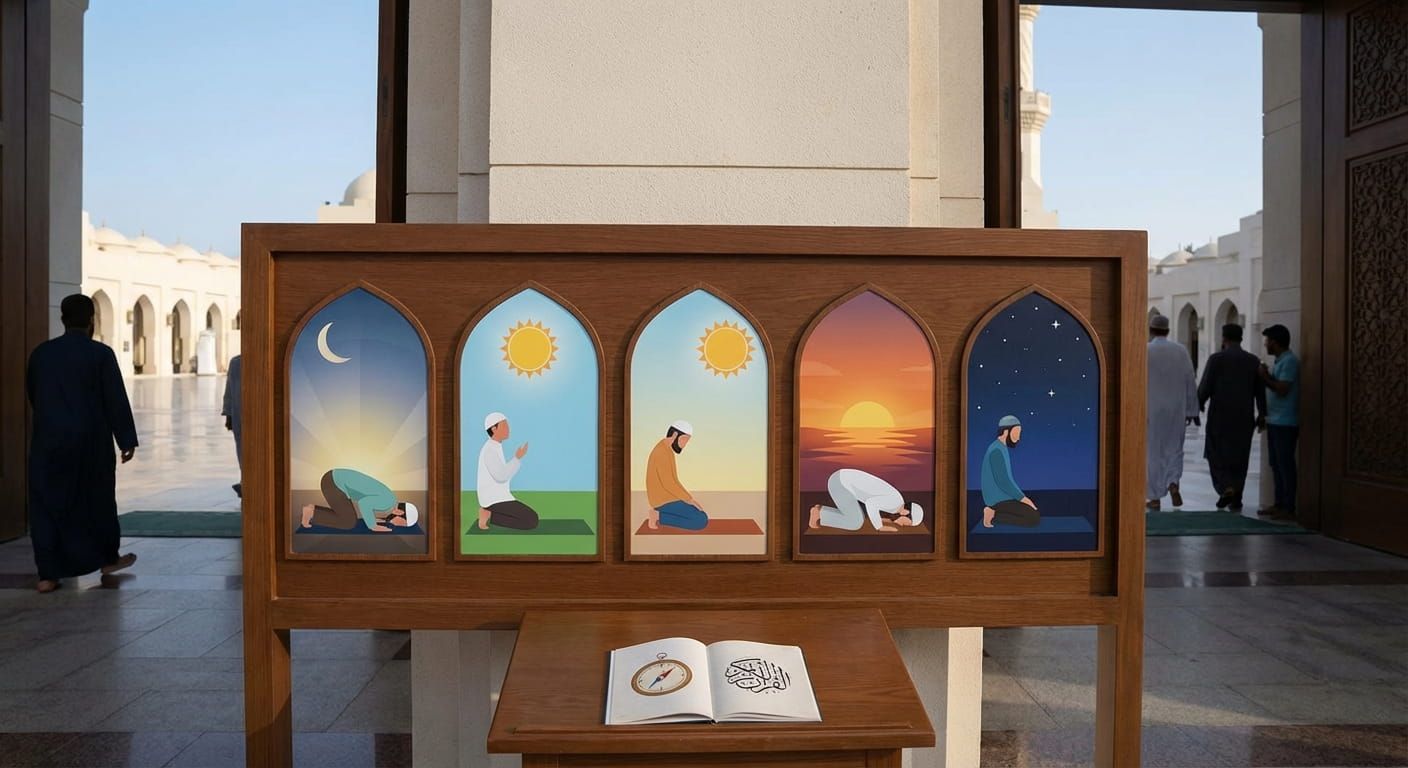
The five daily prayers have start markers. Some also have end markers, though daily schedules often focus on the beginning of each prayer window. Here is the practical breakdown, framed the way a calculator sees it.
Fajr, the start of morning twilight
Fajr begins at true dawn, when the first light spreads along the horizon. Astronomers model this using a sun angle below the horizon. Different authorities pick different angles, which is why two cities using different methods can show slightly different Fajr and Isha times even if they are neighbors.
In computation, the tool finds the moment the sun reaches the chosen negative altitude in the morning. That is the start of Fajr. The angle might be 18 degrees in one method, 15 degrees in another, and some regions use a value tied to local practice.
Sunrise, not a prayer, still a key marker
Sunrise shows up on most schedules even though it is not one of the five prayers. It matters because Fajr ends at sunrise, and it helps you check if a timetable looks reasonable for your season and latitude. Calculators compute sunrise by finding when the sun’s upper edge appears at the horizon, adjusting for atmospheric refraction and the sun’s apparent radius.
Dhuhr, after solar noon
Dhuhr begins after the sun passes its highest point in the sky for that day. That point is solar noon, also called transit. Solar noon is not always 12:00 on the clock, because clocks follow time zones and daylight saving rules, while the sun follows geometry and Earth’s orbit.
A calculator finds the transit time, then applies a small safety offset in some timetables. Many schedules show Dhuhr a few minutes after transit to avoid the brief time when the sun is exactly at the top and shadows are shortest.
Asr, the prayer that follows the shadow
Asr is tied to shadow length. That is the reason Asr often shows the biggest difference between two juristic settings.
In one widely used setting, Asr begins when an object’s shadow becomes equal to its height plus the length of its shadow at noon. In another setting, it begins when the shadow becomes twice the object’s height plus the noon shadow. Your chosen setting changes the computed time because it changes the target sun altitude needed to produce that shadow length at your latitude and date.
Maghrib, the moment of sunset
Maghrib begins at sunset, when the sun disappears below the horizon. The calculator solves for that horizon crossing, with the same physical corrections used for sunrise. In many places Maghrib feels the most intuitive because you can often see the moment happen, if you have a clear view of the horizon.
Isha, when night settles in
Isha begins when the evening twilight fades. Like Fajr, it is commonly set using a sun angle below the horizon, but now in the evening. Some regions use a fixed interval after Maghrib instead, especially in places where twilight behavior is unusual in some seasons.
This is one reason you may see an option labeled as minutes after Maghrib in some methods. It is a practical rule that helps keep a stable schedule when a strict twilight angle would produce very late or ambiguous results.
The math engine, simplified into steps
Most prayer time engines, including the ones behind major Islamic authorities, follow a similar pipeline. Here is the process in plain terms, with each step building on the one before it.
- Read your inputs such as date, latitude, longitude, elevation, time zone, and calculation method.
- Compute the sun’s declination for the date, which tells how far north or south the sun appears relative to Earth’s equator.
- Compute the equation of time, which captures the mismatch between clock time and solar time across the year.
- Find solar noon for your longitude and time zone.
- Solve for each target sun altitude to get the times for sunrise, sunset, Fajr angle, and Isha angle.
- Solve for Asr by converting the chosen shadow rule into a target sun altitude, then compute the time it occurs.
- Apply adjustments such as local offsets, high latitude rules, and rounding conventions.
- Format the schedule into a clean list for the day, often with options for weekly or monthly views.
Why the same day can show different results
It surprises people at first: two reliable sources can show different minutes. That does not mean one is careless. It usually means they made different choices in the parts where scholars allow multiple valid approaches.
Calculation method choices for twilight
Fajr and Isha depend on twilight. Twilight is real, but the exact boundary between twilight and day or night is modeled with angles. Different organizations set different angles based on observational studies, regional norms, and scholarly consensus in their communities.
Juristic setting for Asr
Asr has two well known settings tied to shadow length. Many prayer time tools let you pick the one followed by your community, so the schedule matches what your local mosque announces.
Local corrections and safety buffers
Some published timetables apply minute offsets for caution, or to match established local calendars. Others use pure astronomy with minimal padding. Both can be reasonable, but you should stick with one source you trust for consistency.
High latitudes and the twilight challenge
In far northern and far southern regions, summer can bring very long days, and winter can bring very short ones. In some seasons, twilight can behave in a way that makes strict angle definitions difficult or even impossible to apply for a period of time.
To handle this, calculators offer high latitude rules. Common approaches include dividing the night into portions, using the nearest day where twilight behaves normally, or using a fraction of the night based on a chosen angle. The aim is practical worship, not mathematical perfection.
Quote for anyone living far from the equator
If twilight stays on the horizon for hours, a good schedule uses a rule that your local scholars recognize, then keeps your daily routine stable.
A colorful table of the most common settings
The table below shows the kinds of decisions that shape a timetable. Exact names vary by app or authority, but the categories are consistent.
| What is being set | Common options | How it changes times | Where you notice it most |
|---|---|---|---|
| Fajr twilight angle | Different degrees below horizon | Earlier or later Fajr by minutes | Season changes and higher latitudes |
| Isha twilight rule | Angle based or minutes after Maghrib | Later Isha, sometimes much later | Summer evenings and far north regions |
| Asr juristic setting | Shadow equals height, or shadow equals twice height | Moves Asr later with the twice height option | Afternoons, especially in winter |
| High latitude rule | Night portions, nearest day, or similar policies | Prevents extreme or missing times | Cities with very long twilight periods |
| Local offsets | Minute adjustments per prayer | Shifts one or more times slightly | Matching mosque announcements |
A listicle of factors that shift prayer times day to day
Even with the same method, your schedule changes. The sun’s path is never identical from one date to the next. These are the main reasons, written in a way that matches what a calculator actually uses.
- Date, Earth’s tilt changes the sun’s declination through the year.
- Latitude, higher latitude means bigger seasonal swings in daylight.
- Longitude, it shifts solar noon relative to your time zone.
- Time zone, a political decision that sets your official clock time.
- Daylight saving, where used, it shifts civil time by one hour.
- Elevation, higher elevation can affect the apparent horizon line.
- Calculation method, especially the twilight settings for Fajr and Isha.
Making sense of results in real places
Context helps. A schedule that looks normal near the equator can look surprising in a northern coastal city. Local practice also matters, especially for choosing a method and an Asr setting.
If you want a grounded example, compare a Southeast Asian city view through Malaysia prayer times with a Gulf region view through Saudi Arabia prayer times. The core definitions stay the same. The sun path and chosen method shape the minute by minute details.
How tools turn astronomy into a friendly timetable
A modern prayer time page looks simple, but under the hood it handles details that matter.
Here is what a practical tool typically does in one flow:
That is also why two people in the same country can have different times if they live far apart, or if one person uses a different method setting. A good page makes those choices visible and keeps the schedule consistent once selected.
Common questions people ask, answered plainly
Why do Fajr and Isha vary more than Dhuhr and Maghrib?
Dhuhr and Maghrib are tied to solar noon and sunset, which are crisp geometric events. Fajr and Isha depend on twilight, which fades gradually and is modeled with angles. That modeling is where different methods can lead to different minutes.
Does weather change the computed prayer times?
The computed times are astronomical, not weather based. Clouds can hide the sun, but they do not change the sun’s geometric position. People may observe the sky differently on a cloudy day, yet the schedule remains the same.
Why does the clock not match solar noon?
Your clock follows your time zone, which is set by borders and policy. Solar noon follows your longitude and Earth’s orbit. The gap between them is normal, and the equation of time changes that gap through the year.
How should I choose a method?
A steady approach is to follow your local mosque or the national standard used in your area. If you travel, a location based schedule helps you keep the same approach while updating the times to the new city. If you want a refresher on the meaning of each prayer and its role in the day, five daily islamic prayers is a helpful companion read.
Choosing consistency without losing the spirit
Prayer times are a bridge between worship and the natural world. The sun’s movement is steady, and the rules that map that movement into prayer windows are designed to be practical across the globe. That is why a location based timetable can serve a small village and a large city with the same underlying logic.
If you set your method once, check that it matches your community, then stick with it, the daily schedule becomes calm and predictable. You stop thinking about calculations and start thinking about the prayer itself. That is the real win: the math fades into the background, and the rhythm of the day feels clear again.