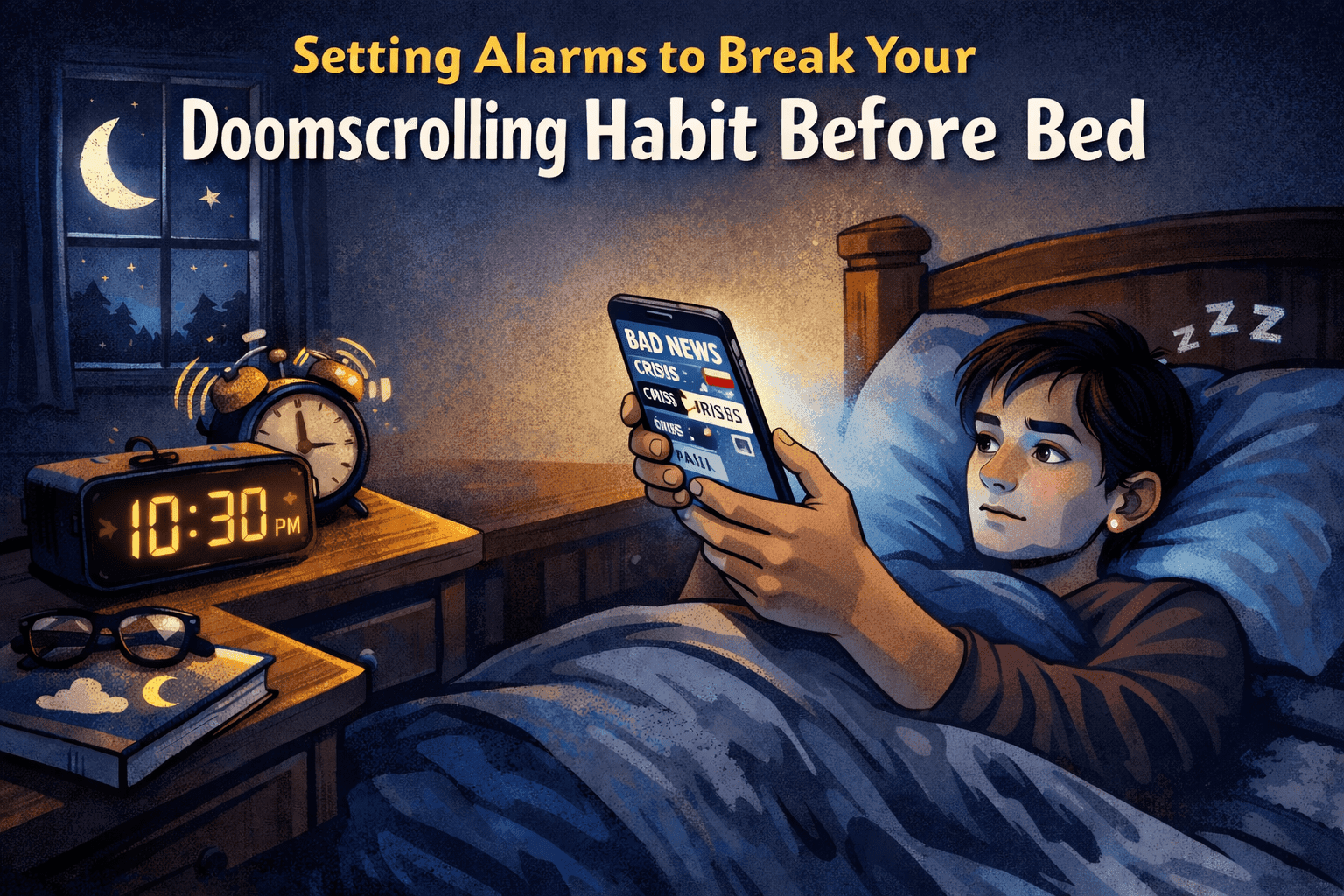
Your phone has a certain gravity at night. Even when you intend to check one harmless notification, the moment the screen lights up, a cascade of information starts pulling you inward. You scroll once. Then again. Headlines, warnings, tragedies, and updates roll past your eyes in a steady stream. Before long, the world outside your screen grows dim while the world inside your screen becomes strangely urgent. This pattern feels effortless, almost automatic, particularly in the late hours when your mind is tired and emotions are closer to the surface. This behavior has a name now, doomscrolling, and its impact on mental and emotional wellbeing is larger than most people realize.
During the last few years, doomscrolling became deeply woven into people’s routines, especially during global crises. The sense of uncertainty encouraged many to seek more information than ever before. Unfortunately, the information they found was often distressing. That combination, fear, vigilance, and constant updates, forms the core of doomscrolling, and it takes hold most powerfully at night.
Doomscrolling is commonly defined as a habit of scrolling through social media and news feeds where users obsessively seek depressing and negative information.
Doomscrolling may feel like a casual habit, but research shows it is associated with deeper emotional and cognitive patterns. A comprehensive study by Satici, Tekin, Deniz, and Satici explored doomscrolling across three separate groups of participants. Using the Doomscrolling Scale, a tool designed to measure the frequency and intensity of negative news scrolling, they discovered several important relationships. Doomscrolling was consistently linked with psychological distress, lower mental wellbeing, reduced life satisfaction, and decreased harmony in life. The findings showed that doomscrolling is not simply browsing, it is a cycle with measurable emotional consequences.
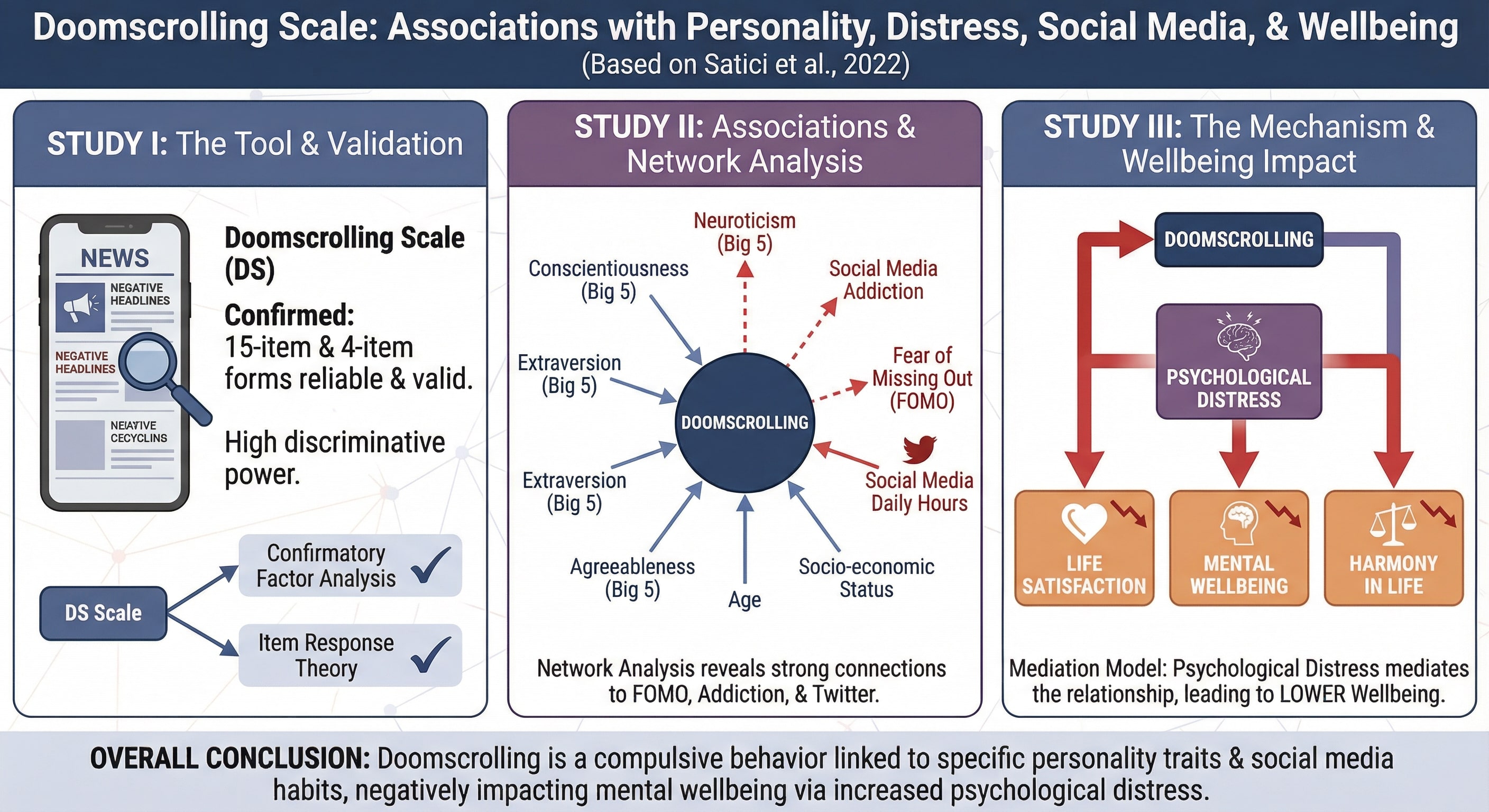
The study also explored personality traits. People who scored high in neuroticism were significantly more likely to doomscroll. This group tends to feel negative emotions more intensely, making them more sensitive to online content. Conversely, individuals high in conscientiousness or agreeableness were less likely to engage in doomscrolling. These traits contribute to stronger self regulation and more balanced emotional responses. The researchers additionally found connections between doomscrolling and fear of missing out, social media addiction, and longer daily screen time. These discoveries explain why doomscrolling can feel irresistible, especially at night. It draws on emotional tendencies, online habits, and algorithm driven feeds that serve increasingly negative content.
| Behavior | Common Effect |
|---|---|
| Late night news scanning | Increased anxiety |
| Repeated refreshing | Compulsive checking |
| Extended scrolling sessions | Disrupted sleep patterns |
How Nighttime Heightens the Pull of Doomscrolling
Nighttime weakens certain cognitive defenses that we rely on during the day. Decision making, emotional regulation, and self control naturally decline when we are tired. At the same time, sensitivity to threat related information increases. Historically this was adaptive, but today those instincts attach themselves to digital content instead. Instead of listening for predators or threats in the environment, we scroll through news feeds that present distressing events as if they are unfolding right beside us.
In the Doomscrolling Scale research, participants who scored higher on doomscrolling consistently reported experiencing more psychological distress. This suggests that doomscrolling at night feeds on emotional vulnerability. Without external tasks or interactions to ground the mind, negative content sinks in more deeply. Anxiety rises. Sleep becomes harder. And because doomscrolling provides the illusion of control, people continue searching for updates in hopes of restoring a sense of safety.
One simple strategy to anchor awareness is to check the current time once before using your phone. A brief glance at this reference time can remind you that your evening has boundaries. This small act softens the pull of the feed by reconnecting you with the passing of time.
The Emotional Cost of Staying Inside the Scroll
The Doomscrolling Scale studies found strong negative correlations between doomscrolling and wellbeing measures such as life satisfaction, mental wellness, and harmony in life. These findings connect with broader research showing that negative news exposure heightens stress hormones, amplifies fear, and increases feelings of helplessness. The constant flow of distressing information wears down emotional resilience over time.
Doomscrolling was significantly and negatively related to life satisfaction, mental wellbeing, and harmony in life, and positively related to psychological distress.
The study revealed that psychological distress mediates the relationship between doomscrolling and wellbeing. This means doomscrolling leads to higher distress, and that distress lowers overall wellbeing. Doomscrolling does not simply expose people to information. It shapes emotional states in ways that ripple outward into daily life.
Another factor is time distortion. Negative emotional content changes how long moments feel. Articles such as this exploration of time show how attention and mood alter the perception of minutes and hours. When you are deeply absorbed in negative content, you lose the ability to sense duration accurately. What feels like five minutes may actually be thirty.
Why One Alarm Can Interrupt the Doomscrolling Loop
Doomscrolling thrives on momentum. The feed is endless, and each new negative development reinforces the urge to keep going, just in case something important appears next. Breaking this momentum requires an external cue, one that does not depend on emotional strength or self control. That cue is an alarm.
An alarm disrupts the scrolling cycle immediately. It lifts your attention out of the screen and into your physical space. It cuts through the rhythm of refreshing and swiping. For a moment, you step outside the emotional tunnel created by the feed, and that break gives you the power to redirect your focus.
Using a gentle alarm tool allows you to create a nightly boundary around your screen time. The tone you choose should be soft enough to avoid stress but firm enough to catch your attention. Placing your phone slightly away from your body increases the effectiveness by preventing automatic tapping.
How Awareness of Time Strengthens Your Routine
Doomscrolling often feels fast. Entire nights can disappear into news cycles because your brain is not tracking time normally when under emotional strain. Articles like this look at how time is measured show why human perception is unreliable compared to actual clocks.
The more emotionally charged the content, the more distorted time becomes.
The more emotionally charged the content, the more distorted time becomes. Reading this explanation of shifting time perception deepens the understanding that emotional states compress or stretch time. With this insight, the purpose of the alarm becomes clear. It stabilizes your evening routine and restores an accurate sense of duration.
Seven Steps for Using Alarms to Break the Cycle
- Choose a cutoff time that matches your real habits, not your ideal bedtime.
- Set your alarm before opening any apps so the boundary exists ahead of the impulse.
- Pick a calm alarm tone for a gentle but steady interruption.
- Place the phone slightly out of reach to reduce reflexive scrolling.
- Pause and exhale once the alarm rings, reconnecting with your body.
- Check the actual time once to restore your sense of duration.
- Transition into a grounding activity such as stretching, dimming lights, or reading.
Habits That Reinforce the Alarm Method
- Reduce screen brightness to soften stimulation at night.
- Move news related apps off your main screen to prevent impulsive tapping.
- Charge your phone on a dresser instead of your nightstand.
- Use a nightly ritual after the alarm rings, such as slow breathing or journaling.
- Learn more about doomscrolling through introductory material like this Wikipedia article, which helps frame the behavior clearly.
A Visual Anchor for Resetting Your Attention
Nighttime Alarm Guidance
| Habit | Why It Helps |
|---|---|
| Set a consistent nightly alarm | Creates a predictable rhythm in your evenings |
| Use a soothing alarm tone | Interrupts scrolling without creating tension |
| Pair the alarm with a slow breath | Helps regulate stress triggered by scrolling |
Rebuilding Your Evenings With Intention
The Doomscrolling Scale studies reveal something important. Doomscrolling is more than a habit. It is closely tied to emotional patterns, personality traits, and online design systems that encourage endless engagement. It heightens psychological distress, which reduces life satisfaction and mental wellbeing. Yet the research also provides hope. Small, consistent interventions like a simple alarm can break the automatic cycle and restore control over your evenings.
Psychological distress mediated the relations between doomscrolling and mental wellbeing indicators.
Alarms cut through the momentum of scrolling. They shift your attention back to the physical world. They help recalibrate your perception of time. Over weeks, this tiny boundary can soften anxiety, support better rest, and transform the emotional quality of your nights.
You do not need a dramatic lifestyle overhaul to reduce doomscrolling. You need one intentional moment, the moment your alarm sounds and brings you back to yourself. With practice, this moment becomes a nightly act of care that reshapes your relationship with your phone and with your time.
Information in this article is supported by the research published here: https://pmc.ncbi.nlm.nih.gov/articles/PMC9580444/