Dog age charts feel simple until you meet a Chihuahua that outpaces your daily walk, or a Great Dane that seems wise at two and “old” at seven. Size changes the timeline. It shifts how fast a dog grows up, when adult life peaks, and how quickly the senior years arrive. If you want a human year conversion that feels honest, breed size is the first question to answer.
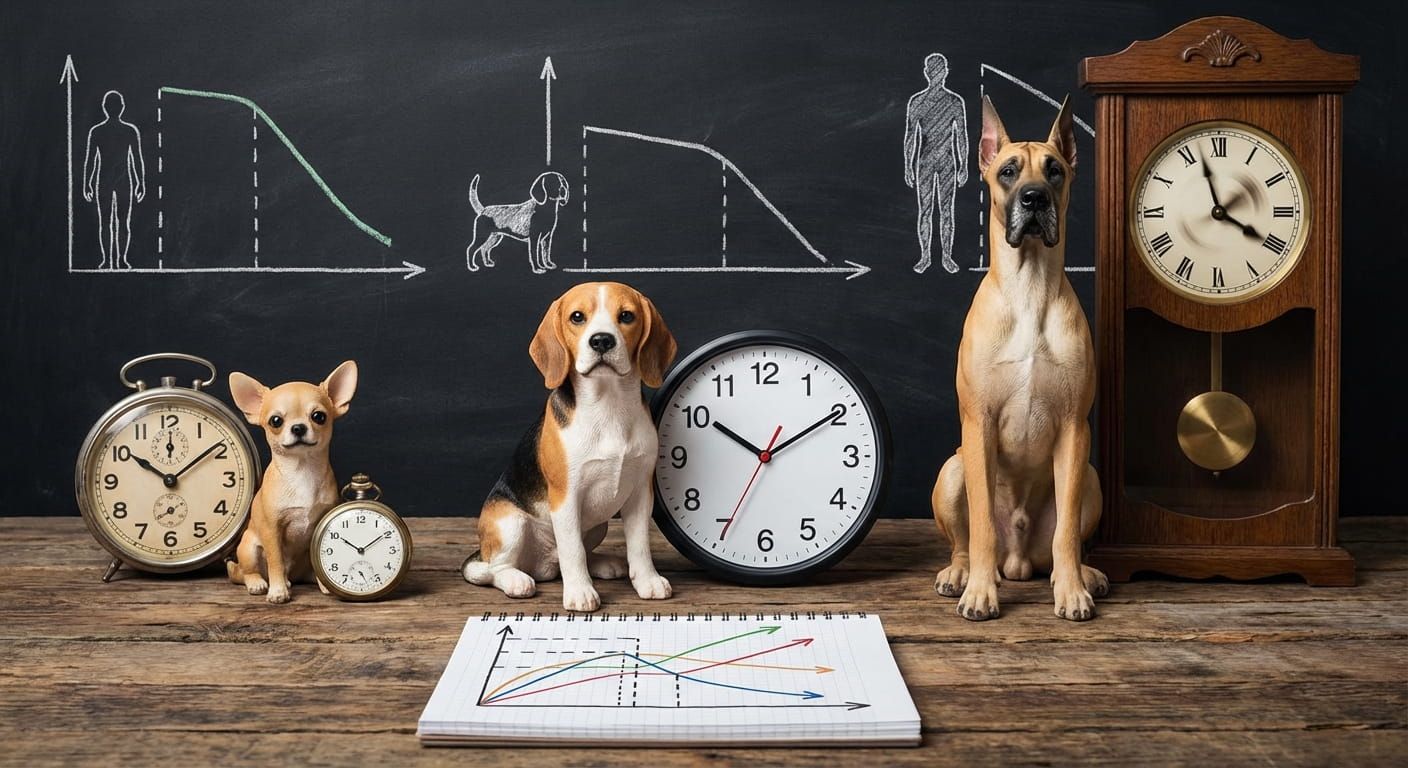
Dog breed size changes human year conversions because bodies mature and age at different rates. Small dogs usually reach adulthood fast, then stay “adult” longer. Large and giant dogs mature fast too, but their senior phase begins earlier. The most accurate approach is a size based curve: high early growth, then slower middle years, then a steeper rise into senior life. Use size and life stage, not a single multiplier.
Quiz: Match The Dog To The Human Age
Pick the closest human age
Answer all three, then tap check. This uses a size aware rule of thumb.
1) A small dog, 1 year old
2) A large dog, 6 years old
3) A giant dog, 9 years old
Dog Size Is A Clock, Not A Label
Breed size is more than a number on a chart. It often tracks with growth speed, metabolism, joint load, and how the body handles repair over time. Two dogs can be the same chronological age and still live in different life stages. That is why “one dog year equals seven human years” breaks down fast.
The better mental model is a curve. Early life moves fast for all dogs. Then the middle years stretch out, especially for smaller breeds. Later life accelerates again, with large and giant breeds feeling that acceleration earlier.
A handy phrase
Think “life stage matching” instead of “math matching”. Ask what stage the dog is in, then translate that stage into a human age band.
The Real Reason The Seven Year Rule Feels Off
The seven year rule tries to average everything into one line. But dogs do not age linearly. Most dogs pack a lot into year one: teething, social learning, hormone shifts, body growth, and brain development. After that, the pace calms down. Then, later on, the pace speeds up again, with size changing how early that final shift shows up.
In practical terms:
- Puppy time is dense. The first year can map to a big jump in human years.
- Midlife is wide. Many dogs spend more years as “adult” than we expect.
- Senior time is size sensitive. Bigger bodies often hit age related wear sooner.
How Size Changes The First Two Years
Most dogs reach physical maturity earlier than humans. Yet size changes the pacing. Small breeds can finish growing and settle into adult routines sooner. Many giant breeds keep filling out longer, even if they act grown up early. So year one and year two are not identical across sizes, even though both are big leaps.
If you want a practical conversion mindset, treat the first two years as “front loaded” for every dog, then tune the later years based on size.
A Size Aware Conversion Table You Can Actually Use
This table is meant for everyday decisions: vet check in timing, senior food transitions, and noticing when “slowing down” is normal versus concerning. It is not a medical tool. It is a life stage guide you can keep in your head.
Want a single number for your dog, tuned by size? The dog age converter can help you plug in age and see a human year estimate, without forcing every breed into the same pace.
What Changes Inside The Body As Dogs Get Bigger
Size comes with tradeoffs. Bigger dogs carry more weight on joints, and their hearts and lungs work against a larger load. Growth is also intense. Large and giant puppies build a lot of body mass fast. That early surge can raise the odds of stress on bones and connective tissue later. None of this means a big dog is “unhealthy” by default. It means the calendar can feel shorter in the later years.
Smaller breeds often have less mechanical load. They can keep a stable adult phase longer. That is why a 10 year old small dog may still feel like a capable middle aged adult, while a 10 year old giant dog may already need senior pacing and extra support.
Life Stages That Map Cleanly To Human Years
If you want conversions that make sense in daily life, think in stages. Then map the stage to a human band. The bands below are not rigid. They are meant to feel intuitive.
- Puppy and teen phase, birth to about 2 years, the human feel is childhood to early adulthood.
- Prime adult phase, varies by size, small dogs can sit here for years, large dogs get fewer years in this band.
- Mature adult phase, the dog still feels steady, but recovery slows a bit, the human feel is late 40s to 60s depending on size.
- Senior phase, mobility, senses, and stamina shift, giant breeds often enter here earlier.
That stage approach also matches how people actually use age. You are rarely asking, “Is my dog exactly 57?” You are asking, “Is my dog closer to 35 or 70?” That is a stage question.
Breed Size Tips That Improve Any Conversion
Even within a size category, two dogs can land differently. Build a better estimate with these practical cues. They work because they tie conversion back to the real world.
- Body condition, lean dogs often move and recover better at the same age.
- Spay and neuter timing, talk with your vet, growth patterns can change.
- Activity history, steady exercise supports joints and heart across sizes.
- Dental status, teeth and gums often reveal “age feel” better than charts.
- Genetics, some lines age slower, some faster, even at the same size.
A simple check
If your conversion says “senior” but your dog behaves like an adult, recheck the size category and think in stages. Charts should follow the dog, not override the dog.
Common Scenarios Where Size Based Conversions Help
People usually reach for human year conversions during decision moments. Here are the moments where size awareness pays off.
- Switching food, large dogs might benefit from senior support earlier.
- Adjusting exercise, giant breeds may need more joint friendly movement sooner.
- Scheduling checkups, older large breeds can benefit from more frequent monitoring.
- Planning training, puppies develop fast, but attention and impulse control still need time.
For readers who enjoy comparisons, you can also calculate your own timeline beside your dog. The age calculator helps you frame exact ages in years and dates, then you can line that up with your dog’s stage and see how the rhythms differ.
“Age Feel” Signs By Size
These signs are not a diagnosis. They are clues that a conversion estimate is landing in the right neighborhood.
- Small breeds, steady energy into later years, quicker bounce back after play, gradual changes in hearing and vision.
- Medium breeds, balanced pacing, noticeable midlife mellowing, stamina dips show up before big mobility shifts.
- Large breeds, earlier stiffness after rest, longer warmups, more need for recovery days after intense activity.
- Giant breeds, earlier senior posture and slower transitions from lying down to standing, benefits from softer surfaces and gentle daily movement.
Make The Math Feel Personal, Not Mechanical
People love conversions because they help translate care. But a dog is not a spreadsheet. If you want the conversion to feel human centered, pair the number with a story: what your dog can do today, how recovery looks tomorrow, and what seems to be changing month by month.
If you are tracking changes over time, you can also measure your dog’s age milestones in more playful ways. The age in seconds view can be a fun reminder of how much life is packed into a single year, especially in the puppy phase.
How To Use Conversions Without Overthinking Them
Use the conversion as a prompt, not a verdict. Here is a reliable approach that stays grounded in real life.
- Start with size, choose small, medium, large, or giant based on adult weight.
- Place the dog in a stage, puppy, prime adult, mature adult, or senior.
- Use a range, pick a band of human years rather than chasing a single number.
- Watch function, appetite, sleep, play, and mobility tell you more than any chart.
- Adjust with your vet, health conditions can shift the “age feel” up or down.
A Closing Thought On Size And Time
Breed size changes the conversion because it changes the shape of the life curve. Small dogs often enjoy a long middle chapter. Large and giant dogs often live with a faster turning page in the later years. The kindest way to translate dog years into human years is to respect that curve, then meet your dog where they are today. The number should help you notice, plan, and care, with size setting the pace.